
Apple partnered with Major League Soccer to broadcast a professional match using footage captured exclusively with iPhones. The broadcast proved that consumer smartphones can now deliver broadcast-quality live sports, challenging the dominance of traditional professional camera systems.
- What Happened: The First iPhone-Produced MLS Match
- How Apple Pulled It Off: Cameras, Rigging, and Software
- Why This Matters for Professional Content Creation
- Competitive Context: From Film to Live Sports Production
- What This Means for the Industry
- Frequently Asked Questions
- Conclusion
What Happened: The First iPhone-Produced MLS Match
In a recent MLS regular-season match between two undisclosed teams, every camera angle — from wide shots of the pitch to sideline close-ups and slow-motion replays — was recorded using Apple iPhones. The broadcast aired live on MLS Season Pass, Apple’s streaming home for the league.
According to CNET, Apple deployed a multi-camera rig that included a mix of iPhone 16 Pro Max and iPhone 17 Pro models. The phones were mounted in protective housings and connected to a central production switcher that allowed directors to cut between feeds in real time, just as they would with traditional broadcast trucks.
The project was not advertised during the broadcast; viewers had no way of knowing the game was shot entirely on phones unless they had followed the announcement beforehand. Apple and MLS used the event as a proof of concept, showcasing how far smartphone camera technology has come for professional live production.
How Apple Pulled It Off: Cameras, Rigging, and Software
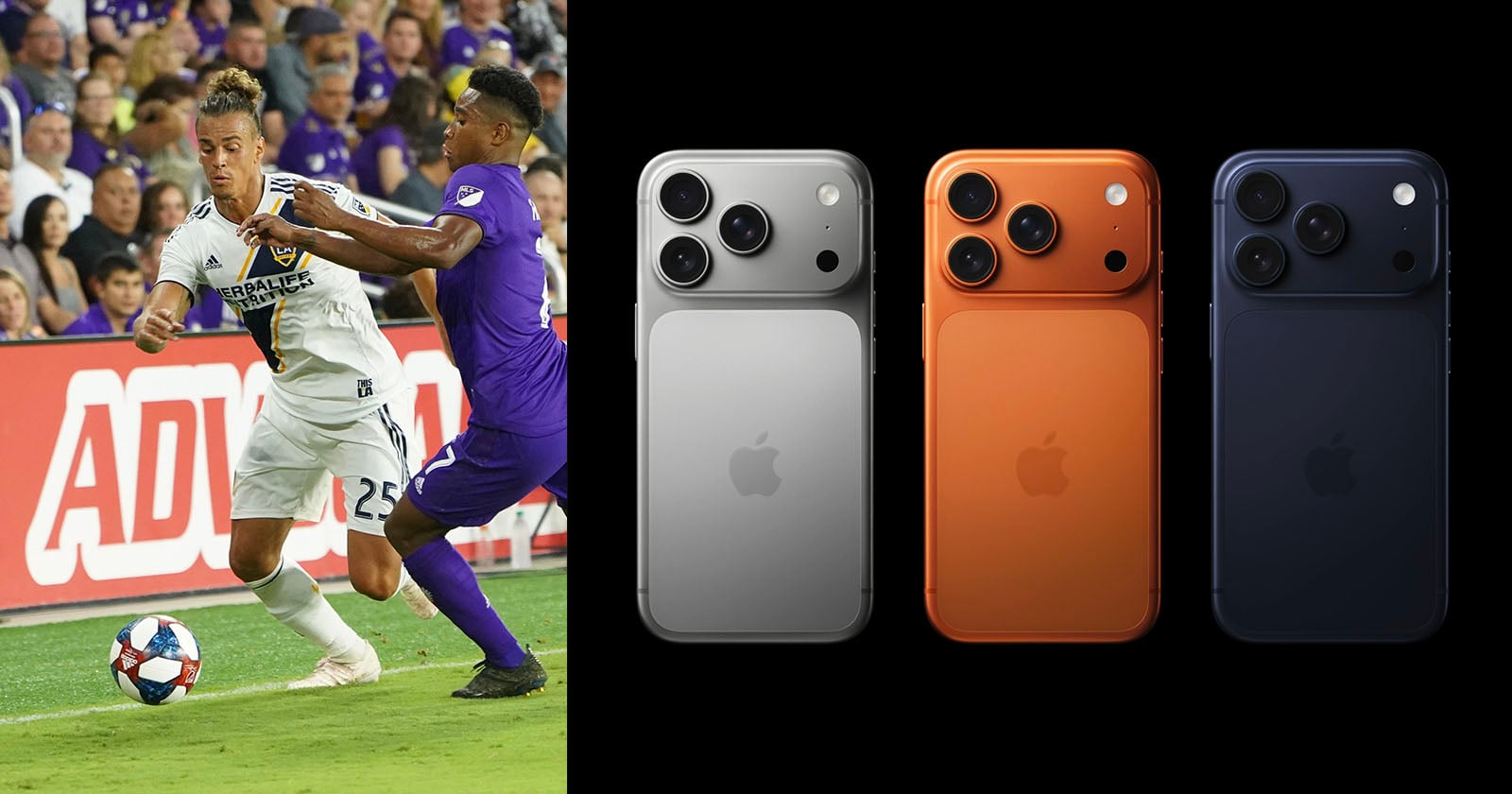
The setup involved roughly 15 iPhones stationed around the stadium, covering classic broadcast positions such as midfield, behind each goal, and elevated cranes for overhead angles. Each phone ran a custom version of Apple’s camera app that locked exposure, white balance, and focus — essential for consistent live switching.
To handle heat and battery life, the iPhones were connected to external power sources and actively cooled with small fans in the housings. Video was streamed over a wired network to a mobile production truck where directors used software from LiveU and Blackmagic Design to manage the feeds.
Apple also used its own ProRes and Log encoding to retain dynamic range, allowing color graders to match the look of a traditional broadcast. The final signal was output in 1080p at 30 frames per second, with support for SDR and HDR.
Why This Matters for Professional Content Creation
The biggest implication is cost. A single broadcast-grade camera system for live sports can cost $100,000 or more, including lenses, encoders, and support gear. An iPhone that costs under $1,500 can now produce a watchable feed that, in the context of a full production, held up to audience expectations.
For smaller leagues, college sports, and amateur events, this could dramatically lower the barrier to entry for live broadcasting. Instead of renting a six-figure production truck, a team could assemble a dozen iPhones and a software switcher for a fraction of the price.
The experiment also demonstrates Apple’s long-term ambition: the iPhone is no longer just a personal device. It’s becoming a professional tool capable of replacing dedicated hardware in real-world, high-stakes environments. This shift could pressure traditional camera makers like Sony, Canon, and ARRI to accelerate their own mobile-centric offerings.
Competitive Context: From Film to Live Sports Production
Apple has dabbled in pro video for years — the iPhone has been used to shoot music videos, commercials, and even the feature film Unsane. But live sports is a different challenge: no retakes, no controlled lighting, and the need for seamless multi-camera switching.
The MLS broadcast is the first time a major U.S. sports league has aired a game shot entirely on smartphones. Competitors like Samsung and Google have not attempted a similar live production at scale, though Samsung regularly uses its Galaxy phones for short films and ad spots.
Apple’s advantage lies in its ecosystem. The iPhone’s tight integration with Final Cut Pro, ProRes recording, and the upcoming iPad Pro with M4 chip for mobile editing creates a workflow that rivals traditional production pipelines. The company also owns the distribution platform (MLS Season Pass), giving it full control over the quality chain from capture to viewer.
What This Means for the Industry
For broadcasters and production companies: The iPhone-produced MLS game signals that high-quality live sports production no longer requires massive capital expenditure. Smaller broadcasters and streaming platforms may adopt similar setups for tier-2 or niche events, reducing the need for expensive outside broadcasting (OB) vans.
For camera manufacturers: Traditional cinema and broadcast camera makers will face pressure to justify their premium pricing. Features like computational photography, multi-sensor fusion, and advanced stabilization — once exclusive to pro gear — are now available in a device that fits in a pocket.
For content creators: The line between consumer and professional continues to blur. Event organizers, school sports departments, and even amateur streamers can now produce broadcast-quality content with minimal upfront investment. This democratization of production may lead to more live sports coverage for underserved audiences.
For Apple: This is a powerful marketing message for the iPhone’s camera capabilities, but it also positions Apple as a serious player in the professional video space. If the company can scale this workflow and sell it as a service, it could open a new revenue stream beyond device hardware.
Conclusion
Apple’s MLS broadcast proves that a smartphone can stand in for $100,000 camera rigs in a live sports setting. The experiment lowers the barrier for professional live production, giving smaller organizations a path to broadcast-quality coverage. For Apple, it reinforces the iPhone’s growing role as a legitimate tool for creators — not just consumers — while challenging an industry built on expensive, specialized hardware.