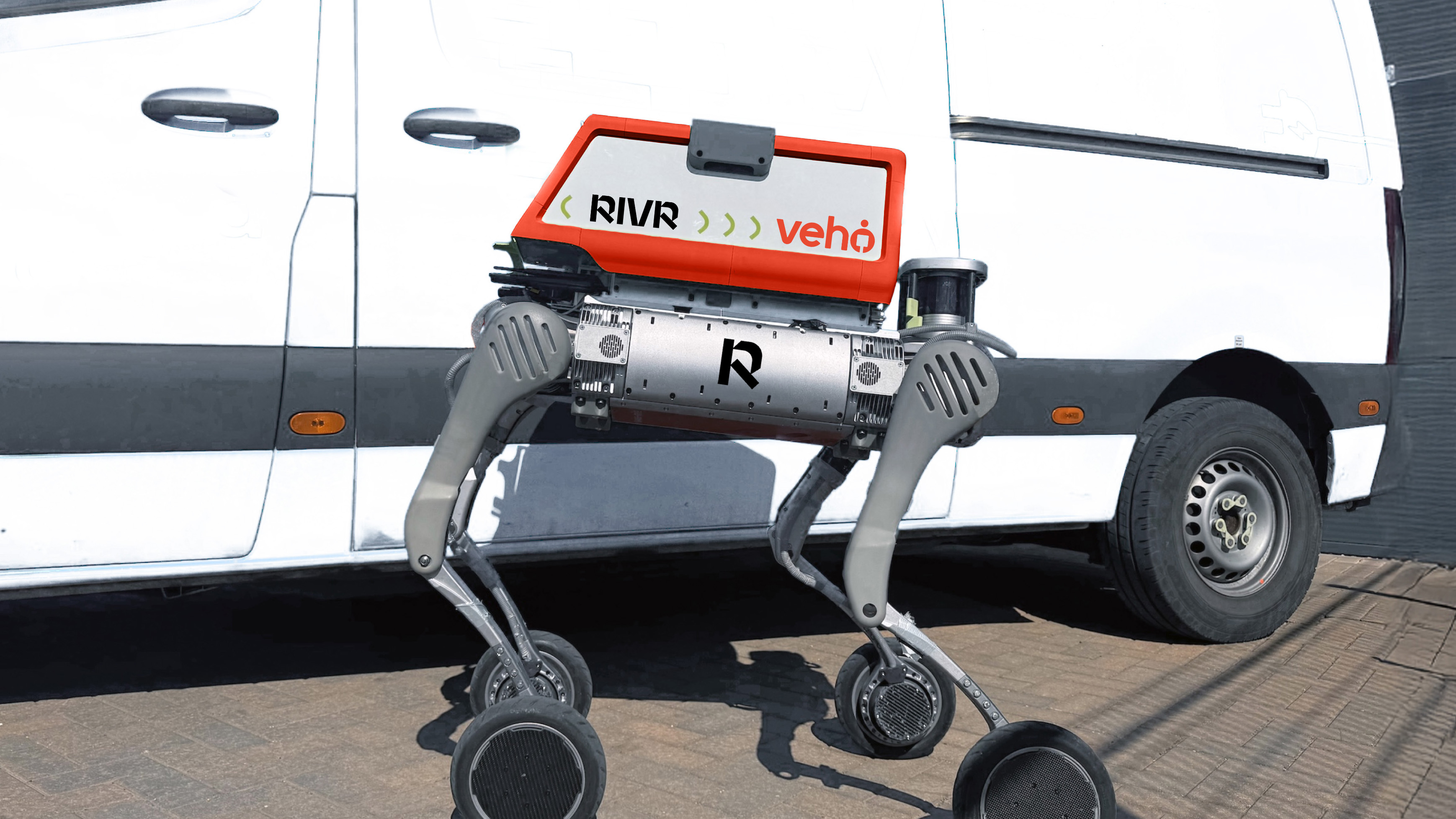

Amazon has acquired Rivr, a startup that built a stair-climbing delivery robot, in a move that signals the e-commerce giant's renewed commitment to autonomous last-mile delivery. The acquisition is notable because stairs — not open roads or warehouse floors — have historically been the wall that stops delivery robots cold.
Table of Contents
- What Is Rivr and What Does Its Robot Do?
- Why Stairs Are the Last-Meter Problem No One Has Solved
- Amazon's Delivery Robot History: From Scout's Failure to Rivr's Promise
- How Rivr Fits Amazon's Broader Physical AI Strategy
- What This Means for Robotics and Automation
What Is Rivr and What Does Its Robot Do?
Rivr built an autonomous robot designed specifically to navigate stairs and deliver packages to front doors — not just to the base of a building. Prior to the acquisition, both Amazon and Jeff Bezos had personally invested in the startup, suggesting the deal was less a cold discovery than a deliberate follow-on commitment to technology that was already showing promise.
The specific technical architecture of Rivr's stair-climbing system has not been publicly detailed. However, stair-climbing delivery robots generally rely on a combination of legged or articulated wheeled mechanisms, real-time terrain mapping via LiDAR or depth cameras, and reinforcement learning-trained locomotion policies to handle the variability of real-world steps — different heights, surface materials, edge conditions, and inclines.
What distinguishes Rivr's positioning is the focus on the final meters of delivery: not the street, not the lobby, but the actual doorstep. That specificity matters. It is a much narrower problem than general mobile manipulation, and narrower problems are often where commercial robotics makes its earliest reliable progress.
Why Stairs Are the Last-Meter Problem No One Has Solved
Sidewalk delivery robots have been commercially available for several years — yet virtually none can climb stairs. This single constraint has limited their deployment to flat-terrain environments: university campuses, planned suburban developments, and ground-floor commercial corridors.
The physics are unforgiving. A wheeled robot optimised for smooth pavement faces a fundamental design conflict when asked to climb a 7-inch riser. Legged systems handle stairs more naturally but introduce exponential complexity in balance, power draw, and mechanical durability. Hybrid wheeled-legged platforms — like those explored by several university labs and a handful of startups — have shown promise in controlled settings but have been slow to reach the reliability threshold required for unsupervised commercial deployment.
The scale of the problem is significant. In the United States alone, an estimated 45 million housing units have front stoops or multi-step entrances. Apartment buildings add further complexity. Any delivery robot that cannot reliably reach a front door in these environments is functionally useless for a large portion of the residential delivery market.
Rivr's stair-climbing capability — if it achieves production-grade reliability — directly addresses this constraint. That is why Amazon paid for it.
Amazon's Delivery Robot History: From Scout's Failure to Rivr's Promise
Amazon's history with delivery robots is instructive, and not entirely flattering. Amazon Scout, the company's wheeled sidewalk robot launched in 2019, was quietly discontinued in 2022 after limited deployments in a handful of US cities failed to demonstrate scalable commercial viability. Scout was a flat-terrain machine. It could not handle stairs, curbs above a certain height, or the general chaos of residential environments.
The contrast with Rivr is sharp:
| System | Deployment Era | Terrain Capability | Outcome |
|---|---|---|---|
| Amazon Scout | 2019–2022 | Flat sidewalks only | Discontinued |
| Rivr (pre-acquisition) | Recent | Stair-climbing capable | Acquired |
| Agility Robotics Digit | Current | Warehouse/indoor floors | Active (Amazon-owned) |
| Starship Technologies | Current | Flat campus terrain | Commercially operating |
| Boston Dynamics Spot | Current | Multi-terrain, stairs | Industrial/inspection use |
Agility Robotics, which Amazon acquired in 2023, builds Digit — a bipedal humanoid designed for warehouse tote-handling. Digit navigates structured indoor environments but is not designed for doorstep delivery. Rivr fills a completely different gap in Amazon's automation portfolio: the unstructured outdoor-to-doorstep transition zone that neither Scout nor Digit was built for.
The pattern here is deliberate portfolio construction rather than scattered experimentation. Amazon is assembling a physical AI stack that covers warehousing (Digit), middle-mile logistics (various drone programs), sidewalk delivery (post-Scout), and now stair-capable last-meter delivery (Rivr). Each acquisition or program targets a specific bottleneck in the physical delivery chain.
How Rivr Fits Amazon's Broader Physical AI Strategy
Amazon's robotics investments increasingly reflect a thesis about embodied AI — the idea that the next competitive moat in logistics is not software or cloud infrastructure, but physical systems that can operate reliably in the messy real world. Rivr is a direct expression of that thesis.
The acquisition also reflects a broader industry shift. Delivery robots that operate at ground level face a regulatory and infrastructure question: most cities were not designed for them, sidewalk access is contested, and liability frameworks remain unresolved. A robot that can navigate directly from street to doorstep — bypassing the need for elevator access agreements, building manager approvals, or lobby infrastructure — has a simpler deployment model than indoor last-mile alternatives.
From a competitive standpoint, Amazon's move also signals urgency. Starship Technologies has logged millions of autonomous deliveries, primarily on flat campuses. Nuro has focused on road-going autonomous delivery vehicles. Neither directly competes with a stair-capable doorstep robot. If Rivr's technology works at scale, Amazon would own a capability no competitor currently offers commercially.
The prior investment by Jeff Bezos personally — alongside Amazon's corporate stake — also tells a story about conviction. Personal investment from a founder-CEO is a meaningful signal that the technology was perceived as genuine, not merely strategically interesting.
What This Means for Robotics and Automation
For the robotics industry, Rivr's acquisition validates stair-climbing locomotion as a commercially viable product direction, not just an academic research problem. Startups working on hybrid locomotion, terrain-adaptive wheeled robots, and outdoor mobile manipulation should expect increased investor interest in this specific capability.
For delivery automation buyers and operators, the near-term implications are limited — Rivr's technology will enter Amazon's integration pipeline and is unlikely to appear in any commercial third-party offering. Amazon does not license its core logistics robotics externally.
For the broader robotics market, the deal reinforces a pattern: the most valuable robotics acquisitions target narrow, hard physical problems that block otherwise functional systems from reaching their full deployment potential. Stairs are not glamorous. They are not humanoid arms or large language models. But they are a concrete obstacle that has blocked sidewalk delivery robots from serving tens of millions of homes. Solving that obstacle — reliably, cost-effectively, at scale — is worth an acquisition.
If you're following the broader landscape of mobile delivery and service robots, the used industrial robots marketplace on Robot Overflow tracks available platforms across automation categories as the market evolves.