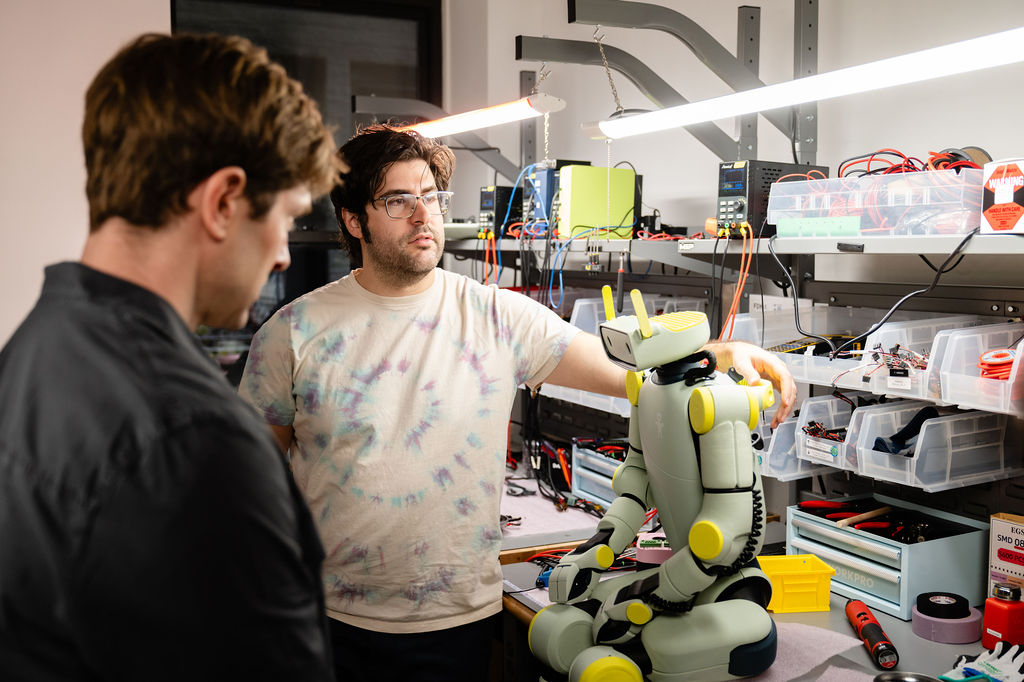

Amazon's purchase of Fauna Robotics — a startup specialising in child-sized humanoid robots — marks the company's second robotics acquisition in a single month, signalling an aggressive push into embodied AI. The compact form factor raises an immediate question: is Amazon building toward warehouse deployment, a consumer product, or something else entirely?
Table of Contents
- What Is Fauna Robotics and What Did Amazon Buy?
- Why Two Robotics Acquisitions in One Month?
- What Does a Kid-Size Humanoid Actually Do in a Warehouse?
- Fauna Robotics Valuation vs. the Current Humanoid Market
- What This Means for Robotics Buyers and the Humanoid Market
- Frequently Asked Questions
What Is Fauna Robotics and What Did Amazon Buy?
Fauna Robotics was a pre-commercial startup building compact, child-sized humanoid robots — roughly the height and weight profile of a 10-to-12-year-old — designed to operate in environments sized for humans but not necessarily full adult frames. Amazon has not disclosed financial terms of the acquisition.
The startup sat at a genuinely interesting intersection: humanoid form factor with a smaller physical envelope. That design choice is not cosmetic. A robot standing roughly 130–140 cm tall and weighing significantly less than an adult-size humanoid can access shelving tiers, conveyors, and storage configurations that larger platforms — like Agility Robotics' Digit or Figure's Figure 02 — physically cannot. Amazon already owns Agility Robotics outright, having acquired the Digit manufacturer in 2023, which makes this second humanoid acquisition all the more strategically pointed.
According to TechCrunch, the Fauna deal is the second robotics startup Amazon has purchased this month, though the identity of the first acquisition has not been publicly confirmed at the time of writing.
Why Two Robotics Acquisitions in One Month?
Two robotics acquisitions in a single month is not coincidence — it reflects a deliberate land-grab strategy as the humanoid robotics race reaches an inflection point. Amazon appears to be hedging across form factors rather than betting on a single hardware architecture.
The broader context matters here. The humanoid robotics sector has attracted an extraordinary concentration of capital in recent cycles. Companies like Figure AI, Physical Intelligence, and 1X Technologies have collectively raised billions, while Chinese manufacturers including Unitree and UBTECH have dramatically reduced the cost of functional bipedal platforms. Amazon's response appears to be vertical integration: own the hardware IP, the trained models, and the deployment infrastructure simultaneously.
Acquiring startups at the pre-commercial stage is also considerably cheaper than buying proven platforms. Fauna Robotics, operating without a shipping product, would carry a valuation reflecting its IP portfolio and engineering talent — not revenue multiples. For Amazon, that is the optimal acquisition window: capture the team and the embodied AI research before a competitor does.
This pattern mirrors Amazon's earlier robotics playbook. The company acquired Kiva Systems (now Amazon Robotics) in 2012 for $775 million, then spent a decade building a proprietary fulfilment automation stack that now deploys over 750,000 robots across its warehouse network. The Agility and Fauna acquisitions look like the opening moves of a similar long-horizon play — this time targeting humanoid platforms specifically.
What Does a Kid-Size Humanoid Actually Do in a Warehouse?
The compact form factor is the most technically interesting detail in this acquisition, and it solves a real problem that full-size humanoids have largely ignored. Amazon's fulfilment centres were designed around human workers — but not uniformly adult-sized humans. Conveyor heights, bin configurations, and packing station ergonomics vary considerably across the network.
A smaller humanoid unlocks deployment zones that Digit-class robots cannot practically reach. Consider the specific challenge of split-case picking in high-density storage: shelving units in some Amazon facilities run to heights where the optimal pick zone is between 90 cm and 150 cm off the ground — precisely where a kid-size platform operates most efficiently, without the mechanical overhead of a taller robot crouching or extending a manipulator arm to an awkward angle.
There is also a safety argument. Smaller, lighter robots operating near human workers carry lower kinetic energy at equivalent speeds, which simplifies the safety case for human-robot collaboration zones. Regulatory frameworks around cobots (collaborative robots) are partly defined by force and momentum thresholds — a lighter humanoid may clear those thresholds more easily than a 70 kg adult-size platform.
Consumer applications are a secondary hypothesis worth tracking. Amazon operates in the home via Alexa and has experimented with Astro, its wheeled home robot. A compact humanoid with dexterous manipulation could theoretically evolve toward a home assistant product line. That said, the fulfilment network — processing billions of packages annually — represents the more immediate and scalable deployment context.
Fauna Robotics Valuation vs. the Current Humanoid Market
Without disclosed deal terms, valuation requires inference from comparables. Pre-commercial humanoid startups have transacted across a wide range in recent cycles, and the Fauna acquisition almost certainly fell below the headline numbers attached to venture-backed Series B and C rounds for more mature platforms.
| Platform | Stage at Key Transaction | Reported Valuation / Price |
|---|---|---|
| Agility Robotics (Digit) | Acquired by Amazon, post-product | Undisclosed, est. >$150M |
| Figure AI | Series B (venture) | ~$2.6B |
| 1X Technologies | Series B (venture) | ~$100M+ |
| Boston Dynamics | Acquired by Hyundai | ~$1.1B |
| Fauna Robotics | Pre-commercial, acquired by Amazon | Undisclosed |
| Unitree G1 (retail) | Commercial product | ~$16,000 per unit |
The Unitree G1 comparison is instructive for buyers assessing the current market. At roughly $16,000, the G1 represents the lowest accessible price point for a functional adult-adjacent humanoid on the open market. For teams looking to evaluate humanoid form factors without committing to enterprise contracts, platforms at this price tier are now genuinely accessible — you can browse humanoid robots on Robot Overflow to compare current availability and pricing across manufacturers.
Fauna's acquisition price, by contrast, reflects IP and talent value rather than hardware cost — a structurally different kind of transaction.
What This Means for Robotics Buyers and the Humanoid Market
Amazon's dual acquisition strategy sends a clear signal to the broader market: the humanoid form factor is graduating from research curiosity to strategic infrastructure. For buyers evaluating automation investments, several implications deserve attention.
Consolidation will accelerate. When the largest logistics operator on the planet makes two humanoid acquisitions in a month, other large enterprises will accelerate their own evaluations. Expect more acqui-hires and strategic partnerships across the humanoid sector over the next 12–18 months.
Form factor diversity matters more than it appears. The industry has largely converged on adult-size humanoids as the default assumption. Fauna's acquisition suggests that sub-adult form factors may have genuine operational advantages in specific deployment contexts. Buyers designing automation roadmaps should evaluate task requirements before defaulting to the largest available platform.
Amazon's vertical integration creates competitive moats. By owning Agility (full-size humanoid), Fauna (compact humanoid), and Amazon Robotics (wheeled AMR fleet), Amazon will operate the most diversified in-house robotics stack of any logistics company. Third-party fulfilment operators and competing e-commerce platforms will need to source equivalent capability from the open market — driving demand for commercially available humanoid and cobot platforms.
For operations teams evaluating near-term automation without the luxury of a proprietary R&D pipeline, used industrial robots and commercially available cobots remain the practical deployment path while the humanoid market matures.