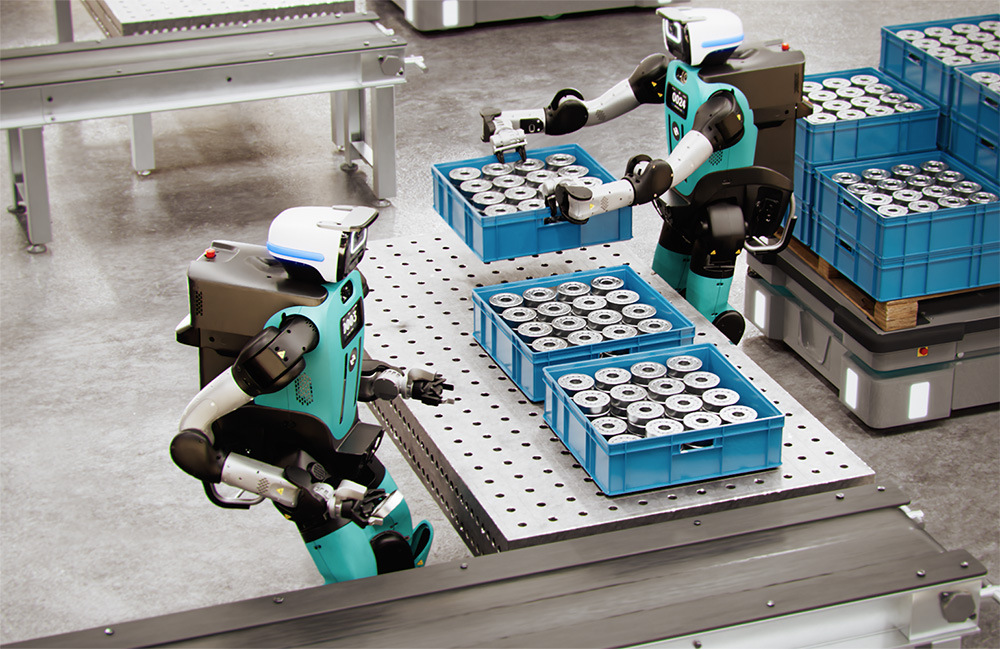

Agility Robotics unveiled Digit 5, a humanoid robot with redesigned legs, upgraded batteries and a broader safety architecture, first reported by Therobotreport. The company says the robot can work close to people without physical safety barriers, while its design incorporates safety requirements, facility logistics and certifications identified during earlier customer deployments.
The redesign follows three years of Digit 4 working on production floors. Jonathan Hurst said scaling required more than completing a task: FCC requirements, UL and ISO certifications, aisle dimensions, charger placement and facility workflows became hundreds of engineering requirements. The redesign connects the robot’s physical capabilities to the practical constraints of a facility.
Hardware built around industrial tasks
New proprietary cycloidal actuators power more human-like legs that can repeatedly lift up to 50 lb (22.7 kg). Padded knees help Digit kneel, while a stable squat lets it sit on the ground and turn off its motors when a person approaches.
It weighs 284 lb (129 kg), stands 5’ 11” (1.81 m), and can reach 7.2 feet (2.2 m), up from 5.5 ft for Digit 4. An autonomous charger supports 90 minutes of operation and a nine-minute full charge, giving Digit 5 a 10:1 run-to-charge ratio, up from Digit 4’s 2:1. The ratio enables more than 20 hours of work in a 24-hour day.
Agility also says Digit 5 will extend tote-based material handling into depalletizing, machine tending, kitting and sequencing, quality inspection and palletizing.
Safety is built into the platform
Agility says proprietary AI algorithms and multiple sensor technologies let Digit 5 detect people within a 360º radius. It can autonomously avoid, stop or assume a seated position as people approach, with no defined zones. Visual and auditory cues convey intent, while an independent safety controller oversees the response to people within an unsafe distance.
Agility is preparing to go public through a proposed SPAC merger with Churchill Capital Corp. XI. Recent SEC filings show $1.8 million in 2025 net sales, and the SPAC values Agility at $2.5 billion. Peggy Johnson said the company has more than $300 million in multi-year orders.
Early access is expected in the first half of 2027, with general availability for manufacturing, warehouse and distribution operators by the end of 2027. Agility also plans commercial deployment outside North America for the first time, starting in the European Union and United Kingdom, with a CE mark and additional regulatory marks expected for market access.