Overview
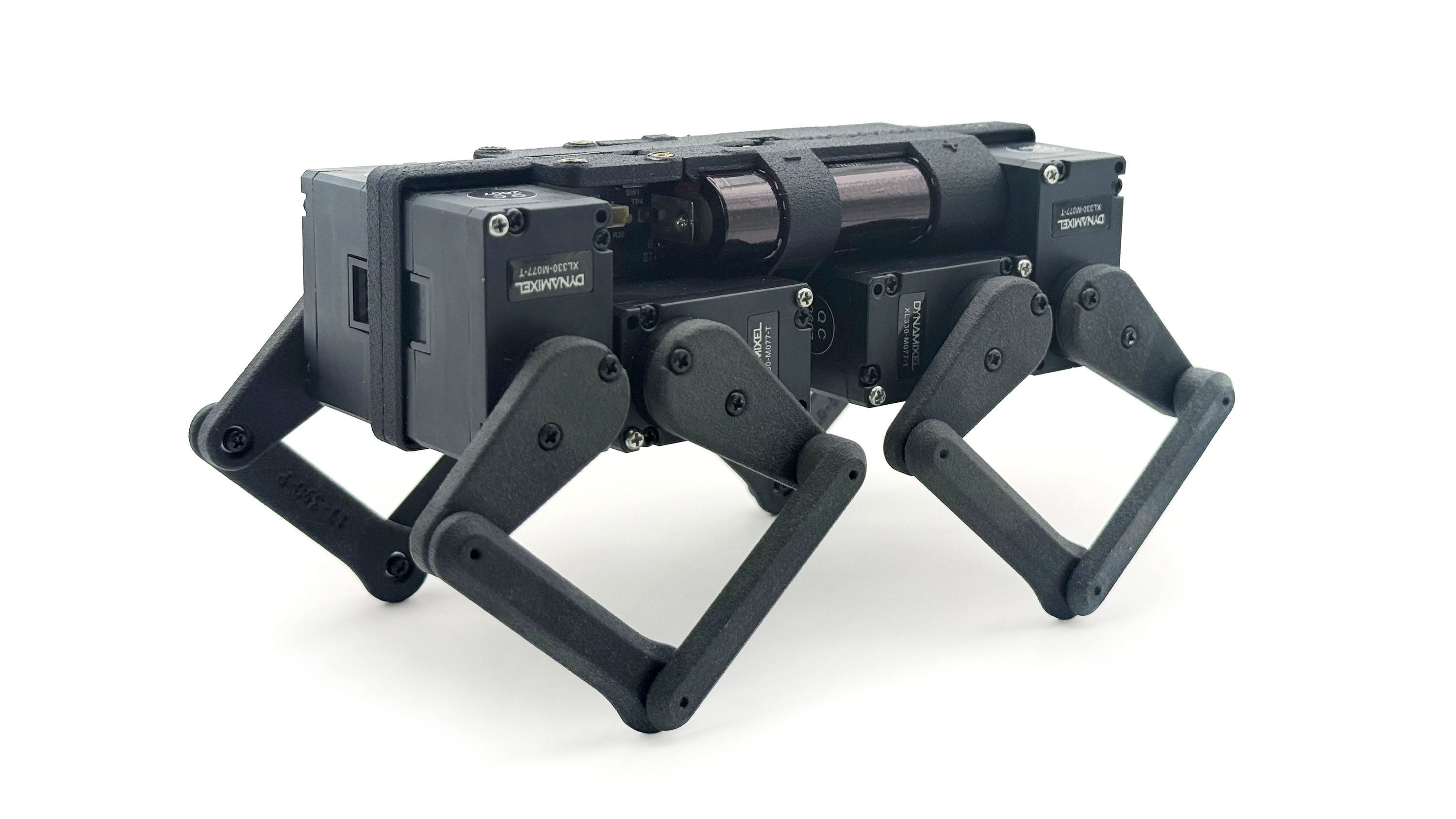
Q8botOne is a quadruped robot small enough to fit in the palm of a hand. ZeroWire Robotics of Cupertino, California, built it with no wires or cables: every component connects directly to a central printed circuit board. It uses eight ROBOTIS DYNAMIXEL XL330-M077-T smart actuators, which can be addressed individually over a shared serial bus, and an ESP32-C3 microcontroller. The legs are parallel linkages in 3D-printed Nylon PA12. The maker says it can jog fast, jump, carry twice its own weight and be programmed for many gaits. It launched on Crowd Supply on 6 October 2026, and nothing has shipped yet.
Price & Value
New MSRP: $599 for the Assembled Robot; $199 for the Robot Kit, which does not include the 8 actuators
Used range: None: no units have shipped
The campaign offers two configurations that are not equivalent. The $199 Q8botOne Robot Kit includes the chassis, batteries, motor screws, leg linkages, a pre-programmed controller, a USB-C cable and screwdrivers, but it requires assembly and the eight DYNAMIXEL actuators must be bought separately. The campaign page says those actuators are a significant part of the robot's cost and does not state their price, so the total cost of a kit-built robot cannot be calculated from it. The $599 Q8botOne Assembled Robot is the only configuration listed as one complete robot. Both list free worldwide shipping and prices in US dollars. The page does not say what pricing will apply after the campaign closes on 19 November 2026.
Who Is It For?
Best for: - Robotics hobbyists and students who want an open, programmable palm-sized quadruped - Researchers who want individually addressable smart actuators with joint feedback in a very small platform - Makers who want to add sensors through the Qwiic / STEMMA QT connector or a powered UART port
Not for: - Buyers who need a robot immediately: delivery is estimated for March 2027 - Kit buyers who have not budgeted for eight DYNAMIXEL actuators sold separately - Anyone who needs published payload, speed or runtime figures: none are published
Alternatives & Comparison
Q8botOne sits in the small hobby and education quadruped segment. The campaign's own comparison table lines it up against the Petoi Bittle X, the Hiwonder MechDog and the Unitree Go2 Pro on openness, actuators, compute and size. Those comparisons come from the maker, so treat them as marketing claims.
| Model | Price | Available | Key Difference |
|---|---|---|---|
| Petoi Bittle X | See manufacturer | See manufacturer | Per the campaign page: 9 alloy PWM servos, software and partial hardware open, larger at 190 x 153 x 107 mm. |
| Hiwonder MechDog | See manufacturer | See manufacturer | Per the campaign page: 8 PWM servos, software-only openness, larger at 214 x 126 x 138 mm. |
| Unitree Go2 Pro | See model page | See model page | Per the campaign page: 12 integrated joint motors and an 8-core CPU with SDK-only openness; a much larger 700 x 310 x 400 mm robot. |
Verdict: Q8botOne's pitch is serious actuators in a tiny, open, wire-free body, not the lowest price. The assembled $599 version is the only listed way to get a complete robot, and the $199 kit only makes sense for builders who will also buy the eight actuators. With delivery not due until an estimated March 2027, it is a campaign to back with caution, not a product to buy today.
Use Cases & Capabilities
Learning and teaching robotics
The maker positions Q8botOne as accessible enough to take apart, modify and understand. It can be driven with the included controller, or the controller can act as a wireless dongle for a laptop, where the desktop GUI, an Xbox controller or the Python API can be used. The firmware and Python software repositories are published under the MIT license. The abstract rectangular body and parallel-linkage legs are meant to feel approachable for students.
Small legged-robot research
Unlike most small educational robots that use PWM servos, Q8botOne uses DYNAMIXEL smart actuators, which are individually addressable over a shared serial bus and expose parameters such as position, velocity and PID gains. The maker says the robot can read and write each joint's registers at high frequency and provides real joint feedback. No speed, payload or runtime figures have been published, so any research use should start by measuring them.
Adding sensors and compute
Q8botOne starts without extra sensors. A Qwiic / STEMMA QT connector opens compatibility with many Adafruit and SparkFun sensors as well as custom I2C devices. A 4-pin UART port can supply up to 3 A at 5 V for co-processors such as an ESP32-CAM module or a low-power Raspberry Pi. Mounting holes on top of the robot make it easy to attach modules.
History & Background
Q8botOne grew out of the original open-source Q8bot project, which ZeroWire Robotics' campaign page cites as its predecessor. The team says it went through multiple hardware revisions and extensive prototyping before settling on the current design. ZeroWire Robotics launched Q8botOne on Crowd Supply on 6 October 2026, with funding open until 19 November 2026. Elecrow handles PCB assembly and MJF 3D printing, final assembly takes place in Cupertino, and Mouser Electronics fulfils orders worldwide. The team's own risk section warns that actuator or IC shortages, higher-than-expected demand and compliance or battery-shipping reviews could delay delivery. The campaign page says technical support is handled through issues in the relevant GitHub repository.