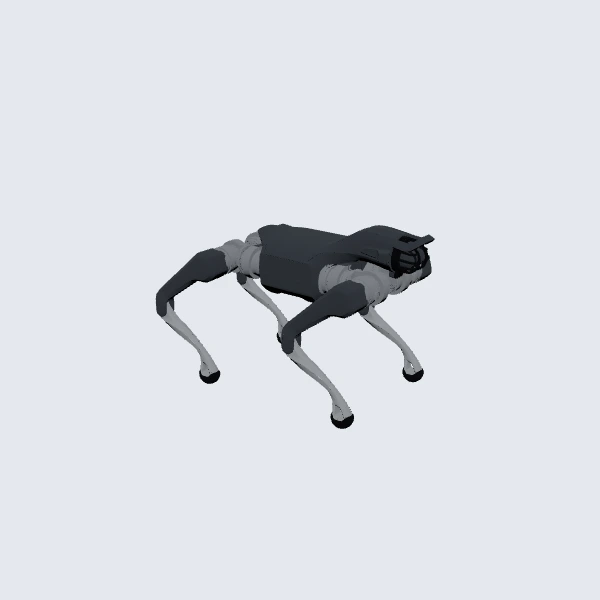
quadruped

Unitree As2 — Specs, Price & Where to Buy (2026)

A 20 kg robot dog by Unitree Robotics, unveiled in February 2026: larger and heavier than the Go2, with about twice its dynamic performance (Unitree), 12 inner-rotor joint motors of up to 95 N·m, a LiDAR at its nose, an 8-core computer and an 8,000 or 15,000 mAh battery for 2–4 hours. On sale from US$3,100 (As2 Air); shown here as the As2 Air.

📅First Built
2026
🌍Origin
CN
⚖️Weight
20 kg
🦾Degrees of freedom
12
🔋Battery
2–4 hours
🛒Availability
—

What is the Unitree As2?

A 20 kg robot dog by Unitree Robotics, unveiled in February 2026: larger and heavier than the Go2, with about twice its dynamic performance (Unitree), 12 inner-rotor joint motors of up to 95 N·m, a LiDAR at its nose, an 8-core computer and an 8,000 or 15,000 mAh battery for 2–4 hours. On sale from US$3,100 (As2 Air); shown here as the As2 Air.

Specifications

Facts about the Unitree As2 from its project's published documentation, design files and its makers' own figures. A figure marked Estimate is worked out from those files or parts lists rather than stated by the maker.

SpecDetail
Version shownThe As2 Air: the 3D file's LiDAR is Unitree's L2, which Unitree's table lists only on the Air (the Pro, X and EDU have an industrial 64–128-line LiDAR). All four versions share the body; they differ in LiDAR, battery, motor ratings and software. (Estimate: Unitree publishes one 3D model; the version differences are in its parameter table.)
Size720 × 378 × 457 mm standing; 776 × 378 × 233 mm lying down (Unitree).
WeightAbout 20 kg with the battery (Unitree, October 2026); at launch Unitree gave about 18 kg (heise, eWeek). Unitree's 3D model adds up to 17.64 kg; its newer simulator model (unitree_mujoco, August 2026) adds up to 20.7 kg.
Joints12 joints, 3 per leg: the hip swings the leg sideways (−45° to 45°), the thigh swings forward and back (−115° to 200°) and the knee bends (−159° to −47°) (Unitree's ranges).
Joint motors12 'low-inertia, high-speed inner rotor PMSM' joint motors on 'industrial-grade crossed roller bearings', with dual encoders (Unitree). Maximum joint torque about 65 N·m on the Air, 75 N·m on the Pro and 95 N·m on the X and EDU (Unitree, October 2026; at launch 45, 65 and about 90 N·m, heise). Unitree's model allows 60 N·m at the hips and thighs and 90 N·m at the knees.
Main computer'8-Core high-performance CPU' on every version (Unitree); the chip is not named. The EDU can add a computing expansion dock with modules 'such as Orin NX'; the X and EDU allow your own software (secondary development).
BatteryLithium battery: 8,000 mAh on the Air, 15,000 mAh (648 Wh) on the Pro, X and EDU; the robot runs on 36–50.4 V; chargers 50.4 V 4 A (Air) or 7.4 A (the others). About 2 h of walking (about 10 km) on the Air and 4 h (about 20 km) on the others, or more than 2.5 h (about 13 km) carrying 13–15 kg (Unitree).
SensorsUnitree's L2 LiDAR at the nose on the Air, an 'Industrial-grade 64~128-line LiDAR' on the Pro, X and EDU, an HD camera and a microphone (Unitree); an IMU in the body (Unitree's MuJoCo model).
Radio and portsWi-Fi 6 and Bluetooth 5.2 on every version; GPS and 4G on the Pro, X and EDU, off by default and turned on with the user's permission. Gigabit Ethernet, SBUS and a battery power output for add-ons (Unitree).
CoolingLocal air cooling (Unitree's table); the joint motors are built for 'enhanced response & heat dissipation'.
PerformanceAs2 Air: 0–3.0 m/s, walks with about 10 kg, stands with about 45 kg, 30° slopes, 20 cm stairs. Pro: 3.7 m/s, 13 kg, 55 kg, 40°, 25 cm. X and EDU: up to about 5 m/s for short bursts, 15 kg, 65 kg; climbs onto 50 cm platforms. Works from −20 °C to 50 °C (55 °C on the X and EDU); the Pro, X and EDU are rated IP54 against dust and rain (Unitree).
PriceUS$3,100 for the As2 Air and US$4,650 for the As2 Pro at Unitree's online store, before tax and shipping (15 Oct 2026). As2 X and As2 EDU: 'Contact Sales'. Unitree's product page lists every version as 'Contact Sales', and gave no prices at launch.
AvailabilityUnveiled on 24 February 2026 (Unitree's launch video). The As2 Air and Pro have been in Unitree's online store since 30 April 2026 and could be ordered on 15 October 2026; the X and EDU are sold through Unitree's sales team. Warranty: 6 months on the Air, 12 months on the others (Unitree).
Where it is madeUnitree Robotics, Hangzhou, China. Unitree designs and assembles its joint modules, gearboxes and battery packs itself; it buys the battery cells and the core boards of its computers.
Wheeled versionThe As2-W puts a 7-inch (178 mm) wheel at the end of each leg: 16 joints, about 25 kg, over 6 m/s, 648 Wh, sold as the As2-W X and EDU ('Contact Sales'). Its 3D model is in the same repository; the dataset has not built it. A news site put its base price at ~$36,700 (July 2026).
Parts cost~US$1,345 (¥9,000): the dataset's line-by-line estimate of the parts in an As2 Air, scaled from Unitree's audited Go2 costs and the G1 teardown. Joint motors are 56% of it. That is about 43% of the Air's US$3,100 store price (the Go2's audited materials are about 40% of the Go2 Pro's US$2,800). (Estimate: Unitree publishes no As2 costs and no teardown has been published; every line is scaled from other robots.)
Pose shownStanding with thighs at 0.8 rad and knees at −1.6 rad, chosen so the model stands 457 mm tall, Unitree's standing height. Unitree gives no standing pose: with every joint at zero the legs are straight, outside the knees' limits. (Estimate: The joint angles are the authors'; the height they give matches Unitree's figure.)

3D model

The interactive 3D model on this page is converted from the project's published design: Unitree As2 by Unitree Robotics (github.com/unitreerobotics/unitree_ros, robots/as2_description). 3D model © 2016-2022 HangZhou YuShu TECHNOLOGY CO.,LTD. ("Unitree Robotics"), BSD-3-Clause licence: commercial use allowed with this notice and the licence's disclaimer.

Sources

Unitree As2 in 3D

Loading the 3D model…
Drag to rotate · click the model, then scroll or pinch to zoom · click a part to inspectSwipe sideways to turn · pinch to zoom · tap a part to inspect3D model credit and licence

Unitree As2 supply chain

Point at or select a step to light up its chain: bright lines are its direct links, softer lines the rest of the path from raw material to robot.

Swipe sideways to follow the whole chain.

ExtractionRefiningMaterialsComponentsModulesRobotsCompaniesUnitree's self-developed 4D LiDAR (Unitree).Unitree designs its joint modules and assembles them itself from custom-made parts.Unitree designs and assembles its battery packs and builds its own battery management system; it buys the cells.Lithium compounds (carbonate, chloride, hydroxide) are produced from mined lithium.Lithium is produced from brine and mineral operations.Mined copper is smelted and refined.Primary aluminium from smelters.Bauxite is refined to alumina for aluminium.6061 aluminium contains 0.8–1.2% magnesium.6061 aluminium contains 0.40–0.8% silicon.A lithium-ion cell has a cathode (positive electrode), typically a metal oxide or phosphate. IEA tracks the 2025 mix of LFP and nickel-based cathodes in electric-car batteries.Camera units are built around image sensors (CMOS image sensors from makers such as Sony and OmniVision).Silicon metal is made from silica in natural forms such as quartzite (USGS).Silicon metal can be refined further into ultra-high-purity semiconductor-grade silicon, called polysilicon (USGS). Chips are made on wafers: thin slices of crystalline silicon (Wikipedia).Magnesium is recovered from dolomite, serpentine, magnesium-bearing evaporite minerals and brines (USGS).In wire-bond packaging, fine gold or copper wire connects each die to its leadframe or substrate. ASE is gradually replacing gold wire with copper to cut material cost, though gold wire is still one of its main materials.Steel is made from iron ore: US mines shipped 98% of their usable iron ore to the steel industry (USGS).Precision bearing rings are made of through-hardened chromium bearing steel 100Cr6 (SAE 52100) (GMN).Sony makes its CMOS image sensors in its own production facilities in Japan (Nagasaki, Kumamoto). SIA/BCG count optoelectronics and sensors in one fab group with discrete and analog chips (DAO), apart from logic.Bosch makes its MEMS sensors in its own fabs in Reutlingen and Dresden; a MEMS sensor is a MEMS element plus an evaluation chip (ASIC).A MEMS sensor is packed in a semiconductor housing, such as an LGA package (Bosch).Mined cobalt is refined further into chemicals or metal (Cobalt Institute). In 2025 DR Congo's export restrictions left refiners short of cobalt hydroxide feed and forced some to limit production, though world refined output still rose 5% to 240 kt (Cobalt Institute).Cobalt sulphate, the largest refined cobalt product, is typically used in NCM (NMC) batteries, and cobalt tetroxide often in LCO batteries (Cobalt Institute). Cobalt-free substitutes that use iron and phosphorus (LFP) held a significant market share in China (USGS).Mined nickel ore and concentrate go to smelters and refineries. In Indonesia, laterite ore is processed into nickel pig iron and ferronickel for stainless steel, or into battery intermediates such as mixed hydroxide precipitate (IEA); the US Eagle Mine's concentrate is exported to smelters (USGS).Battery cathodes need nickel sulphate, made from Class I nickel metal or from intermediates such as mixed hydroxide precipitate and nickel matte (IEA). LFP (lithium iron phosphate) cathodes contain no nickel.Stainless steel is the biggest use of nickel, 66% of demand in 2025 (Cobalt Institute). In the US, stainless and alloy steels and nickel alloys take more than 85% of nickel use (USGS). The world made 64.2 Mt of stainless steel in 2025 (worldstainless), against about 1,900 Mt of raw steel (USGS).Lithium-ion cathodes are lithium compounds, generally a layered oxide (such as lithium cobalt oxide), a phosphate (lithium iron phosphate) or a spinel (lithium manganese oxide). Batteries took an estimated 88% of world lithium in 2025 (USGS).Natural graphite flakes must be made into spherical particles, purified to over 99.95% carbon and coated before they can be used in lithium-ion battery anodes (IEA). Natural graphite is now a small part of anode supply: under 8% of China's 2025 anode shipments (GGII), and about 14% worldwide in 2022 (Rystad).Synthetic graphite is made by calcining and graphitising petroleum coke or needle coke at nearly 3,000 °C (IEA). It was 92.7% of China's 2025 anode shipments (GGII).The negative electrode (anode) of a conventional lithium-ion cell is typically graphite. IEA's 2025 data on electric-car battery anodes show only graphite and silicon-doped graphite.89.8% of the world's plastics in 2024 were made from fossil feedstock (Plastics Europe).Solder is the largest use of tin, 51% of world tin use in 2023 (International Tin Association; in the US solder took 11%, USGS). The common lead-free alloy SAC305 is 96.5% tin (AIM).Tin-lead solder is nearly half lead (PubChem), but the electronics industry has moved toward lead-free solders (USGS): 92% of solder for electronics was lead-free in 2023 (ITA).The lead-free alloy SAC305 contains 3% silver (AIM). In the US, brazing and solder took 3% of silver (USGS).The lead-free alloy SAC305 contains 0.5% copper (AIM).FR-4 laminate is woven fibreglass cloth with an epoxy binder (Wikipedia), and fibreglass is made from silica sand (Covia).A thin layer of copper foil is laminated to one or both sides of an FR-4 panel; these are called copper-clad laminates (Wikipedia; ChinaBaogao).FR-4 epoxy resin systems typically use bromine to resist fire (Wikipedia); a grade of the brominated flame retardant TBBPA is used to make epoxy resins for circuit boards (Wikipedia). Brominated flame retardants are one of bromine's two leading uses (USGS).Barite is used to make barium carbonate, which goes into dielectrics (Wikipedia). Barium titanate, the dielectric ceramic used in capacitors, can be made by heating barium carbonate with titanium dioxide (Wikipedia).Barium titanate, the ceramic in high-capacitance MLCCs, can be made by heating barium carbonate with titanium dioxide (Wikipedia); titanium dioxide comes from ilmenite and rutile (USGS).99% of MLCCs made worldwide use base-metal electrodes of nickel or copper; the industry moved from palladium and silver to cut cost (NASA, 2015). TDK replaced palladium electrodes with nickel in 1993 (Wikipedia).Platinum-group metals are used in multilayer ceramic capacitors (USGS). High-reliability MLCCs use palladium-silver electrodes (NASA, 2015).High-reliability MLCCs use precious-metal electrodes of palladium and silver (NASA, 2015).Connector contacts are copper alloys: beryllium copper is called the best copper alloy for contacts, connectors and cables (Wikipedia), and phosphor bronze (copper-tin-phosphorus) can replace it (USGS).Copper-clad laminate is the core material of circuit boards (ChinaBaogao); FR-4 is a common material for printed circuit boards (Wikipedia).Parts are soldered onto bare boards: Adafruit's BNO055 board is a "breakout PCB", and the Raspberry Pi Zero 2 W brief warns against damage to the printed circuit board.SAC305 lead-free solder is made for soldering printed circuits, by wave, hand and SMT reflow soldering (Conro; AIM).MLCCs store and release charge and absorb noise in phones, home appliances and IoT devices (Murata). The Raspberry Pi's RP3A0 package includes the decoupling capacitors that smooth its supply voltage (Raspberry Pi).Boards carry connectors: the Raspberry Pi Zero 2 W brief speaks of the board and its connectors, and Waveshare's servo adapter has a USB-C connector and a power connector.Brass is copper and zinc: CW614N free-cutting brass is about 39% zinc. In the US, brass and bronze are the second use of zinc after galvanized steel.Brass is mostly copper: 57–59% in CW614N free-cutting brass.Free-cutting brass such as CW614N holds 2.5–3.5% lead so it machines cleanly; lead-free brasses exist.XT30 battery plugs (G1 harness, Open Duck Mini) have gold-plated brass contacts.Antimony is used in circuit boards to cut flammability further. A review lists two studies of scrap PC boards, parts and solder still on, with 0.45% and 1.97% antimony, so the share in the laminate alone is not known.It scans with a brushless motor turning a mirror ('non-contact brushless rotating mirror scanning', Unitree).Built-in IMU: 3-axis accelerometer and 3-axis gyroscope (Unitree).MEMS microphones are silicon chips: the diaphragm is etched into a silicon wafer (Wikipedia). Pollen's HAT uses a MEMS microphone.Heat sinks are often aluminium: the Go2's main board has two fans blowing over an aluminium heat sink (Simplexity).In the Unitree G1, the heat pipe and heat spreaders that teardowns show are copper: a copper heat pipe presses against a motor (a published teardown), and copper heat-spreader plates cool its knees (China Post Securities).Unitree lists aluminium alloy for the As2; the motor barrels and the lower legs are bare metal in its photos.Unitree lists 'High-Strength Engineering Plastic' for the As2.'Industrial-grade crossed roller bearings (high precision, high load capacity)' in every joint (Unitree).The motor's coils: a permanent-magnet synchronous motor (Unitree: 'inner rotor PMSM') turns its rotor with wound stator coils; Unitree's co-founder says its joint motors' only outside suppliers sell raw materials, such as copper wire and magnets.A permanent-magnet synchronous motor: its inner rotor carries permanent magnets (Unitree). The magnet type is not stated.A lithium battery on a 36–50.4 V supply: 8,000 mAh on the Air, 15,000 mAh (648 Wh) on the Pro, X and EDU (Unitree); Unitree buys its cells.The 8-core processor sits on a circuit board (Unitree: '8-Core high-performance CPU'); Unitree buys the core boards of its computers.Magnet wire is drawn from rod of pure electrolytic copper: Elektrisola starts from 8 mm rod with at least 99.90% copper, and most magnet wire is fully annealed, electrolytically refined copper (Elektrisola; Wikipedia).Small DC and brushless motors' coils are wound from magnet wire, usually copper (Wikipedia); maxon says its coreless windings are enamelled copper wire, a copper core with lacquer insulation (maxon). Nidec does not say what wire its coils use.ASML's DUV machines, 'the workhorses of the industry', print the majority of layers in chips, older-generation chips included (ASML annual report 2025).The body shell, motor barrels, thigh covers, lower legs and feet that make up the As2's body.Twelve joint motors, three per leg (Unitree).Its battery, on a 36–50.4 V supply: 8,000 mAh on the Air, 15,000 mAh (648 Wh) on the Pro, X and EDU (Unitree).Its main computer: an '8-Core high-performance CPU' (Unitree).The As2 Air's LiDAR is Unitree's L2, at the nose in a guard cage; the Pro, X and EDU have an industrial 64–128-line LiDAR instead (Unitree).An HD camera on every version (Unitree).Unitree's MuJoCo model has an IMU in the body: a gyroscope and an accelerometer at its 'imu' site.A microphone on every version (Unitree).A speaker on every version (Unitree).Wiring and connectors between the battery, the computer and the 12 motors; Unitree lists Gigabit Ethernet, SBUS and a battery power output.'Local Air Cooling' (Unitree's table); its joint motors are built for 'enhanced response & heat dissipation'. Which fans or heat sinks it uses isn't published.Unitree Robotics makes the As2.Quartz and silica sandQuartz and silica sandMagnesium ores and brinesMagnesium ores and brinesOil, gas and coal(plastics feedstock)Oil, gas and coal (plastics feedstock)Steel (gear, bearing andstainless grades)Steel (gear, bearing and stainless grades)Lithography machines (chipprinting)Lithography machines (chip printing)Mature-node chipfabrication (28 nm and…Mature-node chip fabrication (28 nm and older; analog and sensor chips)Aluminium alloysAluminium alloysBattery-grade lithiumcompoundsBattery-grade lithium compoundsPermanent magnets (typeundisclosed)Permanent magnets (type undisclosed)Lithium chemicalconversionLithium chemical conversionCopper smelting andrefiningCopper smelting and refiningAlumina refining andaluminium smeltingAlumina refining and aluminium smeltingLithium miningLithium miningCopper miningCopper miningBauxite miningBauxite miningIron ore miningIron ore miningMagnesium smeltingMagnesium smeltingSilicon metal smeltingSilicon metal smeltingChip packaging and test(OSAT)Chip packaging and test (OSAT)Precision bearingsPrecision bearingsSmall precision motors (DCand BLDC)Small precision motors (DC and BLDC)Image sensorsImage sensorsIMUs (motion sensors)IMUs (motion sensors)Lithium-ion cellsLithium-ion cellsCameras and depth camerasCameras and depth camerasUnitree 4D LiDAR L2Unitree 4D LiDAR L2UnitreeUnitreeCobalt miningCobalt miningCobalt refining (chemicalsand metal)Cobalt refining (chemicals and metal)Nickel miningNickel miningNickel smelting andrefiningNickel smelting and refiningNatural graphite miningNatural graphite miningBattery anode graphite(spherical natural and…Battery anode graphite (spherical natural and synthetic)Cathode active material(NMC, NCA, LCO, LFP)Cathode active material (NMC, NCA, LCO, LFP)Titanium minerals(ilmenite and rutile)Titanium minerals (ilmenite and rutile)Engineering plastics (ABS,PC, nylon, PEEK)Engineering plastics (ABS, PC, nylon, PEEK)Tin miningTin miningLead miningLead miningSilver miningSilver miningPalladium mining(platinum-group metals)Palladium mining (platinum-group metals)Antimony miningAntimony miningBromine (from brines)Bromine (from brines)Barite mining (barium)Barite mining (barium)Solder (tin alloys:lead-free SAC and…Solder (tin alloys: lead-free SAC and tin-lead)Copper-clad laminate (FR-4glass-fibre epoxy board…Copper-clad laminate (FR-4 glass-fibre epoxy board material)Printed circuit boards(bare boards)Printed circuit boards (bare boards)Multilayer ceramiccapacitors (MLCC)Multilayer ceramic capacitors (MLCC)Connectors and wiringharnessesConnectors and wiring harnessesElectronics assembly(circuit boards with part…Electronics assembly (circuit boards with parts soldered on)Zinc miningZinc miningBrass (copper-zinc alloy)Brass (copper-zinc alloy)Copper magnet wire(enamelled)Copper magnet wire (enamelled)MicrophonesMicrophonesSmall speakersSmall speakersCooling fans and heatsinksCooling fans and heat sinksUnitree As2Unitree As2Structure: Unitree As2Structure: Unitree As2Unitree As2 joint motorUnitree As2 joint motorAs2 battery pack (8 or 15Ah, 36–50.4 V)As2 battery pack (8 or 15 Ah, 36–50.4 V)As2 main computer (8-coreCPU)As2 main computer (8-core CPU)