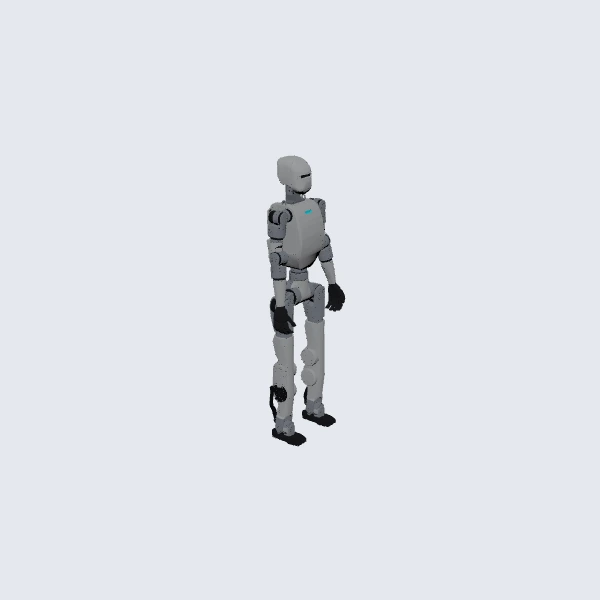
What is the ROBOTIS AI Sapiens K1?
ROBOTIS's open humanoid for physical-AI research, from the Seoul maker of DYNAMIXEL servos: 1,355 mm and 35 kg, with 23 joints driven by its own DYNAMIXEL-Q quasi-direct-drive actuators, an NVIDIA Jetson Orin NX 16GB and a 460.8 Wh battery. Its ROS 2 software and 3D model are open (Apache-2.0); ROBOTIS starts selling it in November 2026, first to Korean universities and research institutes.
Specifications
Facts about the ROBOTIS AI Sapiens K1 from its project's published documentation, design files and its makers' own figures. A figure marked Estimate is worked out from those files or parts lists rather than stated by the maker.
| Spec | Detail |
|---|---|
| Size | 1,355 mm tall (ROBOTIS); its drawing gives 292 mm across the shoulder joints and 204.8 mm from chest to back. In ROBOTIS's 3D model the legs' hip joints are 250 mm apart, the thigh is 357 mm from the hip-pitch axis to the knee and the shin 294 mm from the knee to the ankle (measured). |
| Weight | 35 kg (ROBOTIS). The link masses in ROBOTIS's 3D model add up to 35.71 kg; the torso alone is 8.49 kg. |
| Joints | 23 joints, all driven by DYNAMIXEL-Q actuators: 6 per leg (hip pitch, roll and yaw, knee, ankle pitch and roll), 5 per arm (shoulder pitch and roll, an upper-arm twist, the elbow and a wrist twist) and 1 at the waist, which turns the whole upper body. The head is fixed: there is no neck joint. |
| Joint motors | ROBOTIS's own quasi-direct-drive actuators, each with a frameless motor, 20:1 gears, two encoders and an ARM Cortex-M33: 11 QC080-240-R020-RE (waist, hips, knees, ankle pitch; 24.2 N·m continuous, 72.6 N·m peak; 845 g on ROBOTIS's AI Sapiens page, 865 g on its product page) and 12 QC060-200-R020-RE (ankle roll and arms; 10.6 and 30.0 N·m; 435 g or 455 g). ROBOTIS's 3D model allows 96.9 and 47.3 N·m. |
| Ankle drive | Estimate: the ankle-pitch actuator sits in the shin, 185 mm above the ankle (measured), and tips the foot through a black crank and a push rod to a lever at the back of the ankle; the ankle-roll actuator sits in the ankle itself. (Estimate: Inferred from ROBOTIS's 3D model and photos: the crank and rod are drawn, but ROBOTIS does not describe the drive.) |
| Range of motion | In ROBOTIS's 3D model (software limits, not measured travel: ROBOTIS publishes no ranges, and round values such as the waist's ±360° and the many ±180° look like stand-in values): hip pitch ±140°, hip roll −35° to 145° (outwards), hip yaw ±180°, knee 0° to 135°, ankle pitch ±45°, ankle roll ±30°; waist ±360°; shoulder pitch ±180°, shoulder roll 0° to 180° (outwards), upper-arm twist ±180°, elbow −45° to 125°, wrist twist ±180°. |
| Computer | NVIDIA Jetson Orin NX 16GB (8-core Arm Cortex-A78AE, 1,024-core Ampere GPU, up to 157 TOPS) with a 256 GB SSD, Wi-Fi 5 and Bluetooth 5.0 (Realtek RTL8822CE), Ethernet ports of 2.5 and 1 Gbps, four USB-A and one USB-C. ROBOTIS's photo shows it under NVIDIA's heat sink with a fan. |
| Battery | A lithium-ion pack of 26 LG Energy Solution M50LT 21700 cells, 13 in series and 2 in parallel: 48 V, 10 Ah, 460.8 Wh. It slides straight into a bay in the torso next to the red emergency stop; its power button and LEDs are on the pack's side panel. ROBOTIS gives no runtime (a third-party spec listing gives about two hours). |
| Boards and buses | ROBOTIS's HAT board: an STM32H562AGI6 bridges Ethernet to five RS-485 buses at up to 6 Mbps for the 23 actuators and the IMU board; an STM32C532CCU6 handles the remote control and battery monitoring; it takes 30–60 V, gives 24 V and 12 V at up to 5 A each, and runs the emergency stop and the LEDs. In ROBOTIS's settings the right leg and the waist share one bus (7 actuators). |
| Sensors | An IMU board in the pelvis (an STM32C532CCU6 with an ICM-42688-P or BNO085); ROBOTIS gives an 8 kHz IMU update without saying which chip that is for. Every actuator reports its position, speed and current. ROBOTIS's photos also show a camera with two lenses behind the helmet's black band, which its specifications do not list. |
| Head camera | Estimate: in ROBOTIS's 3D model the camera behind the face band measures 90.7 × 25.1 × 24.7 mm, the size of Intel RealSense's D435 depth camera (90 × 25 × 25 mm); ROBOTIS does not name it. (Estimate: A match by size and look only; ROBOTIS lists no camera.) |
| Software | Cyclo OS (built with the Yocto Project) and ROS 2 Jazzy in a Docker container on the Jetson; ROS 2 control runs at 1 kHz on a real-time (PREEMPT-RT) kernel and sends each actuator a target, a feed-forward torque and two impedance gains. ROBOTIS trains whole-body skills on 4,096 simulated K1s in NVIDIA Isaac Lab (about 4 hours per motion) and runs the policy on the robot at 50 Hz. |
| Remote control | A RadioMaster Pocket radio remote (ExpressLRS link) with E-STOP switches; the HAT board reads its channels and link quality. |
| Safety | A red emergency-stop button on the back of the torso cuts power to the actuators when pressed; it latches, and a twist releases it. |
| Cooling | A fan on the computer's heat sink (ROBOTIS's photo). The actuators have no fans: a report says ROBOTIS designed the DYNAMIXEL-Q to need none. |
| Look | Light grey matt covers on the helmet, chest, back, pelvis, thighs, shins and upper arms; polished metal housings at the shoulders, hips and pelvis (aluminium alloy, per a third-party spec listing); black actuators, hands, feet and ankle linkages; a black band across the helmet over the camera, a cyan light bar on the chest and a red emergency stop (ROBOTIS's photos). ROBOTIS's product renders show a different head: an egg shape under a black cap. |
| Hands | Black rubber hands with fixed fingers: they cannot grip (ROBOTIS's 3D model names them rubber hands and has no finger joints). |
| Price | Not announced. ROBOTIS planned to publish the final specifications and price in September 2026 (iNews24); none was public on 15 Oct 2026. Its CEO said the price can be similar to or lower than the AI Worker's (from ~$60,512 before VAT at Generation Robots, converted from euros at the ECB rate of 9 Oct 2026). Lower figures are unconfirmed: early reports in April said $8,000–12,000, a Korean financial news site wrote that it would cost ₩10–20 million (~$7,454–14,909), and a third-party spec listing's database lists $8,000 with a 'Not Verified' mark. The dataset's parts-cost estimate is ~$6,825 (~$8,265 to build, with factory work), so a price under ~$10,000 would leave ROBOTIS little or no margin. |
| Availability | Official sales start in November 2026, first only to Korean universities and research institutes; the first batch is already sold (Sisa Journal-e, 7 Sep 2026). Through its OH!GYM! programme ROBOTIS gave K1 robots and its open-source software free to four university teams (Seoul National University, Yonsei, Seoul National University of Science and Technology and Gachon), which showed their results on 31 Aug 2026; phases 2 and 3 are planned. |
| Made in | Seoul, South Korea: ROBOTIS builds about 10 K1s a month at first at its Magok headquarters and aims at 10,000 humanoids a year from 2027. All its Q-series actuators are to be made at its new plant in Uzbekistan, which starts partly in October 2026. |
| Maker | ROBOTIS (Seoul), the maker of DYNAMIXEL servos; it developed the AI Sapiens from March 2026 and finished it in about two months (ZDNet Korea), and it also makes the AI Worker, a humanoid on wheels. |
| Parts cost | Estimate: ~$6,825 for the parts, the dataset's line-by-line estimate of what ROBOTIS pays, scaled from the teardown costs for the Unitree G1 and NVIDIA's module price. No K1 parts list or teardown is public (ROBOTIS says its parts list is coming). The 23 actuators are 62% of it. (Estimate: No K1 teardown or price list exists; the actuator costs come from another maker’s joints.) |
| Open model | ROBOTIS publishes the K1's URDF (25 links, 23 joints, a fixed head, one STL mesh per link in millimetres) and a MuJoCo model with the two actuator classes, under Apache-2.0 (commit 937c67d of 8 Oct 2026). Its STEP files, parts list, 3D-printable covers and circuit-board files are announced as coming. |
| Pose shown | Arms lowered as in ROBOTIS's photos (shoulder roll ±0.16 rad, elbows 1.4 rad); every other joint at 0, ROBOTIS's own 'home' pose. (Estimate: The authors' choice of arm angles, matched by eye to ROBOTIS's photos; the rest is ROBOTIS's own keyframe.) |
3D model
The interactive 3D model on this page is converted from the project's published design: AI Sapiens K1 by ROBOTIS (github.com/ROBOTIS-GIT/ai_sapiens, ai_sapiens_description, K1 rev1). 3D model under the Apache License 2.0: commercial use allowed; the licence and a list of the dataset's changes travel with the model. ROBOTIS does not endorse this model.
Sources
- Project repository: github.com/ROBOTIS-GIT/ai_sapiens