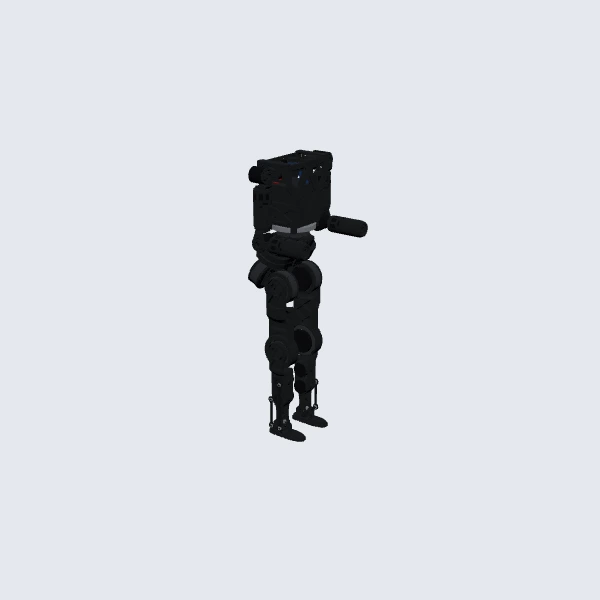
What is the RoboParty Roboto Origin?
A 1.25 m, 34 kg open-source humanoid robot by RoboParty, built from a kit of machined aluminium parts and 23 bought-in Damiao motors (6 per leg, 5 per arm, 1 at the waist), with a 48 V battery and a small AI computer in the chest. It can run at 3 m/s.
Specifications
Facts about the RoboParty Roboto Origin from its project's published documentation, design files and its makers' own figures. A figure marked Estimate is worked out from those files or parts lists rather than stated by the maker.
| Spec | Detail |
|---|---|
| Size | 1.25 m tall (RoboParty's figure; its pictures show a display head, which the 3D model lacks); thigh 250 mm, shank 300 mm, each arm 440 mm. The 3D model, without a head, is 1.06 m from sole to shoulder top. |
| Weight | 34 kg (RoboParty). Its 3D model's link masses add up to 33.76 kg. |
| Joints | 23 joint motors: 6 per leg (hip yaw, roll and pitch, knee, and two for the ankle's pitch and roll), 5 per arm (shoulder pitch, roll and yaw, elbow, wrist roll) and 1 at the waist. No hands. |
| Joint motors | Bought-in Damiao motors with built-in driver and two encoders: 9 DM-J10010L (120 N·m peak, 10:1, 1,375 g) at the waist, hips and knees, and 14 DM-J4340P (27 N·m peak, 40:1, 375 g) in the arms and shins. The two shin motors of each leg move the ankle through steel rods. |
| Range of motion | Hip pitch −120° to +45°, knee −11° to +143°, hip roll and hip yaw 69° each (−11° to +57°, mirrored left and right), ankle pitch ±34° and roll ±29°, shoulder pitch −180° to +90°, waist ±180° (RoboParty's URDF limits; the V2 waist also has a mechanical limit switch). |
| Main computer | Two boards are documented. The parts list and the official kit name a D-Robotics RDK X5 with 8 GB (8 Cortex-A55 cores at 1.5 GHz, 10 TOPS AI accelerator). RoboParty's own wiring guide and 3D file use an Orange Pi 5 Plus (Rockchip RK3588, 6 TOPS): the guide plugs the power board's USB-to-CAN, the IMU and the gamepad receiver into it. RoboParty's software is verified on both. |
| Battery | 48 V, 15 Ah lithium-ion pack (about 720 Wh, 140 × 140 × 115 mm), for more than 2 hours (RoboParty). It is charged through a 3-pin aviation plug. |
| Power and wiring | RoboParty's own RBE board (80 × 60 mm) turns 48 V into 5 V (8 A) for the computer, shares the 48 V among four XT30 outputs and has four USB-to-CAN channels. 23 harnesses with XT30 plugs chain the motors; the cables run inside the frame. |
| Sensors | A HiPNUC HI14M0 IMU in the chest. An Intel RealSense D435i depth camera and a 3D LiDAR are optional (RoboParty; a reseller names an E1R LiDAR). |
| Speed | Runs at up to 3 m/s (RoboParty), with its open-source reinforcement-learning gait. |
| Emergency stop | A red emergency stop button on the back of the chest (Lanbo, metal head), and a latching power switch with a green ring light for the computer. |
| Frame | 26 machined parts: 6061 aluminium, with 7075 for the waist support and battery bottom cover, all sandblasted and black anodised; the ankle rods, cranks and foot links are 45 steel with a black-oxide finish. RoboParty's README says the robot can be built from Taobao parts and JLC (Jialichuang) prototypes. |
| Screws | 1,168 fasteners in the parts list: socket-head screws from M2.5 to M6 in 12.9-grade alloy steel (200 of them M4 × 8), 60 steel dowel pins, 10 standoffs and 4 eye bolts. |
| Price | Kit at a reseller: $12,450 for the official full kit without battery; $11,800 for Kit 1 (frame, battery and motors); $5,000 for the 23 motors (AIFITLAB, 14 Oct 2026). RoboParty's own January 2026 parts list totals about $7,429 (¥49,713). |
| Where it comes from | Designed by RoboParty (Shanghai RoboParty Technology, founded 21 Feb 2025, Zhangjiang Robot Valley, Shanghai). By May 2026 its first several hundred robots were being delivered, assembled by their users; the next product is RP1. The motors are made by Damiao in Shenzhen, the IMU by HiPNUC in Beijing. |
| Pose shown | All joint angles at zero (the zero pose): standing straight, upper arms down, forearms pointing forward. |
3D model
The interactive 3D model on this page is converted from the project's published design: Roboto Origin V2 (RPO) by RoboParty (github.com/Roboparty/roboto_origin, commit c71fd92, modules/rpo_description). 3D model © 2025–2026 RoboParty, CERN-OHL-W-2.0; this converted model is shared under the same licence, with its source location and changes in the notice. RoboParty does not endorse this model.
Sources
- Project repository: github.com/Roboparty/roboto_origin