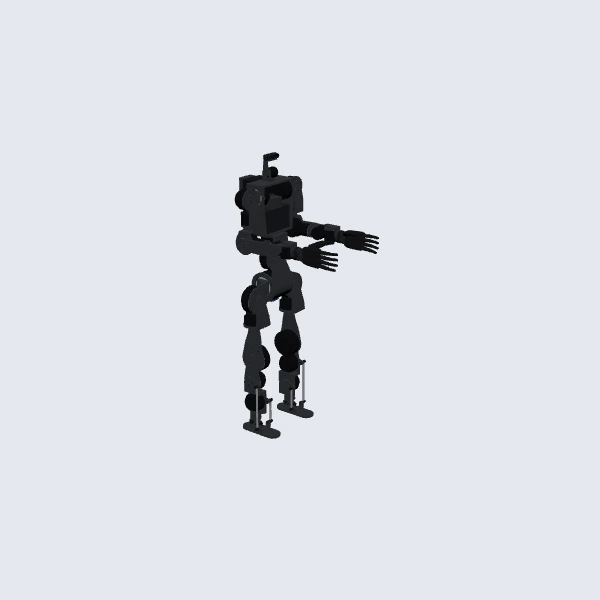
What is the Primo Humanoid?
An open-source humanoid designed by Alessio Pagliai (River Family) and published on 19 Sep 2026: about 1.40 m and 45 kg when finished, with 30 RobStride joint motors, a 3D-printed carbon-fibre nylon body, an NVIDIA Jetson AGX Thor and Inspire dexterous hands. It is still in design: nothing is built yet, and its walking has only been trained in simulation. Its files are public domain (CC0).
Specifications
Facts about the Primo Humanoid from its project's published documentation, design files and its makers' own figures. A figure marked Estimate is worked out from those files or parts lists rather than stated by the maker.
| Spec | Detail |
|---|---|
| Status | In design, not built yet (state of 21 Sep 2026, still the latest on 16 Oct 2026). The first step is a bench build of the right arm and hand, one ankle, the battery, the safety chain and the torso on a table (phase 1: €4,009 with VAT); then the legs and walking (€3,998), then the left arm, waist, neck, sound and battery operation (€2,258). The lab already owns the Thor computer and the two hands. |
| Size | About 1.40 m tall when finished (the designer's figure, partly from the two stacked ankle motors in each shin). The published CAD stands 1.25 m from the soles to the top of the head camera (measured in the 3D model). |
| Weight | About 45 kg finished (the designer's estimate); the bought parts weigh about 33 kg. The URDF's link masses add up to 32.3 kg, the printed parts 5.5 kg of it. |
| Joints | 30: 6 per leg (hip pitch, roll and yaw, knee, ankle pitch and roll), 7 per arm (shoulder pitch, roll and yaw, elbow, wrist roll, pitch and yaw), 2 in the waist (roll and yaw; there is no waist pitch, so the hips bend the torso forward) and 2 in the neck (yaw and pitch). |
| Joint motors | 30 RobStride quasi-direct-drive modules, each with its own driver and two encoders: RS04 ×6 (hip pitch and roll, knees: 40 N·m rated, 120 N·m peak), RS03 ×3 (hip yaw, waist roll: 20 / 60 N·m), RS06 ×11 (ankles, waist yaw, shoulder pitch and roll, elbows: 11 / 36 N·m), RS00 ×8 (shoulder yaw, wrists: 5 / 14 N·m), RS05 ×2 (neck: 1.6 / 5.5 N·m); about 20.9 kg of motors. |
| Hip yaw motor | The CAD, the URDF and so the 3D model have an RS06 at each hip yaw; since 21 Jun 2026 the BOM, the README and the wiring plan buy an RS03 there (60 instead of 36 N·m peak), because a sharp turn at 45 kg could need about 36 N·m. The project will measure the hip-yaw torque while turning in simulation before it orders the leg motors. The dataset follows the BOM: 3 RS03, 11 RS06. |
| Ankles | Two RS06 motors in each shin work the foot through 47 mm cranks and two adjustable aluminium push rods (140 and 40 mm bodies) with igus rod ends. Turning together they tip the foot up and down (up to 72 N·m); against each other they tilt it (66 N·m). The foot hangs on an offset gimbal with two Ø8 mm shoulder-screw axes, pitch above roll. |
| Range of motion | From the URDF: hip pitch −2.88 to 2.53 rad, knee −0.09 to 2.88 rad, ankle pitch −0.52 to 0.87 rad and roll ±0.26 rad, waist yaw ±2.62 rad and roll ±0.52 rad, neck yaw ±1.57 rad and pitch ±0.70 rad, elbow −1.05 to 2.09 rad. The README notes that in the CAD the thigh touches the shin from about 123° of knee bend, below the URDF's 165°. |
| Load | Estimate: about 1 kg in each hand. The designer sized the shoulder-yaw and elbow motors for 'roughly a 1 kg box' per hand; each Inspire hand pushes 10 N at a fingertip and 15 N at the thumb. (Estimate: A design target from the project's notes, not a tested load.) |
| Computer | NVIDIA Jetson AGX Thor developer kit (T5000 module), capped at 130 W: perception, the walking policy, state estimation and the 250 Hz motor commands. Two CAN buses from the Thor drive the legs; three USB-to-CAN adapters drive the arms, waist and neck, all at 1 Mbit/s. |
| Battery | A 48 V lithium-ion pack (13S2P: 26 Molicel P45B 21700 cells): 46.8 V, 9 Ah, 421 Wh, under 2.27 kg (the maker says 'under 2.27 kg'; the parts list uses 2.27 kg), with a 45 A (100 A peak) protection board. A WEHO converter makes the 24 V, 240 W rail for the computer, hands and USB hub. Runtime isn't published. |
| Safety chain | Pure hardware at 24 V: a START button latches a relay, precharges the motor bus through a 100 Ω resistor and, after a timer, closes a 100 A contactor; the red e-stop drops it all. The computer, camera and IMU stay on to log the stop. Still open: whether the e-stop should also cut the hands' power. |
| Sensors | A RealSense D436 depth camera with colour and its own IMU on the head, a Phidgets PhidgetSpatial Precision IMU in the pelvis, and two magnetic encoders in every joint motor. The Inspire RH56DFX hands have built-in force sensors; no other force or foot-contact sensors are listed. |
| Hands | Two Inspire RH56DFX hands (6 actuators and 12 joints each, 540 g, RS485). The project is designing its own five-finger hand with 15 driven joints, to replace them after testing. |
| Sound | A 36 mm, 3 W speaker (PUI AS03604AR) on a USB sound card with a microphone, in the third build phase. |
| Materials | The 20 printed parts (35 files with left and right) are carbon-fibre nylon, PA-CF or PPA-CF, printed on a Bambu Lab H2C: 4,395 cm³, 5.5 kg in the CAD. Everything else is bought: motors, hands, battery, computer, camera, power parts, push rods, rod ends and screws. |
| Colours | Not decided: nothing is printed yet, and the project shows only CAD renders in Onshape's working colours (light blue, orange, gold, dark blue). The dataset shows the printed parts in a neutral dark grey for black carbon-fibre nylon, and the bought parts in their makers' finishes (black RobStride motors with silver faces). |
| Walking | Only in simulation: a walking policy for the 12 leg joints and the waist roll was trained in NVIDIA Isaac Lab on rough ground with stairs of 5–23 cm, for forward speeds up to 1.0 m/s; it lasts about 87% of a 1,000-step episode. No pushes or randomised physics yet, the arms held still, and 'not yet ready for the real robot'. |
| Parts cost | About €30,490 all new, including 22% Italian VAT: the BOM's €10,265 over its three build phases, plus the computer (the project's reference €3,300 + VAT; already owned) and two hands (€8,099.16 each at Reichelt; already owned). The README rounds it to €30,000, and €10,300 if you already own the Thor and the hands. About $34,166 at the ECB rate of 9 Oct 2026. Not a price: no one sells Primo. |
| Made by | Designed by Alessio Pagliai with River Family (riverfamily.art, a gallery of open-source 3D-printed designs) and published on GitHub on 19 Sep 2026; the lab plans to build it in Italy (its BOM adds Italian VAT and checks battery shipping to Italy). Nobody makes or sells it. |
| Pose shown | All joint angles at zero (the zero pose): legs straight, upper arms down and forearms straight out in front. The idle animation lowers the forearms and softens the knees, as the project's own simulation stands it. |
3D model
The interactive 3D model on this page is converted from the project's published design: Primo by Alessio Pagliai and the River Family contributors (CC0 1.0), github.com/AlessioPagliai/primo; colours, push rods and piece names.
Sources
- Project repository: github.com/AlessioPagliai/primo