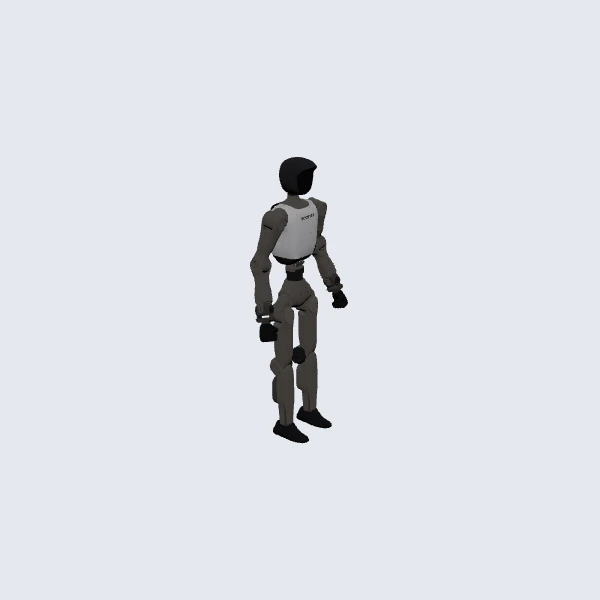
humanoid

Booster T2 — Specs, Price & Where to Buy (2026)

A 1.4 m, 42 kg humanoid by Booster Robotics (Beijing), launched on 10 July 2026 as a development platform: 31 joint motors (6 per leg, 3 in the waist, 7 per arm, 2 in the neck), push-rod ankles and waist, stereo cameras in the head and the waist, an ARM computer with 375 TOPS (or, on the Professional edition, an NVIDIA Jetson Thor T5000) and a 48 V battery for about 2 hours of walking. Resellers sell it from US$30,000 (15 Oct 2026).

📅First Built
2026
🌍Origin
CN
📏Height
1.4 m
⚖️Weight
42 kg
🦾Degrees of freedom
31
🏃Max speed
3 m/s
📦Payload
10 kg
🔋Battery
2 hours
🛒Availability
—

What is the Booster T2?

A 1.4 m, 42 kg humanoid by Booster Robotics (Beijing), launched on 10 July 2026 as a development platform: 31 joint motors (6 per leg, 3 in the waist, 7 per arm, 2 in the neck), push-rod ankles and waist, stereo cameras in the head and the waist, an ARM computer with 375 TOPS (or, on the Professional edition, an NVIDIA Jetson Thor T5000) and a 48 V battery for about 2 hours of walking. Resellers sell it from US$30,000 (15 Oct 2026).

Specifications

Facts about the Booster T2 from its project's published documentation, design files and its makers' own figures. A figure marked Estimate is worked out from those files or parts lists rather than stated by the maker.

SpecDetail
SizeHeight about 1.4 m (Booster: 'Height (standing): ~1.4 m (140 cm)'). Booster's 3D model stands 1,413 mm tall, 463 mm across the shoulders in the pose shown. Booster gives no width or depth. A Beijing government article on the launch says 'nearly 1.7 m'; the authors keep the maker's figure.
WeightAbout 42 kg (Booster: '~42 kg', varying slightly with version and options). The link masses in Booster's 3D model add up to 42.0 kg (41.99 kg).
Joints31 joint motors (Booster): 6 per leg (hip pitch, roll and yaw, knee, ankle pitch and roll), 3 in the waist (pitch, roll, yaw), 7 per arm (shoulder pitch and roll, upper-arm twist, elbow, forearm twist, wrist yaw and roll) and 2 in the neck. With hands: 33 joints with grippers, 43 with six-joint dexterous hands (German shop), up to 75 with Booster's most dexterous hands (36Kr). The standard T2 ends in fists.
Joint motors'Motor: High-speed internal-rotor PMSM' (a brushless permanent-magnet motor) and 'Joint Output Bearing: Industrial-grade crossed roller bearings'; 'Max Peak Torque: 140 N·m' (Booster). Fully torque-controlled joints with dual encoder modules (a German reseller). Booster's 3D model sets four sizes: 135 N·m (hips, knees, waist turn), 74 N·m (shoulder pitch), 60 N·m (the other shoulder and elbow joints, and the six push-rod motors) and 22 N·m (wrists and neck).
Ankles and waistPush-rod linkages, not plain hinges (Booster's parallel model): each ankle is moved by two 60 N·m motors in the front of the shin, 95 mm and 162 mm below the knee, through 25 mm cranks and rods of 172 and 239 mm; the waist's pitch and roll by two 60 N·m motors in the bottom of the torso through 51 mm rods. Booster's URDF and software report them as ankle pitch and roll and waist pitch and roll (their effort limits: 132 and 72 N·m at the ankle, 138 and 144 N·m at the waist).
Range of motionBooster's 3D model: head turn ±63°, nod −18° to 23°; waist pitch −43° to 32°, roll ±20.5°, turn ±138°; hip pitch −168° to 128°, roll −33° to 88° (outward), yaw ±158°; knee 0° to 148°; ankle pitch −37° to 19°, roll ±18°; shoulder pitch −173° to 98°, roll ±87°; upper-arm twist ±118°; elbow 0° to 120.5°; forearm twist ±118°; wrist yaw −43° to 39°, roll −78° to 53°.
ComputersEducation edition: 'High-performance ARM processor, 375 TOPS AI computing power' (Booster; a German shop lists 350 TOPS): a 16-core Arm Cortex-A78AE CPU at 1.9 GHz, 375 TOPS (INT8), 16 GB memory and 512 GB storage (Booster's T2 manual); the chip's maker is not named. Professional edition: 'Jetson Thor T5000, 2070 TFLOPS AI computing power' (Booster), with a 14-core Arm Neoverse-V3AE CPU at 2.6 GHz, 128 GB memory and 512 GB storage (manual): NVIDIA's US$4,999 module (in lots of 1,000).
Cooling'Cooling system: Air cooling' on both editions (Booster's T2 manual). Booster does not describe the fans or heat sinks; it warns by voice of joint overheating.
Battery'Battery Rating: 48 V, 10 Ah'; 'Battery Life: 2 hours of continuous walking'; 'Magnetic charging port; supports charging while in use' (Booster). The battery slides into a slot in the torso, about 2 hours to charge fully, charging only between 0 °C and 45 °C (Booster's T2 manual). A German shop sells the spare as 10.5 Ah, about 2 hours walking or 4 hours standing, with a power indicator, charge balancing and protection against overcharge, deep discharge, short circuits and overheating, for €2,399 (US$2,688.32).
Battery energyEstimate: about 480–504 Wh: 48 V × 10–10.5 Ah. Booster publishes no watt-hours; a 48 V pack is probably 13 lithium cells in series, like the T1's 13S3P pack. (Estimate: Simple arithmetic on the published rating; the usable energy may be a little lower.)
SensorsA binocular (stereo) camera in the head and another in the waist (Booster; a German shop calls them depth cameras); wrist cameras come with grippers or dexterous hands. A 9-axis IMU (a German shop; Booster's T2 manual puts an IMU in the torso). A microphone array and a speaker in the head (Booster; its T2 manual). LiDAR optional: a super-hemispherical 3D LiDAR, 360° × 189°, 40 m at 10% reflectivity and up to 60 m, for head or overhead mounting, €3,290 (US$3,686.77) at a German shop.
Buttons, radio and ports1 power button and 3 interaction buttons, 1 RGB LED; Wi-Fi 6 and Bluetooth 5.2; external ports for power, a locking USB Type-C connector and Ethernet; a handheld remote controller (Booster). Booster's T2 manual names the back panel's buttons: power (hold 3 s), WALK (walking mode), STAND (PREP mode) and F1 (DAMP mode, or a custom function); its photo shows the Ethernet port beside them and a green light bar below. The manual says to touch no part of the robot except the handle while it moves.
SafetySoft and hard emergency stops; voice warnings for low battery and joint overheating (Booster).
Payload'Maximum Dual-Arm Payload: 10 kg' with both arms, varying a lot with arm posture (Booster). A German shop lists 5 kg per arm held out level for the Education edition and 3 kg per arm for the Professional.
Speed'Walking Speed: 3 m/s' (Booster): 10.8 km/h, a running pace for a person.
FrameEstimate: not published. Booster names no materials for the T2. Its photos show a silver-white chest shell, a glossy charcoal helmet with a black visor and gunmetal shells on the neck, arms, pelvis and legs that look like metal; RoboCup teams list its smaller T1 as 7075 aluminium alloy and engineering plastics. (Estimate: Booster publishes no materials; this is inferred from its photos and the T1.)
In the boxRemote controller, battery pack, charger and a packaging case (Funduino's T2 Edu listing; its T2 Pro listing: a transport and carrying case).
PriceUS$38,850 at Robotics Center (San Francisco) for the T2 Edu E1 (no hands), 'In stock', standard delivery 4–6 weeks, US shipping estimated at $1,366.38 (read 29 Oct 2026). Its other configurations: Edu E2 with grippers $52,350, Edu E3 with BrainCo Revo 2 hands $59,850, Pro P1 (no hands) $44,850, Pro P2 with grippers $59,850, Pro P3 with BrainCo Revo 2 hands $67,350, Pro P3-1 with Wuji Hand 2 $139,500, Pro P3-2 with BrainCo Revo 3 tactile hands $148,500. Earlier it listed US$50,000 with $3,000 shipping (23 Oct 2026) and US$30,000 with $2,850 shipping (15 Oct 2026), without naming the edition. A price guide reading US dealer pages on 11 Aug 2026: T2 Edu $32,999, T2 Pro $37,999, with dexterous hands $48,999 / $54,999, with high-DoF tactile hands $118,999. In Germany Funduino lists, with 19% VAT: T2 Edu €32,500 (US$36,419.50), T2 Pro €38,259 (US$42,873.04), Pro with dexterous hands €53,590 (US$60,052.95), at 1 EUR = US$1.1206 (ECB, 9 Oct 2026). Booster itself sells by enquiry: its T2 page shows no price, and its 'Buy now' button opens an inquiry form.
AvailabilityLaunched on 10 July 2026 (Booster; 36Kr). On sale: Robotics Center (US) lists it 'In stock' with 4–6 weeks' delivery; Funduino (Germany) 'Available to order – with you in 21 working days' (15 Oct 2026). Booster's own site takes orders by enquiry.
Made inEstimate: China: Booster Robotics is based in Haidian District, Beijing (founded June 2023). It does not name the plant that builds the T2. (Estimate: The maker's home city; Booster does not say where each robot is assembled.)
Warranty1 year; extended warranty available (Booster).
Parts costEstimate: ~US$12,123 for the Professional edition: the dataset's own estimate, line by line, from the teardown costs for the Unitree G1, NVIDIA's price for the Jetson T5000 module and known camera prices. No T2 teardown or parts list is public. That is about 27% of the US$44,850 Robotics Center lists for the Pro P1 without hands (29 Oct 2026; 24% of the US$50,000 it listed on 23 Oct and 40% of the US$30,000 it listed on 15 Oct, edition not named) and 32% of the Professional's US$37,999 at a US dealer in August 2026; the Jetson module alone is 41% of the parts cost. (Estimate: Every line is the authors' estimate; the joints are scaled from another maker's teardown, and Booster builds far fewer robots than Unitree.)
Pose shownArms as in Booster's own default pose for running its software on a T2 (shoulder pitch 0.2 rad, shoulder roll ∓1.3 rad, elbow ∓0.5 rad); legs, waist and head at zero, Booster's default. The Anatomy viewer bends the knees a little when assembled.

3D model

The interactive 3D model on this page is converted from the project's published design: Booster T2 by Booster Robotics (github.com/BoosterRobotics/booster_assets, robots/T2). 3D model © 2025 BoosterRobotics, BSD-3-Clause licence: commercial use allowed with this notice and the licence's disclaimer. Booster Robotics does not endorse this model.

Sources

Booster T2 in 3D

Loading the 3D model…
Drag to rotate · click the model, then scroll or pinch to zoom · click a part to inspectSwipe sideways to turn · pinch to zoom · tap a part to inspect3D model credit and licence

Booster T2 supply chain

Point at or select a step to light up its chain: bright lines are its direct links, softer lines the rest of the path from raw material to robot.

Swipe sideways to follow the whole chain.

ExtractionRefiningMaterialsComponentsModulesRobotsCompaniesMined copper is smelted and refined.Primary aluminium from smelters.Bauxite is refined to alumina for aluminium.6061 aluminium contains 0.8–1.2% magnesium.6061 aluminium contains 0.40–0.8% silicon.Camera units are built around image sensors (CMOS image sensors from makers such as Sony and OmniVision).Silicon metal is made from silica in natural forms such as quartzite (USGS).Silicon metal can be refined further into ultra-high-purity semiconductor-grade silicon, called polysilicon (USGS). Chips are made on wafers: thin slices of crystalline silicon (Wikipedia).Magnesium is recovered from dolomite, serpentine, magnesium-bearing evaporite minerals and brines (USGS).In wire-bond packaging, fine gold or copper wire connects each die to its leadframe or substrate. ASE is gradually replacing gold wire with copper to cut material cost, though gold wire is still one of its main materials.Primary gallium is recovered mainly as a byproduct of processing bauxite (USGS).Gallium arsenide wafers are used to make optoelectronic devices, including laser diodes and photodetectors (USGS).Ouster's lidars fire light from VCSEL (vertical-cavity surface-emitting laser) arrays; Hesai says its LiDAR products depend on lasers.Ouster's lidars detect the returning light on a CMOS sensor chip with single-photon avalanche diode (SPAD) detectors; Hesai calls semiconductor chips a key component.Steel is made from iron ore: US mines shipped 98% of their usable iron ore to the steel industry (USGS).Precision bearing rings are made of through-hardened chromium bearing steel 100Cr6 (SAE 52100) (GMN).Sony makes its CMOS image sensors in its own production facilities in Japan (Nagasaki, Kumamoto). SIA/BCG count optoelectronics and sensors in one fab group with discrete and analog chips (DAO), apart from logic.Bosch makes its MEMS sensors in its own fabs in Reutlingen and Dresden; a MEMS sensor is a MEMS element plus an evaluation chip (ASIC).A MEMS sensor is packed in a semiconductor housing, such as an LGA package (Bosch).Mined nickel ore and concentrate go to smelters and refineries. In Indonesia, laterite ore is processed into nickel pig iron and ferronickel for stainless steel, or into battery intermediates such as mixed hydroxide precipitate (IEA); the US Eagle Mine's concentrate is exported to smelters (USGS).Stainless steel is the biggest use of nickel, 66% of demand in 2025 (Cobalt Institute). In the US, stainless and alloy steels and nickel alloys take more than 85% of nickel use (USGS). The world made 64.2 Mt of stainless steel in 2025 (worldstainless), against about 1,900 Mt of raw steel (USGS).Solder is the largest use of tin, 51% of world tin use in 2023 (International Tin Association; in the US solder took 11%, USGS). The common lead-free alloy SAC305 is 96.5% tin (AIM).Tin-lead solder is nearly half lead (PubChem), but the electronics industry has moved toward lead-free solders (USGS): 92% of solder for electronics was lead-free in 2023 (ITA).The lead-free alloy SAC305 contains 3% silver (AIM). In the US, brazing and solder took 3% of silver (USGS).The lead-free alloy SAC305 contains 0.5% copper (AIM).FR-4 laminate is woven fibreglass cloth with an epoxy binder (Wikipedia), and fibreglass is made from silica sand (Covia).A thin layer of copper foil is laminated to one or both sides of an FR-4 panel; these are called copper-clad laminates (Wikipedia; ChinaBaogao).FR-4 epoxy resin systems typically use bromine to resist fire (Wikipedia); a grade of the brominated flame retardant TBBPA is used to make epoxy resins for circuit boards (Wikipedia). Brominated flame retardants are one of bromine's two leading uses (USGS).Barite is used to make barium carbonate, which goes into dielectrics (Wikipedia). Barium titanate, the dielectric ceramic used in capacitors, can be made by heating barium carbonate with titanium dioxide (Wikipedia).Barium titanate, the ceramic in high-capacitance MLCCs, can be made by heating barium carbonate with titanium dioxide (Wikipedia); titanium dioxide comes from ilmenite and rutile (USGS).99% of MLCCs made worldwide use base-metal electrodes of nickel or copper; the industry moved from palladium and silver to cut cost (NASA, 2015). TDK replaced palladium electrodes with nickel in 1993 (Wikipedia).Platinum-group metals are used in multilayer ceramic capacitors (USGS). High-reliability MLCCs use palladium-silver electrodes (NASA, 2015).High-reliability MLCCs use precious-metal electrodes of palladium and silver (NASA, 2015).Connector contacts are copper alloys: beryllium copper is called the best copper alloy for contacts, connectors and cables (Wikipedia), and phosphor bronze (copper-tin-phosphorus) can replace it (USGS).Copper-clad laminate is the core material of circuit boards (ChinaBaogao); FR-4 is a common material for printed circuit boards (Wikipedia).Parts are soldered onto bare boards: Adafruit's BNO055 board is a "breakout PCB", and the Raspberry Pi Zero 2 W brief warns against damage to the printed circuit board.SAC305 lead-free solder is made for soldering printed circuits, by wave, hand and SMT reflow soldering (Conro; AIM).MLCCs store and release charge and absorb noise in phones, home appliances and IoT devices (Murata). The Raspberry Pi's RP3A0 package includes the decoupling capacitors that smooth its supply voltage (Raspberry Pi).Boards carry connectors: the Raspberry Pi Zero 2 W brief speaks of the board and its connectors, and Waveshare's servo adapter has a USB-C connector and a power connector.NVIDIA's Jetson Thor modules are 100 × 87 mm and plug in through a 699-pin board-to-board (B2B) connector (NVIDIA).Brass is copper and zinc: CW614N free-cutting brass is about 39% zinc. In the US, brass and bronze are the second use of zinc after galvanized steel.Brass is mostly copper: 57–59% in CW614N free-cutting brass.Free-cutting brass such as CW614N holds 2.5–3.5% lead so it machines cleanly; lead-free brasses exist.XT30 battery plugs (G1 harness, Open Duck Mini) have gold-plated brass contacts.Antimony is used in circuit boards to cut flammability further. A review lists two studies of scrap PC boards, parts and solder still on, with 0.45% and 1.97% antimony, so the share in the laminate alone is not known.MEMS microphones are silicon chips: the diaphragm is etched into a silicon wafer (Wikipedia). Pollen's HAT uses a MEMS microphone.Heat sinks are often aluminium: the Go2's main board has two fans blowing over an aluminium heat sink (Simplexity).In the Unitree G1, the heat pipe and heat spreaders that teardowns show are copper: a copper heat pipe presses against a motor (a published teardown), and copper heat-spreader plates cool its knees (China Post Securities).Joint output bearings: 'Industrial-grade crossed roller bearings' (Booster).Each joint has two encoder modules: 'Fully torque-controlled joints with dual encoder modules' (a German reseller). Driver boards are not described.A protection board: the spare pack has a power indicator, charge balancing and protection against overcharge, deep discharge, short circuits and overheating (a German shop).ASML's DUV machines, 'the workhorses of the industry', print the majority of layers in chips, older-generation chips included (ASML annual report 2025).The frame, shells and covers that make up the Booster T2's body (Booster's 3D model and photos).Education: a high-performance ARM processor (375 TOPS); Professional: NVIDIA Jetson Thor T5000 (2,070 TFLOPS).Binocular (stereo) cameras in the head and the waist (Booster; a German reseller calls them depth cameras); wrist cameras with grippers or hands. The camera models are not named.LiDAR optional (Booster): a super-hemispherical 3D LiDAR, 360° × 189°, 40 m at 10% reflectivity, up to 60 m, for head or overhead mounting, €3,290 at a German shop; its maker is not named.Optional high-DoF tactile hands: a US dealer lists a T2 Pro with them.A 9-axis IMU (a German reseller's T2 listings), in the torso (Booster's T2 manual); Booster's MuJoCo model puts its 'imu' site at the torso's origin.Circuit boards besides the computer: the microphone array, the 1 power and 3 interaction buttons and the RGB LED (Booster), and Wi-Fi 6 and Bluetooth 5.2. The power boards are not described.Booster Robotics makes this robot.Air cooling: 'Cooling system: Air cooling' on both editions (Booster's T2 manual). The fans and heat sinks are not described.31 joint motors: 6 per leg, 3 in the waist, 7 per arm and 2 in the neck (Booster); the waist's pitch and roll and each ankle are driven by two motors through push rods (Booster's parallel model).One 48 V, 10 Ah battery (Booster), about 2 hours of walking; magnetic charging port, charges while in use.'Audio Module: Microphone array + speaker' (Booster).'Audio Module: Microphone array + speaker' (Booster).Quartz and silica sandQuartz and silica sandMagnesium ores and brinesMagnesium ores and brinesGallium recovery (aluminabyproduct)Gallium recovery (alumina byproduct)Steel (gear, bearing andstainless grades)Steel (gear, bearing and stainless grades)Lithography machines (chipprinting)Lithography machines (chip printing)Mature-node chipfabrication (28 nm and…Mature-node chip fabrication (28 nm and older; analog and sensor chips)Laser diodes (VCSEL andedge-emitting)Laser diodes (VCSEL and edge-emitting)Aluminium alloysAluminium alloysCopper smelting andrefiningCopper smelting and refiningAlumina refining andaluminium smeltingAlumina refining and aluminium smeltingCopper miningCopper miningBauxite miningBauxite miningIron ore miningIron ore miningMagnesium smeltingMagnesium smeltingSilicon metal smeltingSilicon metal smeltingChip packaging and test(OSAT)Chip packaging and test (OSAT)Precision bearingsPrecision bearingsImage sensorsImage sensorsIMUs (motion sensors)IMUs (motion sensors)Tactile sensorsTactile sensorsAI compute modulesAI compute modulesCameras and depth camerasCameras and depth camerasLiDARLiDARNickel miningNickel miningNickel smelting andrefiningNickel smelting and refiningTitanium minerals(ilmenite and rutile)Titanium minerals (ilmenite and rutile)Tin miningTin miningLead miningLead miningSilver miningSilver miningPalladium mining(platinum-group metals)Palladium mining (platinum-group metals)Antimony miningAntimony miningBromine (from brines)Bromine (from brines)Barite mining (barium)Barite mining (barium)Solder (tin alloys:lead-free SAC and…Solder (tin alloys: lead-free SAC and tin-lead)Copper-clad laminate (FR-4glass-fibre epoxy board…Copper-clad laminate (FR-4 glass-fibre epoxy board material)Printed circuit boards(bare boards)Printed circuit boards (bare boards)Multilayer ceramiccapacitors (MLCC)Multilayer ceramic capacitors (MLCC)Connectors and wiringharnessesConnectors and wiring harnessesElectronics assembly(circuit boards with part…Electronics assembly (circuit boards with parts soldered on)Zinc miningZinc miningBrass (copper-zinc alloy)Brass (copper-zinc alloy)Booster T2Booster T2Structure: Booster T2Structure: Booster T2Booster RoboticsBooster RoboticsMicrophonesMicrophonesSmall speakersSmall speakersCooling fans and heatsinksCooling fans and heat sinksBooster T2 joint modulesBooster T2 joint modulesT2 battery pack (48 V, 10Ah)T2 battery pack (48 V, 10 Ah)