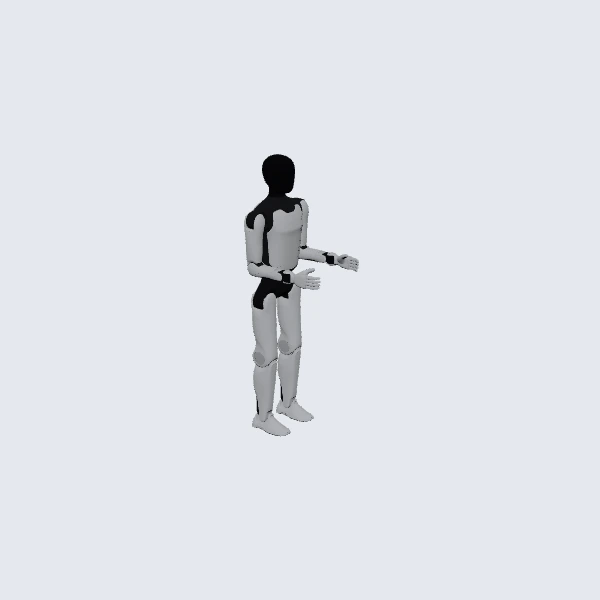
What is the AgiBot Expedition A3?
A 1.73 m, 55 kg full-size humanoid by AgiBot (Shanghai) with 31 joint motors (6 per leg, 7 per arm, 3 in the waist, 2 in the neck), a magnesium-alloy body, two Rockchip computers, a stereo camera and a display in its black head, touch sensors in the shoulders, and two hot-swap battery packs (1,152 Wh) for up to 10 hours.
Specifications
Facts about the AgiBot Expedition A3 from its project's published documentation, design files and its makers' own figures. A figure marked Estimate is worked out from those files or parts lists rather than stated by the maker.
| Spec | Detail |
|---|---|
| Size | 1,730 mm tall, 520 mm wide and 300 mm deep (AgiBot: 173 × 52 × 30 cm). |
| Weight | About 55 kg (AgiBot). The link masses in AgiBot's 3D model add up to 56.8 kg. |
| Joints | 31 joint motors: 6 per leg (hip pitch, roll and yaw, knee, ankle pitch and roll), 7 per arm (shoulder pitch, roll and yaw, elbow, wrist roll, pitch and yaw), 3 in the waist (yaw, roll, pitch) and 2 in the neck. The standard 6-DoF hands add 12 (43 in all); the hands in this 3D model are fixed. |
| Joint motors | AgiBot's own joints of a 'new-generation architecture' (IT之家), dust-protected to IP5X (AgiBot). AgiBot's 3D model sets five torque classes: 320 N·m (knees), 220 N·m (hips and waist yaw), 60 N·m (shoulder pitch and roll), 24 N·m (shoulder yaw, elbow, wrist roll) and 6 N·m (wrist pitch and yaw, neck); the ankles get 118.2 N·m (pitch) and 54.75 N·m (roll), the waist 118 N·m (pitch) and 46 N·m (roll). The whole robot draws up to 150 A and 12 kW at peak. |
| Ankles and waist | Estimate: the ankles (pitch and roll) and the waist (pitch and roll) are each moved by two motors working together through push rods. Their pitch limits in AgiBot's model (118.2 and 118 N·m) are about twice 59 N·m, as two equal motors would give; both pivot on universal-joint crosses in the 3D model, and the waist link carries two push-rod ends with ball joints. (Estimate: The crosses, rods and limits are in AgiBot's files; AgiBot does not describe the mechanism, and the motors are not modelled.) |
| Range of motion | Waist roll ±20°, yaw ±150°, pitch ±30°; hip roll −60° to 100°, yaw ±158°, pitch −168° to 154°; knee −10° to 140°; ankle pitch −52° to 30°, roll ±20°; shoulder pitch ±170°, roll ±91°, yaw ±160°; elbow −60° to 140°; wrist roll ±33°, pitch ±93°, yaw ±160°; head nod −15° to 30°, turn ±90° (AgiBot). Some limits in AgiBot's 3D model differ: for example the head turns ±60° and the wrist rolls ±160° there. |
| Main computers | Two Rockchip boards. The MDU (main data unit: RK3588, 8 cores up to 2.3 GHz, 16 GB memory, 256 GB storage) is the 'cerebellum': it runs motion control and talks to an MCU over EtherCAT, passing hardware status and control commands. The HDU (human-machine data unit: RK3588S2, 16 GB, 128 GB) is the 'brain' for speech, sound and the camera. Both run Ubuntu 24.04. |
| Battery | Two battery packs in the back, 1,152 Wh together, with full-tab cells. AgiBot gives up to 10 hours as its 'maximum endurance' (launch coverage in Feb 2026 said 8 hours). Estimate: 10 hours means only about 115 W on average, low for a 55 kg humanoid, so it likely means light use such as standing, not walking all day. A pack swaps in about 10 seconds while the other keeps the robot running, so it can work around the clock; charging from 110–220 V takes 2 hours or less. The cell maker and chemistry are not published. |
| Sensors | One interactive binocular (stereo) camera on the head, 1920 × 1536 at 30 frames per second; touch sensors in both shoulders; a microphone array for 360° sound pickup (8 channels in the RBTX datasheet); two IMUs, in the pelvis and the torso (AgiBot's 3D model). AgiBot's English table says 'Dual binocular cameras', a translation of 双目 ('two-eyed'). |
| Display, sound and lights | A curved display in the head shows content through the black face; two speakers, left and right (2 × 5 W); a chest 'breathing' light, ear lights and a light strip. |
| Radio and positioning | Wi-Fi, Bluetooth and two 5G modules with dual SIM; UWB positioning to within ±10 cm, for formations of more than 100 robots; GPS in the RBTX datasheet. |
| Frame | A magnesium-alloy body, with titanium alloy at the points of highest stress and flexible TPU (AgiBot); magnesium replaces the usual aluminium (IT之家). The legs are an exoskeleton design, where the shell carries the load (界面新闻). |
| Hands | AgiBot lists 6-DoF dexterous hands as standard (options: 4 or 13 DoF). The German retailer says grippers are not included, and the RBTX datasheet says the A3 comes with demo hands. AgiBot's base 3D model has fixed hands. |
| Price | ~$73,960 before VAT: €66,000 before VAT, €78,540 with 19% VAT, at the German retailer Saturn, sold and shipped by Bipedal GmbH, read 11 Oct 2026 (converted at the ECB rate of 9 Oct 2026); grippers not included. AgiBot's own store sells it by enquiry ('Contact sales'). |
| Parts cost | Estimate: about ¥57,000 (US$8,500) for the parts, the authors' own estimate: no teardown or cost breakdown of the A3 exists. The 31 joints are about 67% of it. That is about 12% of the German reseller's price before VAT; the Unitree G1's teardown cost is about 55% of its Chinese price before VAT. (Estimate: Scaled from another robot's teardown costs by weight; the weights come from AgiBot's older joints, so AgiBot's real costs may be higher. The German price also carries the reseller's and importer's markups, so AgiBot's own selling price is lower than it and the cost's share of that price higher than 12%.) |
| Made in | Estimate: Shanghai. AgiBot's 10,000th robot, an Expedition A3, came off its line on 28 Mar 2026, and AgiBot's factory in Shanghai's Lingang area has built humanoids since Oct 2024. AgiBot runs a dedicated, automated line for its joint modules. Which plant assembles the A3 is not stated. (Estimate: AgiBot names the city and its factories but not the A3's plant.) |
| Pose shown | All joint angles at zero (the zero pose): standing straight with the forearms pointing forward. The Anatomy viewer stands it with relaxed arms when assembled. |
3D model
The interactive 3D model on this page is converted from the project's published design: AgiBot Expedition A3 by AgiBot (AGIBOT Innovation (Shanghai) Technology Co., Ltd.) (github.com/AgibotTech/A3-A3U-robot-model, a3_t3d0). 3D model under the Mulan Permissive Software License v2: commercial use allowed; copies must come with the licence text. No trademark licence; AgiBot does not endorse this model.
Sources
- Project repository: github.com/AgibotTech/A3-A3U-robot-model