
A new framework called GAVIS (Gaussian Splatting Anisotropic Visibility Field) enables real-time uncertainty quantification for 3D Gaussian Splatting at 200 frames per second, while also guiding robots to the most informative next viewpoints. This approach tackles one of the biggest gaps in modern neural rendering: knowing when a model's predictions are unreliable.
What the Researchers Built
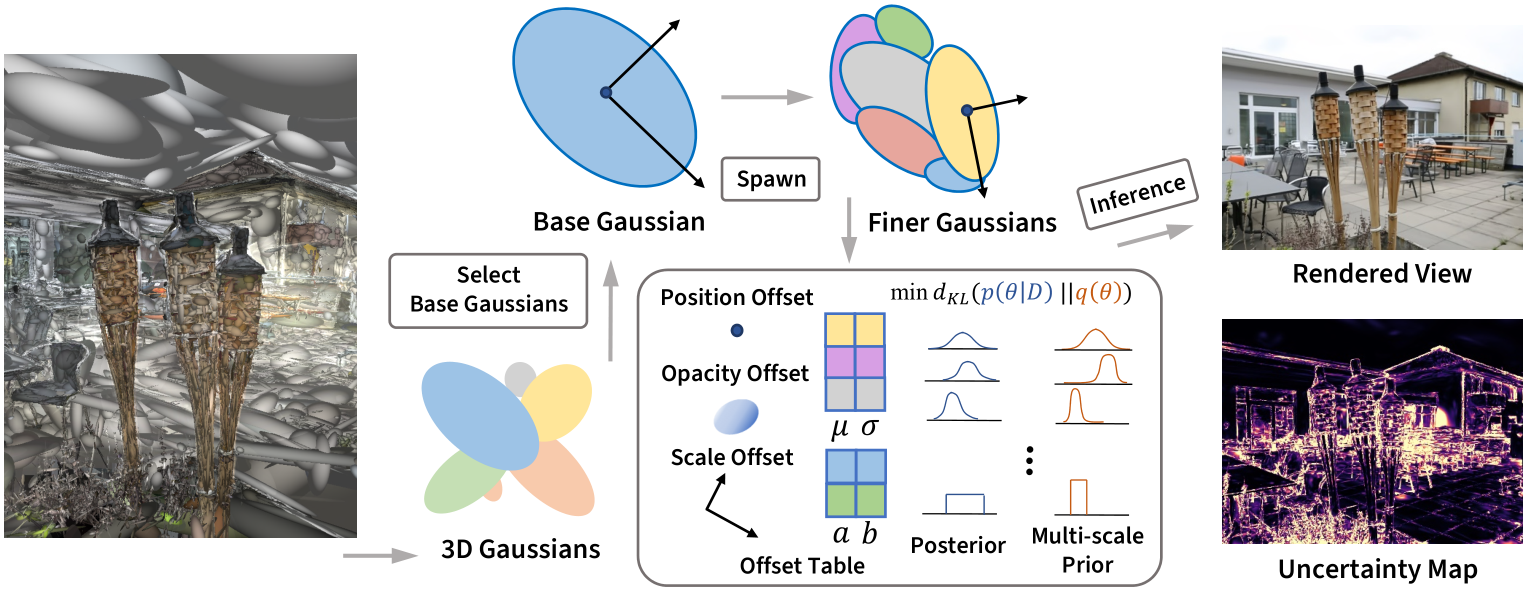
GAVIS is a novel framework that adds a learned visibility field to each 3D Gaussian particle — the basic building block of 3D Gaussian Splatting (3DGS). This visibility field, represented using spherical harmonics, captures how visible each particle is from different directions based on the training views. When synthesizing a new camera view, GAVIS combines this anisotropic visibility with a Bayesian Network-based rasterizer to produce both a rendered image and a pixel-level uncertainty map — all in real time at 200 FPS.
The uncertainty is then used for active mapping: the system selects the next viewpoint that maximizes information gain, effectively deciding where to look next to reduce overall scene uncertainty most efficiently. Crucially, GAVIS can be applied post-hoc to any existing 3DGS model without retraining from scratch, making it a plug-and-play upgrade for current 3DGS pipelines.
Key Results
GAVIS was evaluated across diverse indoor and outdoor environments, including both synthetic and real-world scenes. The framework consistently outperformed prior uncertainty-aware 3DGS methods (such as FisherRF and uncertainty-aware variants) in both reconstruction accuracy and uncertainty prediction quality.
Key performance highlights:
- Real-time inference: Uncertainty quantification runs at 200+ FPS for synthesized views — orders of magnitude faster than prior sampling-based or ensemble-based methods.
- Active mapping improvement: When guiding a simulated robot through an environment, GAVIS-selected viewpoints reduced reconstruction error significantly faster than random or frontier-based exploration strategies.
- Post-hoc compatibility: Adding GAVIS to a pre-trained standard 3DGS model improved downstream task performance (e.g., novel view synthesis) without any additional training data.
- Anisotropic modeling: Compared to isotropic visibility approximations, the spherical-harmonics-based anisotropic visibility captured directional occlusion patterns more accurately, leading to sharper uncertainty boundaries around object edges.
How It Works
GAVIS extends 3D Gaussian Splatting by attaching a visibility field to each Gaussian particle, encoded as a small set of spherical harmonic coefficients. During training from posed images, these coefficients learn the angular visibility of that particle: how many training views have observed it from each direction. Particles seen from many directions get low uncertainty for those angles; unseen regions receive high predicted uncertainty.
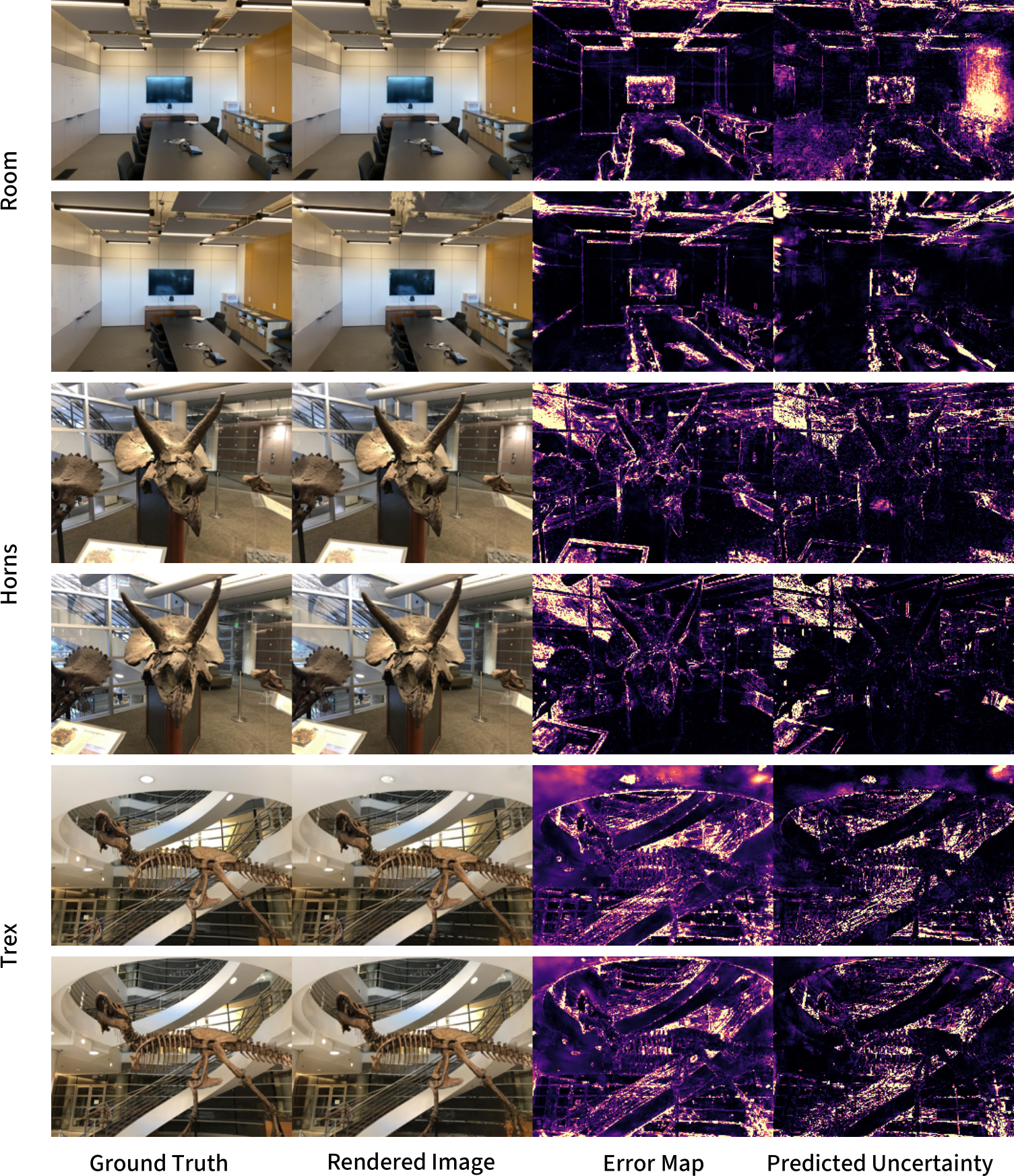
During rendering, GAVIS uses a Bayesian Network that treats each Gaussian's properties (color, opacity, position) as distributions rather than point estimates. The anisotropic visibility field acts as a prior: if a particle is poorly observed from the current viewpoint, its contribution to the pixel is weighted by high uncertainty. The rasterizer then combines these per-particle uncertainties using standard alpha-compositing to produce per-pixel uncertainty maps.
For active mapping, the system evaluates candidate next viewpoints by computing the total predicted uncertainty reduction (information gain) across all pixels in the synthesized view. The viewpoint with the highest gain is selected. Because uncertainty computation is fast (200 FPS), this evaluation can be done online during exploration without significant delay.
Why This Matters for Robotics
For autonomous robots navigating unknown environments — whether warehouse robots, field robots, or humanoid robots — the ability to know what you don't know is critical. A robot using standard 3DGS might confidently render a wall that doesn't exist in unseen areas. GAVIS flags those predictions as uncertain, enabling safer path planning and more efficient exploration.
In industrial use cases like quality inspection with used cobots for sale or mapping with warehouse robots, active mapping directly reduces the time needed to build accurate 3D models. Instead of manually driving every corner, the robot automatically heads to regions of highest information gain. This translates to faster setup, less waste, and lower operational costs.
The post-hoc compatibility is especially practical: companies already using 3DGS pipelines (e.g., for digital twins) can add GAVIS as a bolt-on uncertainty layer without rebuilding their entire system.
Limitations and Open Questions
GAVIS assumes that training views are well-distributed; extreme sparse views with large occlusion gaps may still produce unreliable uncertainty estimates. The visibility field learning also requires sufficient directional diversity in the training data — it degrades with purely forward-facing camera paths.
Active mapping performance depends on the quality of the Bayesian Network approximation; future work could explore more expressive uncertainty models. Additionally, GAVIS currently focuses on RGB scenes; extending to multi-modal sensors (depth, thermal) remains open. The computational overhead of spherical harmonic coefficients is small but not zero — for extremely large scenes with millions of particles, memory may become a bottleneck.
Frequently Asked Questions
What problem does GAVIS solve? It gives 3D Gaussian Splatting models the ability to quantify their own uncertainty for each rendered pixel, enabling robots to identify unreliable predictions and plan informative future viewpoints.
Can I use GAVIS with an existing 3DGS model? Yes — GAVIS can be applied post-hoc to any pre-trained 3DGS model without retraining from scratch, making it a practical upgrade.
How fast is the uncertainty computation? GAVIS produces uncertainty maps at over 200 frames per second — fast enough for real-time robotic planning loops.
What hardware is needed to run GAVIS? The method runs on a standard GPU (e.g., NVIDIA RTX 3080 or better) due to efficient spherical harmonic and Bayesian Network computations.
Conclusion
GAVIS brings principled, real-time uncertainty quantification to 3D Gaussian Splatting by modeling anisotropic visibility for each particle. Its combination of speed, accuracy, and post-hoc compatibility makes it a strong candidate for powering autonomous exploration and safe navigation in robotics. The framework closes a critical gap between high-quality rendering and actionable confidence estimates.