
Researchers have quantified exactly how the mass of a carried object changes a humanoid robot's ability to stay balanced — and found a sweet spot. The work introduces two measurable thresholds, "critical mass" and "transition mass," and uses them to design lifting controllers that stay stable through lift-and-hold and lift-and-release tasks in both simulation and hardware experiments.
What the Researchers Built
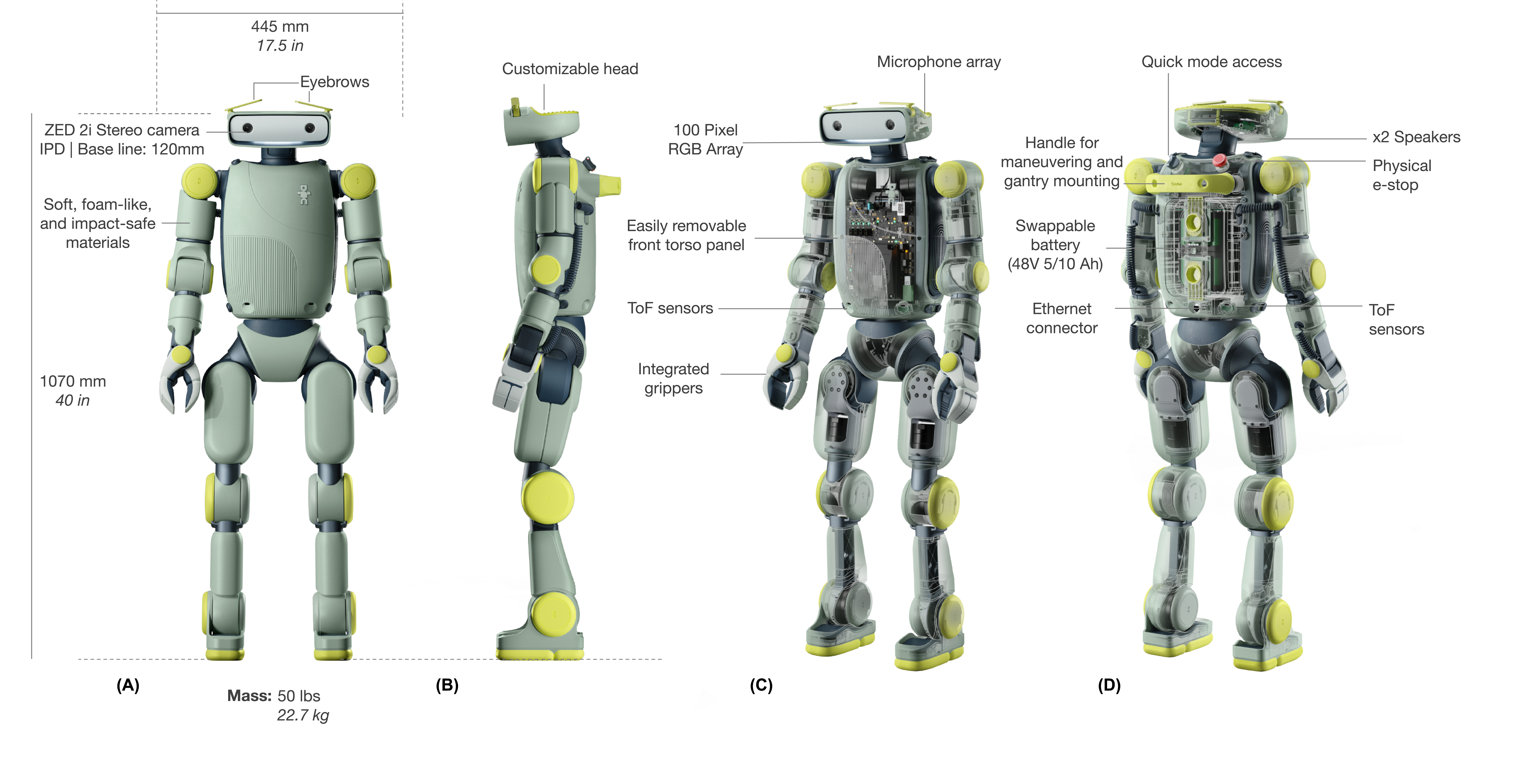
The team built an analytical framework that predicts when a humanoid robot can keep its balance while holding an object of a given mass. Rather than relying on heuristic rules or black-box learning, the framework is grounded in whole-body dynamics — modeling the robot, the held object, and the distributed contact forces between the robot's feet and the ground as one connected system.
The centerpiece is the balanced state basin (BSB), a mathematical region of the center-of-mass state space that defines which combinations of position and velocity allow the robot to hold its stance contacts. Any state inside the basin is provably balanceable; any state outside is not. The team shows how the basin expands or contracts depending on the object's mass, the base of support, actuator torque limits, and body pose.
From this analysis, two practical quantities emerge: the critical mass, where balancing capability peaks, and the transition mass, where the limiting factor on balance switches. These thresholds are then encoded as explicit constraints in a whole-body trajectory optimizer, producing lifting motions that stay inside the balance envelope by construction. The approach was validated with both a full humanoid and a simplified reduced-order mechanism, in simulation and in physical experiments.

Key Results
The central finding is that object mass and balance capability do not have a simple linear relationship. Adding mass to a humanoid can initially improve balancing, then peak, and finally degrade as the load grows — a result that contradicts the common assumption that heavier always means harder.
Two thresholds define this behavior:
- Critical mass: the object load at which the robot's balancing capability is greatest.
- Transition mass: the load at which the limiting factor for balance switches, for example from center-of-pressure constraints at the feet to actuator torque limits.
The study validated BSB predictions across different bases of support, actuation capacities, and poses, systematically mapping how each condition shifts the balance boundaries. Controllers built from these thresholds successfully executed lift-and-hold and lift-and-release tasks with objects of distinct masses, demonstrated in both simulation and hardware experiments. The analytical predictions from the reduced-order mechanism matched full humanoid behavior closely enough to serve as a design tool, not just a visualization.
The practical takeaway is direct: there is an optimal object mass for a given humanoid configuration, and knowing it lets controllers exploit momentum regulation instead of fighting it.
How It Works
The framework starts with a whole-body dynamic model in which the object's mass parameters appear explicitly. The robot and object form a single articulated system, and ground contact is represented as distributed contact wrenches with associated centers of pressure at each stance foot. This formulation captures how object mass couples into the system's linear and angular momenta — the quantities that ultimately decide whether the robot tips over or holds its ground.
From these dynamics, the team constructs the balanced state basin, a partition of the center-of-mass state space into balanceable and non-balanceable regions. A state is considered balanced if there exists a feasible control input, within actuator torque limits, that keeps the center of pressure inside the base of support over the planning horizon. Because object mass enters the dynamics nonlinearly, the basin's boundaries shift in ways that static center-of-mass calculations miss.
The critical mass and transition mass emerge from tracking how the BSB boundary deforms as object mass increases. The critical mass marks the configuration where the balanceable region is largest. The transition mass marks the point where the binding constraint changes — typically from a contact/center-of-pressure constraint to an actuation constraint. Together, the two quantities characterize the trade-off between using object momentum to aid stability and the rising effort required to regulate that momentum.
Finally, balanced states are imposed on trajectories as explicit threshold constraints inside whole-body trajectory optimization. Instead of soft penalties or learned heuristics, the BSB acts as a hard feasibility filter: the optimizer may only produce motions whose states remain inside the balanceable region. This guarantees, by construction, that the lifting trajectory respects the balance envelope at every instant.

Why This Matters for Robotics
For operations teams deploying humanoids, this research answers a fundamental question: how heavy can the object be, and is lighter always better? The surprising result — that a mid-range mass can be easier to balance than a very light one — has direct consequences for payload specifications, tool selection, and task planning.
The framework also reduces reliance on black-box stability heuristics. Engineers can compute the balanced state basin offline, extract the critical mass and transition mass as design parameters, and build controllers with provable balance guarantees. The same basin concept applies beyond humanoids to any legged or mobile manipulator that must regulate momentum while carrying a load.
For buyers comparing platforms, this is a useful lens: rather than a single maximum payload number, look for balance-aware control and published stability margins. Browse humanoid robots on Robot Overflow to see what platforms in this class offer. The lifting controller maps directly onto material handling, pick-and-place, and palletizing workflows — the two primitives tested, lift-and-hold and lift-and-release, are exactly the motions warehouse robots perform thousands of times per shift, and used industrial robots retrofitted with such control could see similar gains.
Limitations and Open Questions
The analysis models the object as a rigid mass rigidly attached to the robot, so deformable, swinging, or fluid loads fall outside the current framework. The study also assumes a fixed, known contact configuration; it does not cover dynamic stepping, regrasping, or walking while carrying a load, where the base of support changes mid-task.
Open questions remain about how the thresholds shift under uncertain object mass estimates or online replanning constraints. The reduced-order mechanism used for analytical validation helps, but mapping its findings back to full-body dynamics in real time is still an active challenge. Multi-contact scenarios such as climbing or crouching with payloads remain untested territory.
Frequently Asked Questions
What is the balanced state basin?
The balanced state basin is a region in the robot's center-of-mass state space where the robot can maintain its desired foot contacts while balancing. Any state inside the basin is provably balanceable, and its shape depends on object mass, base of support, actuator limits, and pose.
What is the critical mass in humanoid balancing?
The critical mass is the object mass at which the robot's balancing capability is greatest. Adding mass beyond this point starts to shrink the balanceable region.
What is the transition mass?
The transition mass is the threshold at which the limiting factor for balance switches — for instance, from center-of-pressure constraints to actuator torque limits. It tells engineers which physical constraint to address first when pushing payload limits.
Does a heavier object always make a humanoid robot less stable?
No — the research shows balance capability improves with object mass up to the critical mass. This counterintuitive result means a mid-range payload can be easier to balance than a very light one.
Conclusion
This research transforms a long-standing assumption about humanoid payloads — that heavier always means harder to balance — into a quantifiable relationship with clear design thresholds. For engineers selecting robots or planning lifting tasks, the critical mass and transition mass offer concrete parameters for stability-aware operation. Expect balance capability curves to become as important as payload ratings in humanoid specifications.