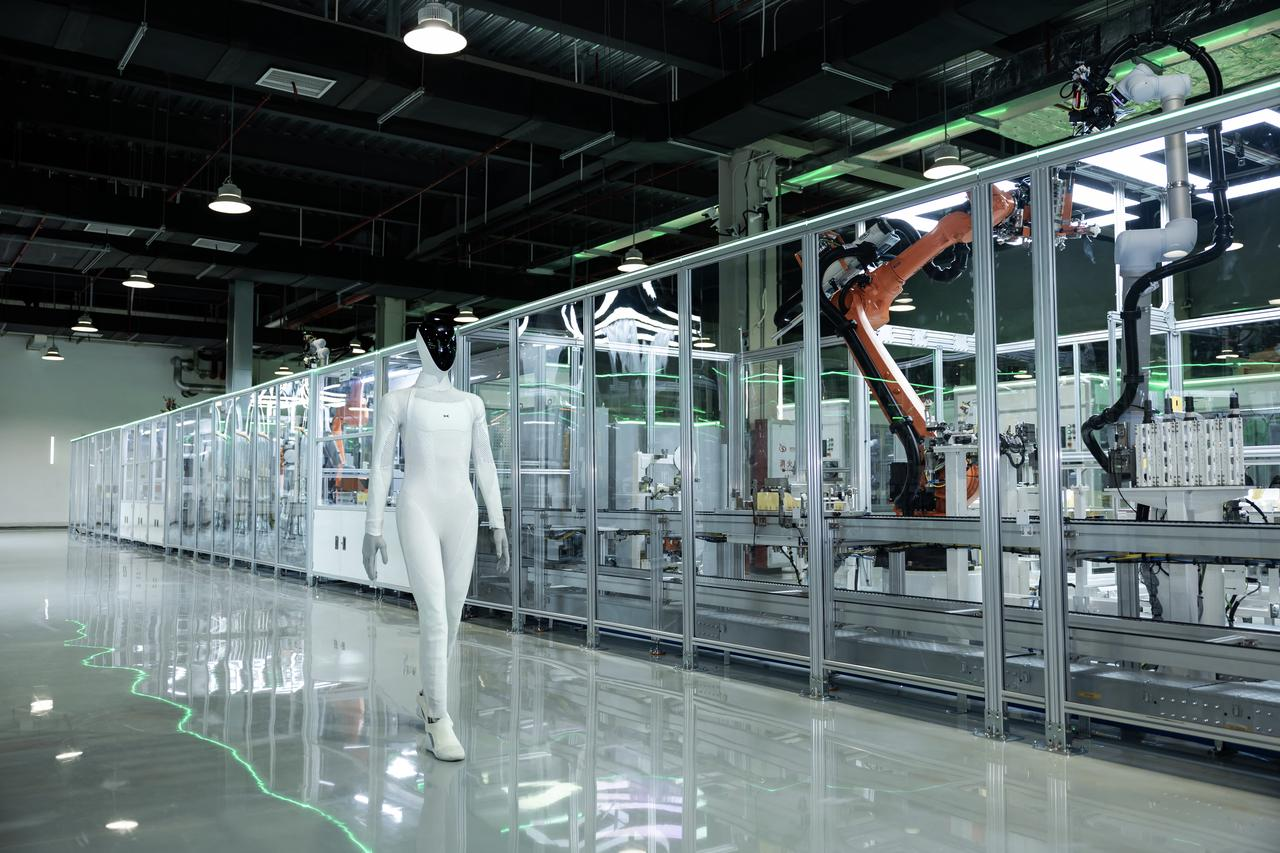

XPENG says its Iron humanoid robot walked autonomously off a newly operational production line after assembly, first reported by Engadget. That factory milestone does not establish whether Iron can make it through a working day, and XPENG has not disclosed the line’s current output or how much testing had been done before the walk itself.
XPENG said over 80 percent of the line’s core processes are automated. It is adapting quality systems from its car business to make robots consistently as production increases, while chairman and CEO He Xiaopeng gave Iron a staff badge.
The autonomous exit demonstrates movement after assembly, while customer-facing performance remains to be established. XPENG plans to deploy robots in its stores and campuses first, with reception, guided tours and sales assistance among the planned roles.
Iron has 76 degrees of freedom across its body and 21 in each hand, referring to the independent ways it can move. XPENG says three Turing AI chips provide up to 2,250 trillion operations per second, letting Iron run its AI model onboard and perform complex tasks without a remote operator.
XPENG also says Iron’s outer structure was designed to be flexible with safety in mind. No independent safety evaluation is provided for that design, and the jobs remain planned while everyday performance is still to be established.
In April, Figure reported that it had produced over 350 Figure 03 robots and demonstrated a production cycle of one robot per hour. Those robots were allocated to uses including internal development and data collection, so the total should not be read as customer deliveries. BMW said an earlier Figure 02 inserted sheet-metal parts for welding at its Spartanburg plant and supported production of more than 30,000 BMW X3s over ten months.
Mass production is still a year-end goal, with deliveries in China and overseas markets planned for 2027. The announcement did not specify U.S. availability or a price.