
Workhorse trains a humanoid to manipulate objects using human demonstrations

Workhorse trains a humanoid to manipulate objects using human demonstrations

2 min read•Oct 8, 2026•
Alex Thornton
Alex Thornton

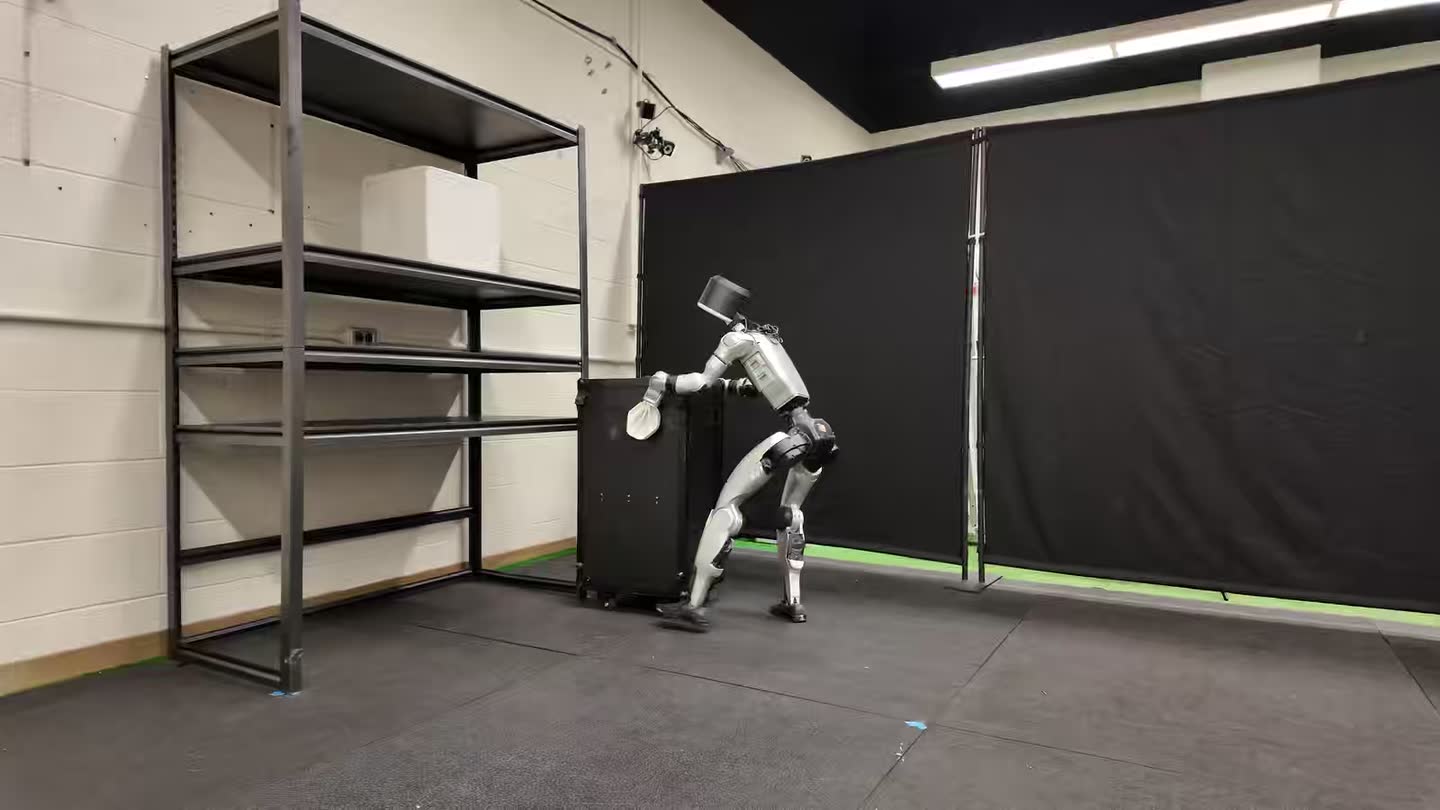
Workhorse learns whole-body humanoid manipulation from human demonstrations and performs tasks on a real Unitree G1, first reported by Arxiv. The system connects human pose demonstrations to visual planning and whole-body robot control; physical box-sorting demonstrations include recovery after a person pushes the robot or takes away the box, and simulation tests measure task completion.

Humanoid robots still struggle to plan contact-rich whole-body manipulation from egocentric RGB and proprioception. Workhorse divides the task between a visual planner and a reinforcement-learning whole-body tracker. The planner predicts five target poses: the torso, both wrists and both feet; the tracker follows them on the robot.

Both policies train separately on the same recorded human poses without retargeting. Each policy's training data is augmented to imitate errors made by the other at deployment, keeping the demonstrations robot-free while bringing cross-policy errors into training.

On a real Unitree G1, Workhorse sorts boxes using its hands and a kick, catches a thrown box, and topples and climbs a suitcase. The box-sorting demonstrations also show recoveries after a person pushes the robot or takes the box away.

In a simulated copy of the demonstration room, box sorting succeeds in 77% of episodes and in 64% under 40 N.s pushes. With both policies retrained from the same demonstrations, a simulated second humanoid completes box sorting in 83% of episodes without pushes.

Plug-in vehicles reach 32% of global registrations in September

Plug-in vehicles reached 32% of global registrations in September, first reported by Cleantechnica. Battery-electric vehicles accounted for 23% of registrations and set a record at 1.54 million, up 8% year over year, while plug-in hybrids fell 9%; year to date in 2026, BEVs were up 12% and PHEVs down 10%.

Global plug-in registrations rose 3% year over year to around 2.16 million in September, close to the all-time record of 2.17 million set last December.

Year to date, plug-in registrations were up 4% year over year: BEVs grew 12%, while PHEVs fell 10%. Their combined share for 2026 stood at 25%, with BEVs at 18% and PHEVs at 7%. The overall growth rate therefore hides a clear split between the two categories.

The Tesla Model Y led the model rankings with a record 165,000 registrations, up 17% year over year. Tesla Model 3 came second with 65,000, enough to move ahead of Geely Xingyuan and BYD Song despite a 4% annual decline.

BYD Song finished fourth at 54,519 registrations, up 19% and the fastest growth rate among the top five. An export push and the new-generation Ultra body helped lift the model.

At the make level, Tesla had a record 232,000 registrations, up 9% year over year. Toyota reached 61,332 for its fourth record in a row, finishing ahead of Volkswagen’s year-best 58,000 to become September’s best-selling legacy make.