

A new robotics startup backed by Toyota, NVIDIA, and Boeing has already placed humanoid robots into production at a Toyota manufacturing plant — just two months after emerging from stealth. Walden Robotics says its general-purpose robots are performing real tasks alongside human workers, signaling a rapid acceleration in humanoid robot commercial viability.
- Who Is Walden Robotics and How Did It Raise $300M?
- How Fast Did Walden Go From Pilot to Production?
- What Makes Walden's Robots Different From Other Humanoids?
- What Does Walden's Launch Mean for the Humanoid Robot Race?
- Frequently Asked Questions
Who Is Walden Robotics and How Did It Raise $300M?
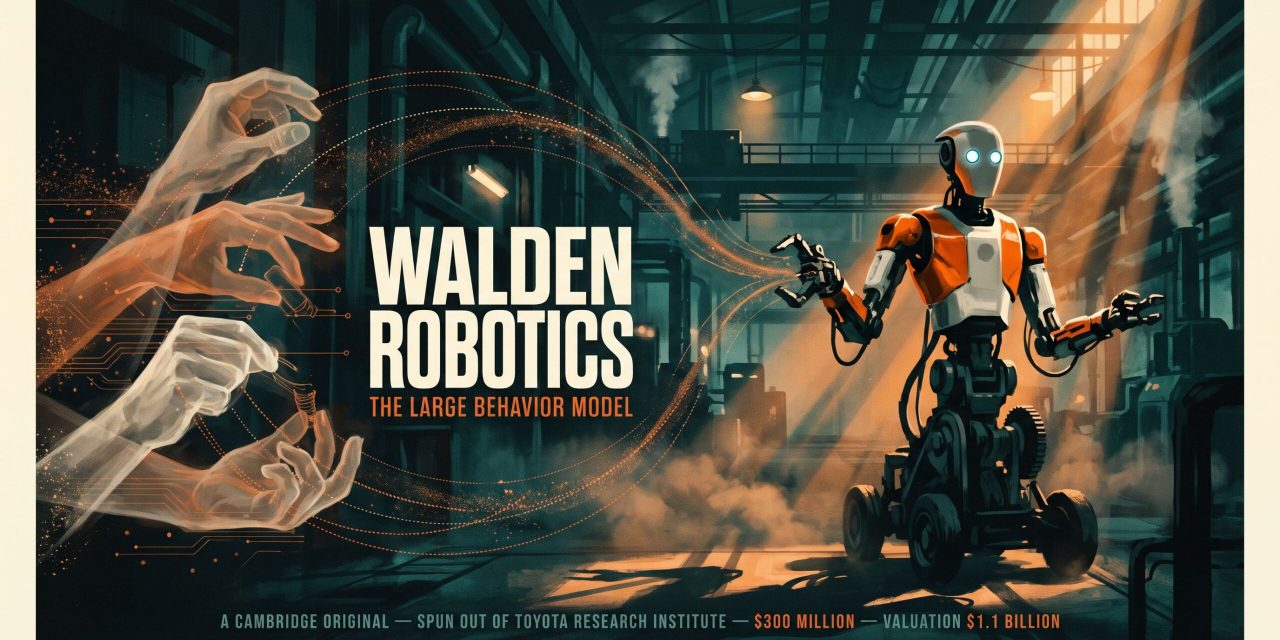
Walden Robotics is a Massachusetts-based startup that emerged from stealth in January 2026 after spinning out of the Toyota Research Institute (TRI). The company raised $300 million in venture funding from an all-star investor list including Toyota Motor Corp, Toyota Invention Partners, Toyota Ventures, NVIDIA, Boeing, AE Ventures, Samsung Ventures, Prologis Ventures, CoreWeave Ventures, and multiple financial partners.
The company is led by Dr. Russ Tedrake, a co-founder and CEO who is also a professor at MIT and formerly served as Senior Vice President of Large Behavior Models at TRI. Tedrake’s background in both academic robotics and industry deployment gives Walden a rare combination of research depth and manufacturing-floor pragmatism.

The round’s anchor investors — Toyota and Deviation Capital — signal confidence that Walden's approach to Physical AI (AI systems that control physical machines like robots) is ready for real-world production, not just lab demos.
How Fast Did Walden Go From Pilot to Production?
Walden Robotics launched from stealth in January 2026 and immediately began working with customers across multiple industries. By February 2026 — less than two months later — its general-purpose humanoid robots were performing useful work in production at a Toyota plant in North America.
This timeline is unusually fast for humanoid robot deployments. Most humanoid startups spend 1–2 years running pilots before customers agree to real production tasks. Walden's ability to move from first pilot to production in under 60 days suggests its robots were already solving a genuine labor bottleneck at Toyota.
The company uses a training method called Large Behavior Models (LBMs) — AI systems that learn a wide range of physical tasks by watching human demonstrations rather than being explicitly programmed for each motion. This allows the robots to continuously improve on the job.
"The best way to make fast and positive progress is by working closely together with the real experts," said Tedrake, referring to the Toyota plant workers who guide the robots' learning.
What Makes Walden's Robots Different From Other Humanoids?
Walden's humanoid robots are designed as general-purpose platforms — not single-task machines. Most industrial robots today are bolted down and programmed for one repetitive action. Walden's robots can walk, manipulate objects, and adapt to new tasks without full reprogramming.
| Feature | Walden Robotics | Typical Industrial Robot Arm | Typical Humanoid (Figure, Tesla, etc.) |
|---|---|---|---|
| Mobility | Bipedal walking | Fixed base | Bipedal walking |
| Learning method | Large Behavior Models (LBMs) | Pre-programmed paths | Varies (RL, VLM, etc.) |
| Time to production | < 2 months | 6–12 months | 6–18 months |
| Key backers | Toyota, NVIDIA, Boeing | N/A | Figure: Amazon, OpenAI; Tesla: internal |
Walden's key differentiator is its LBM architecture, which enables robots to learn from human demonstration in a factory environment and improve over time. This is similar in spirit to Figure's VLA (Vision-Language-Action) models, but Walden claims its approach prioritizes continuous learning in production without needing a cloud connection.
The company also emphasizes a respect for existing manufacturing workflows — its robots are designed to complement human workers, not replace them. Skilled team members delegate "difficult-to-automate" tasks to the robot, freeing themselves for higher-value problem-solving.
What Does Walden's Launch Mean for the Humanoid Robot Race?
Walden's emergence with $300M and a live production deployment at Toyota changes the competitive landscape. The humanoid robot market currently features well-funded players like Figure (backed by Amazon, OpenAI, and Jeff Bezos), Tesla's Optimus, and Chinese firms like Unitree and Fourier. Walden adds another credible contender with deep ties to two of the world's most advanced manufacturing companies: Toyota and Boeing.
The speed from pilot to production is particularly significant. It suggests that humanoid robots are closer to delivering real return on investment in factory settings than many skeptics believed. If Walden can scale its deployment across more Toyota plants, it could set a new benchmark for time-to-value in industrial robotics.
For potential buyers — automakers, logistics operators, and manufacturers — the arrival of Walden means more competition among suppliers, which typically drives down prices and accelerates improvements. Walden has not disclosed pricing, but the market for humanoid robots is expected to grow from $1.6 billion in 2026 to $66 billion by 2032 according to industry estimates.
What This Means for Buyers
If you're evaluating humanoid robots for your facility, Walden's launch adds an important option — but it's still early. Key considerations:
- Toyota's endorsement carries weight: if the world's most efficient automaker found Walden useful, the technology is likely past the proof-of-concept stage.
- Speed matters: Walden's two-month deployment timeline is the fastest we've seen. Ask other suppliers how long their pilots typically last.
- Backing from Boeing hints at aerospace and heavy-industry applications, which could mean higher payload capacity or safety certifications in future versions.
- Pricing unknown: Walden hasn't listed prices yet. For comparison, existing humanoid platforms range from $60,000–$200,000+. Check the latest humanoid robots for sale on Robot Overflow to benchmark.
Buyers should request demonstration data from Walden's Toyota deployment before committing. The company's proximity to MIT and TRI also suggests access to cutting-edge research, which could benefit early adopters.
Conclusion
Walden Robotics has entered the humanoid robot market with a powerful combination: major financial backing, deep industrial partnerships, and the fastest known deployment from pilot to production at a Toyota plant. Its Large Behavior Model approach and MIT/TRI lineage give it a credible shot at becoming a top-tier supplier. For the industry, the message is clear — humanoid robots are no longer a futuristic concept; they are working on real factory floors right now.