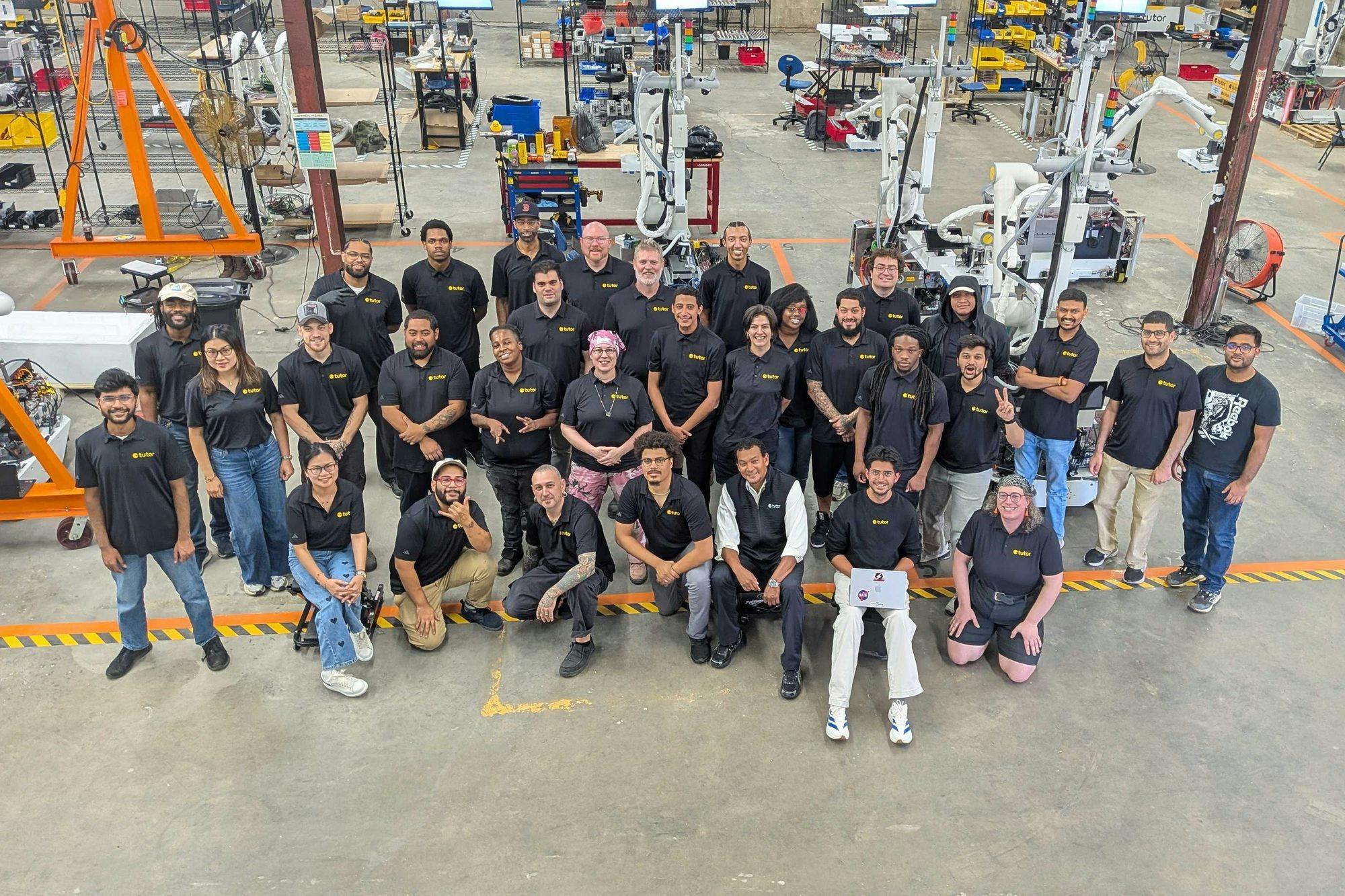

Tutor Intelligence has raised $75 million in a Series B round to expand robot training and deployment, first reported by Therobotreport. Tutor says the money will support frontier robot foundation-model training and the manufacture and deployment of Sonny and Cassie; Andreessen Horowitz led the round, which brings total capital raised to $117 million.
Union Square Ventures and Neo also participated, after leading Tutor’s Series A and seed rounds, respectively. Tutor opened its Data Factory earlier this year to evaluate policies across 100 physical robots. The Data Factory includes Sonny, a two-armed, semi-humanoid robot, and Cassie, a mobile manipulator designed for case picking and palletizing.
Tutor deploys internet-connected fleets in production environments, where robots do customer work with input from remote operators called tutors. It uses real-world data from those deployments to train better frontier models. The same deployments supply both customer work and model-training data.
Businesses pay Tutor by the hour or by the pick, as they would for manual labor, rather than through a robots-as-a-service model. Tutor says customers make no upfront purchase and sign no long-term contract; it handles deployment and maintenance and regularly sends software and intelligence upgrades.
Tutor said twice as many of its robots were working in almost four times as many facilities as a year earlier. Nearly a third of organizations that received Tutor robots in the past 12 months were existing customers installing more, the company said.
Tutor says it is on track to have more than 1,000 robots under contract by the end of 2027, all built in and deployed from the U.S.; the tutors may be overseas.