
Last updated: April 2026
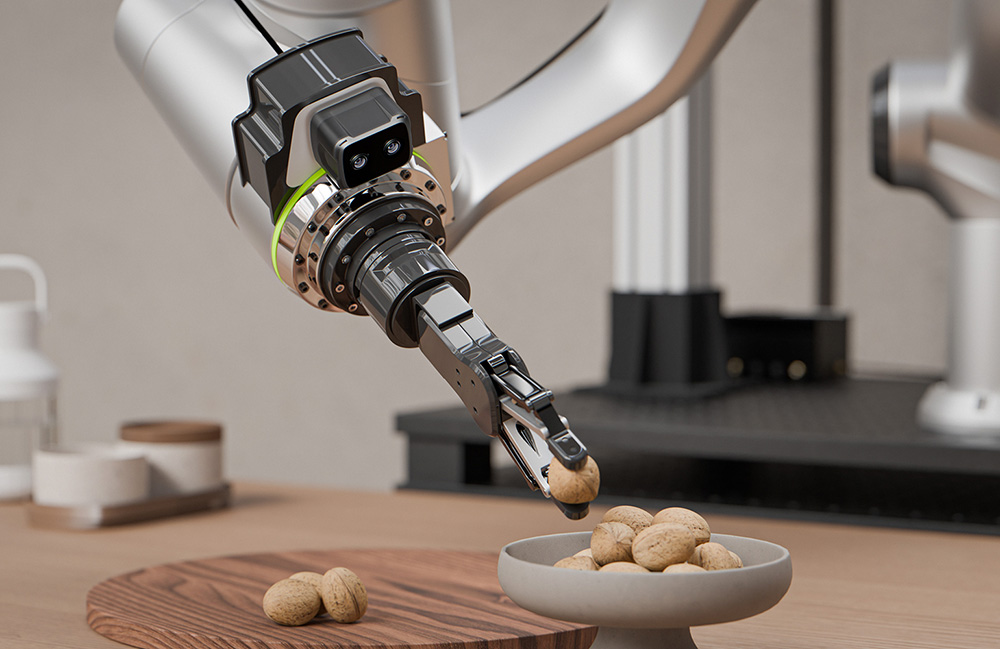
Ouster has launched the Stereolabs ZED X Nano, a compact wrist-mounted stereo camera targeting robotic manipulation, imitation learning, and high-throughput training data collection. The camera delivers 1920×1200 global shutter RGB and depth at up to 120fps over an industrial GMSL2 connection — a significant hardware step up from the USB-based 720p cameras that currently bottleneck most manipulation pipelines.
Table of Contents
- What is the ZED X Nano and what problem does it solve?
- ZED X Nano technical specifications
- How does ZED X Nano compare to Intel RealSense and Luxonis OAK?
- Why the zero-copy GPU pipeline matters for Physical AI
- What This Means for Robotics Teams
- Frequently Asked Questions
What is the ZED X Nano and what problem does it solve?
The ZED X Nano is a miniaturised stereo camera built specifically for end-of-arm placement on robotic manipulators — addressing a well-known pain point in manipulation research and deployment. Most wrist-mounted cameras today rely on USB-C connectivity, are limited to 720p resolution, and push frames through CPU-mediated pipelines that introduce latency precisely where manipulation tasks demand the tightest control loops.
Ouster's answer is a camera that is 40% shorter in height than comparable solutions, mounts directly onto wrists and end-of-arm tooling, and inherits the same 1920×1200 global shutter sensor architecture from the flagship ZED X line. The minimal depth-sensing range reaches 3 cm — closer than most competing stereo cameras — which matters directly for near-field grasping and fine assembly work.
According to The Robot Report, Ouster CEO Angus Pacala framed the release explicitly around Physical AI: "The future of Physical AI depends on massive amounts of high-quality, low-latency image data collected at the edge."
ZED X Nano technical specifications
| Specification | ZED X Nano |
|---|---|
| Image resolution | 1920×1200 per eye |
| Max frame rate | 120fps |
| Depth range (min) | 3 cm |
| Depth accuracy (Z-axis) | Sub-millimeter |
| Sensor type | Global shutter |
| Connectivity | GMSL2 (up to 15m cable run) |
| IMU | Onboard, vibration-proof |
| EMI resistance | Yes (locking connectors) |
| Simulation integration | NVIDIA Isaac Sim / Isaac Lab |
| ROS support | ROS and ROS 2 native |
| GPU pipeline | Zero-copy, direct to NVIDIA hardware encoder |
| Form factor | 40% shorter than comparable wrist cameras |
The GMSL2 connection (Gigabit Multimedia Serial Link 2, an automotive-grade serial interface commonly used in ADAS systems) replaces fragile USB-C with an industrial-grade link designed for repeated cable flex and EMI-heavy factory environments. Video runs cleanly up to 15 meters — relevant for manipulators with long cable management runs or ceiling-mounted compute nodes.
How does ZED X Nano compare to Intel RealSense and Luxonis OAK?
For robotics teams evaluating wrist-mounted depth cameras, the ZED X Nano sits in a meaningfully different hardware tier than the two most common alternatives. Here is how the platforms compare across the dimensions that matter most for manipulation pipelines.
| Feature | ZED X Nano | Intel RealSense D405 | Luxonis OAK-D |
|---|---|---|---|
| RGB resolution | 1920×1200 | 1280×720 | 4056×3040 (stills) / 1080p video |
| Max depth frame rate | 120fps | 90fps | 60fps |
| Min depth range | ~3 cm | ~7 cm | ~20 cm |
| Depth technology | Neural stereo (AI) | Active stereo IR | Passive stereo + optional IR |
| Connectivity | GMSL2 (industrial) | USB-C | USB-C |
| Cable run length | Up to 15m | ~5m practical | ~5m practical |
| Onboard AI inference | Via host (NVIDIA Isaac) | Limited onboard | Yes (Myriad X VPU onboard) |
| ROS 2 support | Native | Native | Native |
| Simulation integration | NVIDIA Isaac Sim/Lab | Limited | Limited |
| Target use case | Manipulation, imitation learning | Close-range industrial inspection | Edge AI, mobile robotics |
| Availability | Pre-order, ships May 2026 | Available now | Available now |
The Intel RealSense D405 is the closest direct competitor for close-range manipulation — it was specifically designed for robot arms — but its 7 cm minimum depth range and 720p RGB capture are real constraints when training high-fidelity imitation learning datasets. The Luxonis OAK-D offers onboard Myriad X inference, which is a genuine advantage for edge-compute-constrained deployments, but its 20 cm minimum depth range effectively rules it out for the near-field grasping tasks ZED X Nano targets.
The ZED X Nano's neural depth engine (Stereolabs' AI stereo depth system) produces sub-millimeter Z-axis accuracy and reportedly superior lateral XY positioning versus structured-light or time-of-flight approaches — which matters for grasp pose estimation where even 2-3mm lateral error can cause manipulation failure at scale.
Why the zero-copy GPU pipeline matters for Physical AI
This is the architectural detail most hardware comparisons skim over — and it may be the ZED X Nano's most consequential advantage for teams training manipulation policies at scale.
Traditional USB camera pipelines route frames through the CPU before they reach the GPU: sensor → USB controller → system RAM → CPU processing → GPU memory. Each hop adds latency and consumes CPU cycles. At 120fps and 1920×1200 resolution per eye, that pipeline becomes a genuine throughput bottleneck.
The ZED X Nano implements a fully zero-copy path from sensor to GPU, with frames flowing directly into NVIDIA hardware encoders and AI inference pipelines simultaneously. For data collection teams, this means capturing full-resolution demonstration datasets without frame drops under concurrent workloads. For deployment teams running live manipulation, it means perception networks, segmentation models, and manipulation policy networks can run in parallel on the same incoming frames with significantly more GPU headroom remaining.
The native integration with NVIDIA Isaac Sim and Isaac Lab extends this advantage into the sim-to-real loop. Teams can capture demonstrations on the physical camera, train in simulation using a matched ZED X Nano camera model, and deploy back to hardware — all without swapping perception stacks or recalibrating between environments. For reinforcement learning and imitation learning workflows, this continuity across the sim-to-real boundary is non-trivial.
What This Means for Robotics Teams
The ZED X Nano is not an incremental update to wrist-mounted vision — it is a hardware tier change. Teams currently bottlenecked by USB-based 720p cameras in their manipulation pipelines have a clear upgrade path. The GMSL2 connection and ruggedised cable design also address a real operational cost that doesn't appear in spec sheets: USB-C cables on robot arms fail regularly under repeated flex, and replacing vision hardware mid-deployment is expensive.
The 3 cm minimum depth range is practically significant. Most manipulation research involves objects at distances where competing stereo cameras either have no depth data or degraded accuracy. For assembly, kitting, and bin-picking tasks, this represents genuine new capability rather than incremental improvement.
The pre-order window opens now, with shipping beginning May 2026. Teams building imitation learning datasets or deploying dexterous manipulation systems in 2026 should evaluate this against their current hardware — particularly if they are already running NVIDIA Isaac infrastructure.
For teams building or expanding manipulation-capable systems, browse industrial robots and automation hardware on Robot Overflow to compare platforms that pair with wrist-mounted vision systems like the ZED X Nano.