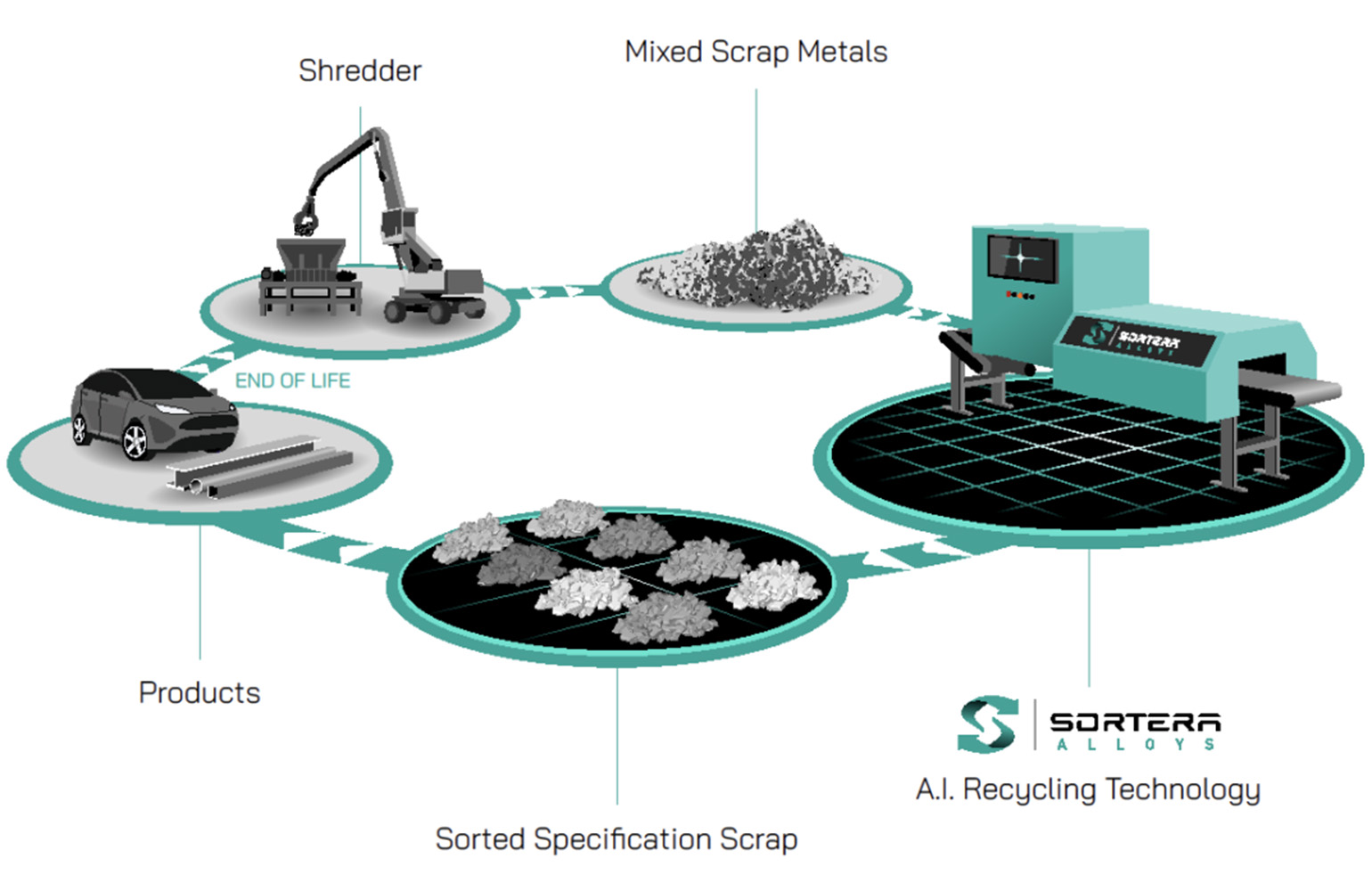

Sortera Technologies has brought its second AI-powered sorting facility online in Lebanon, Tennessee, doubling annual processing capacity to 240 million pounds of mixed-metal scrap. The facility proves that physical AI — combining computer vision, real-time sensor fusion, and robotic sorting — can deliver factory-floor throughput gains without the typical multi-month commissioning delays, with the plant producing sellable material within its first week of operation.
- What Is Sortera's Physical AI Sorting Technology?
- How Does Sortera's AI Sorting Compare to Other Robotic Recycling Systems?
- What Does the Doubled Capacity Mean for the Recycling Supply Chain?
- What Is the ROI of Physical AI in Recycling Operations?
- What This Means for Recycling Buyers and Operators
What Is Sortera's Physical AI Sorting Technology?
Sortera's platform uses proprietary artificial intelligence, data analytics, and advanced sensors to identify and separate mixed alloy scrap into high-purity material streams. Instead of traditional density or eddy-current separation, which often fails to distinguish similar alloys, Sortera's system analyzes each piece of scrap in milliseconds — determining alloy composition, shape, and contamination level — then directs it to the correct output bin via high-speed sorting lines.
The Lebanon facility is a direct replication of Sortera's flagship plant in Markle, Indiana, which already proved the model works at industrial scale. According to The Robot Report, the new plant reached full operational status on schedule and within budget, and produced sellable, high-purity material within its first week. That rapid commissioning is unusual for complex industrial facilities and signals that Sortera's AI platform has matured beyond prototype stage.

The output serves automotive, construction, and aerospace manufacturers — industries that demand tight alloy specifications. Sortera claims its upcycled metal uses 95% less energy than virgin aluminum production and delivers a massive reduction in CO₂ footprint, helping partners meet 2030 and 2040 sustainability goals.
How Does Sortera's AI Sorting Compare to Other Robotic Recycling Systems?
Robotic sorting in recycling is not new — companies like AMP Robotics and Machinex have deployed AI-guided pickers for years. But most systems focus on single-stream waste (plastics, paper, cardboard) using robotic arms to pick items from a conveyor. Sortera's approach is distinct: it targets mixed-metal scrap, a much harder problem because alloys look identical to the human eye and traditional sensors.
| Feature | Sortera (Physical AI) | AMP Robotics (Cortex) | Machinex (MACH AI) |
|---|---|---|---|
| Primary material | Mixed metal alloys | Single-stream waste | Mixed recyclables |
| Sensor type | Hyperspectral + LIBS | Computer vision + NIR | Vision + NIR |
| Sorting method | High-speed conveyor gates | Robotic arm pick | Robotic arm + air jets |
| Throughput per line | 150,000+ lb/day | 80–100 picks/min | 60–80 picks/min |
| Purity guarantee | High (exact alloy) | 90–95% | 85–90% |
| Commission time | < 1 week to production | 4–8 weeks | 8–12 weeks |
Sortera's key advantage is alloy-level purity. AMP and Machinex sort by material class (Aluminum #1 vs #2), but Sortera can separate 5xxx from 6xxx series aluminum alloys, which command significantly higher prices from automotive and aerospace buyers. That level of granularity is only possible with AI trained on thousands of spectral signatures.
What Does the Doubled Capacity Mean for the Recycling Supply Chain?
The U.S. currently exports roughly 30% of its aluminum scrap, much of it mixed alloy that domestic smelters cannot reprocess efficiently. Sortera's capacity expansion — from 120 million lb to 240 million lb annually — directly competes with that export stream. For domestic manufacturers, the benefit is a reliable, low-carbon feedstock with no import tariffs and shorter transport distances.
CEO Michael Siemer told The Robot Report: "The performance of our Markle facility proved there is strong appetite for sustainable, high-quality recycled aluminum." The Lebanon site serves regional customers in Tennessee and the surrounding Southeast, cutting transport emissions and costs.
The scale also matters for domestic supply chain resilience. With aluminum tariffs and geopolitical tensions affecting global metal markets, having a domestic AI-powered sorting network that can turn low-value mixed scrap into premium alloy feedstock reduces reliance on overseas suppliers. Sortera's platform is essentially creating a new tier in the recycling value chain — one that was previously uneconomical.
What Is the ROI of Physical AI in Recycling Operations?
Quantifying the automation ROI for Sortera's technology requires looking at three factors: revenue per ton, operating cost savings, and capital efficiency.
Revenue per ton: Mixed scrap aluminum sells for roughly $0.50–0.70/lb, while sorted, high-purity alloy sells for $1.00–1.50/lb depending on grade. That's a 2–3× price multiple for the same material if you can sort it accurately. On 240 million lb, the revenue delta is between $72 million and $192 million annually — and that's before the energy and carbon credits.
Operating cost savings: Sortera claims 95% less energy than virgin production. Electricity for a typical sorting facility runs $2–4 million/year; a 95% reduction is nearly the entire energy cost. Labor is also reduced: AI sorting requires few human pickers for quality control, though the total headcount impact wasn't disclosed.
Capital efficiency: The Lebanon facility was commissioned within budget and produced sellable material in week one. Typical recycling facilities take 6–18 months to reach full production. That compressed timeline means faster payback — likely 18–24 months vs 3–5 years for traditional MRFs.
What This Means for Recycling Buyers and Operators
If you operate a materials recovery facility (MRF) or source recycled metal for manufacturing, Sortera's expansion signals that physical AI sorting is no longer experimental — it is deployable at scale with proven ROI. The key takeaways:
- Alloy-level sorting is the next frontier in recycling automation. Companies that invest in hyperspectral + AI sorting will capture higher margins than those sticking with conventional density separation.
- Commissioning speed matters. Sortera proved it can go from installation to production in one week. For operators evaluating automation vendors, ask about ramp-up time — it directly affects ROI.
- Domestic supply chains are the tailwind. Tariffs and ESG mandates are pushing manufacturers to buy domestic recycled content. AI-sorted metal fits that demand perfectly.
For buyers of recycled aluminum, Sortera's material qualifies as "low-carbon" and "domestically sourced" — both premium differentiators. The company is currently the only AI-powered metals sorter operating at this scale, which gives it pricing power until competitors catch up.