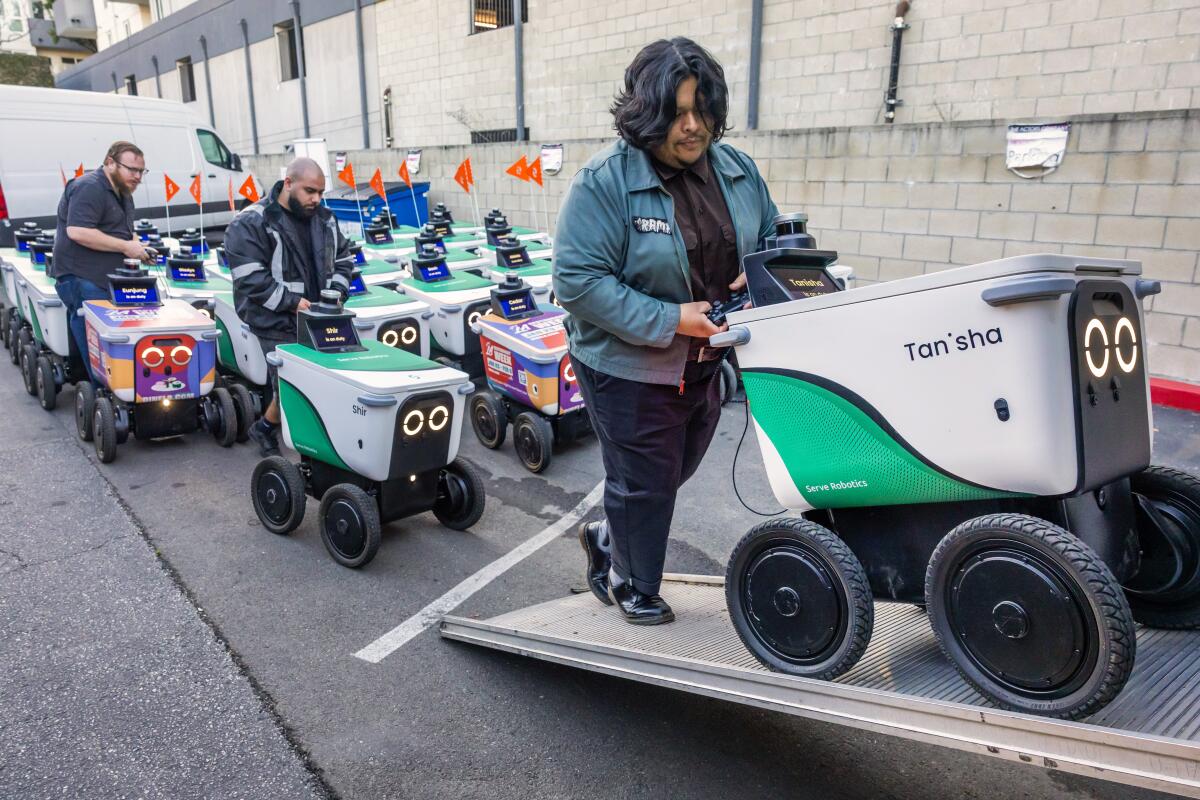

Serve Robotics opens its delivery fleet to outside developers

Serve Robotics opens its delivery fleet to outside developers

Live•Nov 12, 04:30 AM•2 min read•
James Okafor
James Okafor

Serve Robotics has opened its sidewalk delivery fleet to outside developers through a public API, first reported by Therobotreport. The portal also includes a sandbox for simulating robots and testing delivery workflows; live access requires Serve’s approval, and deliveries are limited to active service areas, operating hours and items that fit in a robot’s cargo compartment.

The API lets an application or AI assistant request a pickup and drop-off, confirm the details and track a robot until delivery is complete. Requests can be sent with a few lines of code or through an AI agent; Serve handles dispatch, routing, navigation and remote supervision.

Developers can simulate robots, run delivery workflows and rehearse edge cases in the sandbox before using live robots. Businesses can use robots to move goods between offices, while local businesses can expand delivery footprints without hiring more staff, Serve says.

Serve’s systems had been available only through third-party delivery partners before the portal opened. The company says its systems have completed hundreds of thousands of deliveries across more than 150 neighborhoods in 20 U.S. cities.

Serve says it has deployed more than 2,000 robots across the U.S. and Australia, reaching about 3 million people and supporting delivery for more than 4,000 restaurants. Last week, it launched Serve Physical AI Services, opening its technology to companies building new types of robots.

The portal widens who can build delivery applications, while live trips remain subject to approval and delivery limits. Builders who want to move beyond the sandbox can indicate their interest through the portal.

AI datacentre plans include 181GW of proposed on-site gas power

Plans for AI datacentres in the US, UK and mainland Europe include 181GW of proposed on-site gas-fired capacity, first reported by Theguardian. BloombergNEF estimates the planned rollout could emit about 345m metric tonnes of carbon dioxide equivalent a year in the US if it goes ahead, as grid-connection delays drive developers to seek power on site.

The proposed capacity is almost four times Great Britain’s total peak electricity demand, and 90% of planned on-site gas-fired power stations are in the US. BloombergNEF’s estimate for annual US emissions is equivalent to the greenhouse gas emissions from about 72.8m fossil fuel cars.

Mark Daly, BloombergNEF’s head of datacentres and emerging tech, said AI’s economics make speed to power one of the most important priorities in defining constraints on datacentre developers. He said the climate outcome also depends on how quickly grids connect facilities and whether power systems add cleaner generation alongside demand.

Developers have claimed their gas-fired power supplies would be temporary while they wait for grid connections. Daly said the economics could encourage developers to continue generating energy once the plants are online, creating a longer-term fossil-fuel lock-in risk. BloombergNEF says connecting new datacentres to the grid is the more sustainable option, and faster connections are crucial to limiting emissions and that risk.

Planned UK datacentres made more than 100 inquiries in 2024-5 to connect to gas as a result of delays securing access to the electricity grid, according to Future Energy Networks, the representative body for UK gas networks. Wapseys Wood in Buckinghamshire and Quest Park in Bedfordshire are seeking to build their own on-site gas-fired power stations after long waits for grid access.

On-site fossil-fuel generation is likely to be repeated at many more UK sites after chancellor John Healey gave datacentres the green light to build and run temporary fossil-fuel power stations while waiting for grid connections, as part of a so-called datacentre covenant.

BloombergNEF projected AI datacentre electricity demand would almost quadruple by 2035 to 2,354 terawatt-hours, equivalent to 7% of global electricity demand.