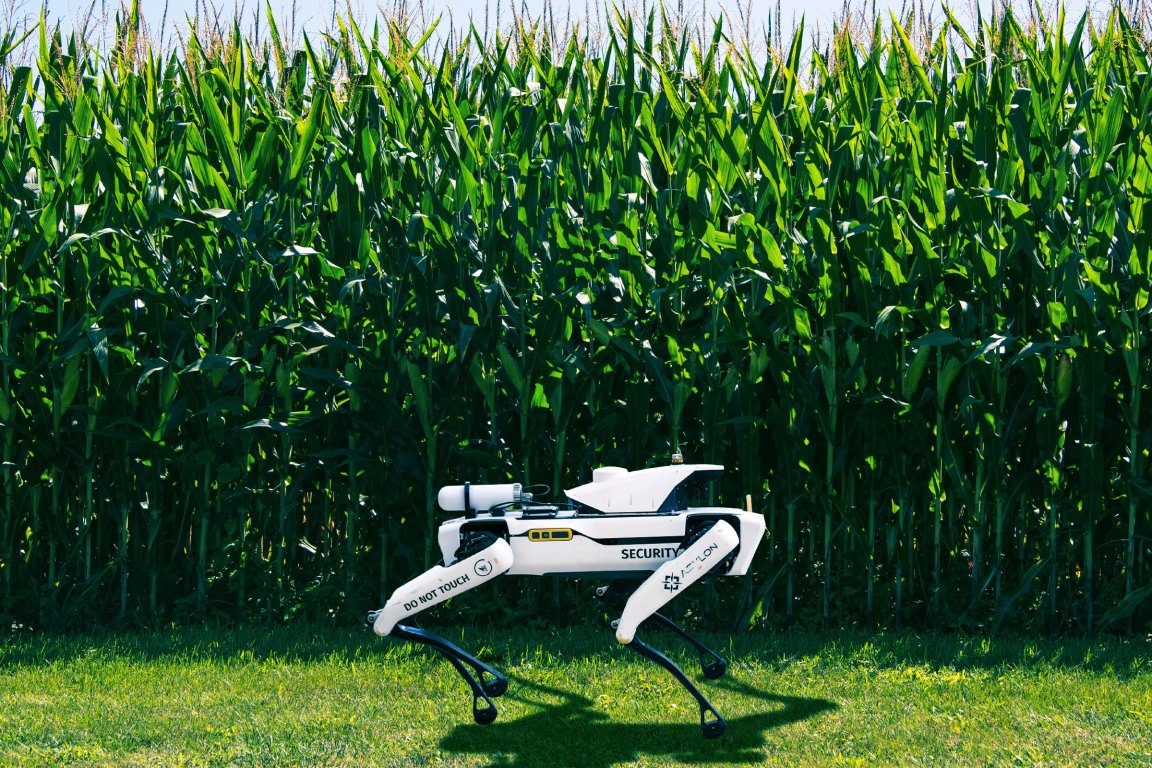

Quadruped robots are hauling produce through mountainous farmland, Unitree's humanoid is doing decidedly un-humanoid things, and magnetic microbot swarms are rotating objects without touching them. This week's best robotics videos span agricultural last-mile logistics, bipedal fall recovery, and aerial robots trained with reinforcement learning — here's what stood out and what it means for buyers.
Table of Contents
- Deep Robotics Lynx M20: Quadrupeds Solving the Agricultural Last Mile
- Unitree's Humanoid Does Nonhuman Things — And That's the Point
- Magnetic Microbot Swarms Manipulate Objects Without Contact
- Georgia Tech Tackles Bipedal Fall Recovery on Moving Vehicles
- What This Means for Robotics Buyers
- Frequently Asked Questions
Deep Robotics Lynx M20: Quadrupeds Solving the Agricultural Last Mile
The most commercially significant video this week shows Deep Robotics' Lynx M20 quadrupeds carrying harvested crops along narrow paths through dense mountainous farmland — terrain that wheeled vehicles simply cannot navigate. This is last-mile agricultural logistics in practice, and it is a much harder problem than it looks.
Rural farming regions in mountainous terrain face a logistics bottleneck that tractors and conveyor systems cannot solve. Produce harvested on steep, terraced, or densely planted fields often has to be carried by hand to a collection point — slow, labour-intensive, and increasingly uneconomical as agricultural workforces shrink. The Deep Robotics Lynx M20 is purpose-built for exactly this constraint, combining a quadruped gait capable of handling uneven ground with a cargo platform that offloads the carrying burden from human workers.
What makes this video notable is not the robot itself but the deployment context. This is not a controlled warehouse floor or a polished lab demo. The robots are operating in actual field conditions — loose soil, irregular paths, dense vegetation — and they are doing so while loaded. That combination of payload capacity and terrain adaptability is exactly the performance envelope that agricultural robotics has been promising for years.
The Lynx M20 is rated for 15 kg of payload, operates for over 4 hours under no load, and carries an IP54 weather resistance rating — enough for light rain and dust exposure in field environments. Range exceeds 13 km on a single charge, which covers meaningful ground across a working farm. For context, a typical agricultural worker carrying 15 kg over broken terrain covers roughly 2-3 km per hour before fatigue becomes a factor. The quadruped does not fatigue.
Unitree's Humanoid Does Nonhuman Things — And That's the Point
Two Unitree clips appeared in this week's roundup, and together they reveal something important about where the humanoid robot market is heading. The first shows a Unitree humanoid performing tasks that drift away from the anthropomorphic motion paradigm — moving in ways that are efficient for a robot rather than mimicking how a person would approach the same task.
IEEE Spectrum's editorial team flagged this directly: we are approaching the inflection point where humanoid robots stop performing for human audiences and start optimising for task completion. That shift matters commercially. A humanoid that moves like a person is easier for humans to supervise and program intuitively. A humanoid that moves like a robot — exploiting its full joint range, bypassing the ergonomic constraints that biology imposes on humans — is potentially far more productive per hour of operation.
The second Unitree clip focuses on the Go series quadruped platform, emphasising the 90 N·m maximum torque, IP54 rain resistance, 15 kg payload, and 13 km operational range. These are not flagship specs — they are mid-tier, practical specs aimed at buyers who need a deployable robot today rather than a research platform for tomorrow.
Unitree has carved out a specific market position: the accessible end of serious robotics hardware. The Go2 quadruped starts at approximately $1,600, making it the entry point for organisations wanting to experiment with legged robotics without committing to Boston Dynamics Spot-level investment (which starts around $75,000). The humanoid H1 sits at approximately $90,000, while the newer G1 is priced around $16,000 — a significant undercut of most humanoid competitors.
| Platform | Payload | Runtime | Price (approx.) | Best Use Case |
|---|---|---|---|---|
| Unitree Go2 (quadruped) | 15 kg | 4+ hrs | ~$1,600 | Research, light inspection |
| Unitree G1 (humanoid) | ~3 kg | ~2 hrs | ~$16,000 | Embodied AI research |
| Unitree H1 (humanoid) | ~30 kg | ~2 hrs | ~$90,000 | Industrial task demos |
| Deep Robotics Lynx M20 | 15 kg | 4+ hrs | ~$20,000+ | Agricultural logistics |
| Boston Dynamics Spot | 14 kg | ~90 min | ~$75,000 | Industrial inspection |
Magnetic Microbot Swarms Manipulate Objects Without Contact
Researchers from the Max Planck Institute for Intelligent Systems, the University of Michigan, and Cornell University demonstrated magnetic microrobot swarms capable of generating fluidic torque (rotational force transmitted through fluid dynamics rather than physical contact) strong enough to rotate gear systems, assemble micro-scale structures, and reposition objects significantly larger than the robots themselves.
This is further from commercial deployment than the agricultural quadruped story, but the implications for precision manufacturing and medical robotics are direct. Contactless manipulation at micro-scale removes a fundamental constraint in semiconductor fabrication and minimally invasive surgery — the inability to physically grasp objects smaller than the gripper mechanism. The study was published in Science Advances, lending it substantial methodological credibility beyond a typical conference paper.
The swarm coordination approach — where emergent collective behaviour produces forces no individual microrobot could generate — is also a relevant architectural model for macro-scale robotics. Multi-agent reinforcement learning for robot swarms draws on exactly the same principles.
Georgia Tech Tackles Bipedal Fall Recovery on Moving Vehicles
Georgia Tech researchers published work this week addressing a specific and underexamined failure mode for bipedal robots: directional instability caused by sudden platform movement. The scenario — a humanoid robot losing balance when the vehicle carrying it makes an abrupt turn — is directly relevant to military logistics, shipboard maintenance, and any deployment where the robot's operating surface is itself in motion.
Until now, most bipedal stability research has focused on static terrain challenges: stairs, loose gravel, obstacles. The dynamic platform problem is categorically different because the disturbance comes from the ground reference frame itself shifting, not from the robot's path. Georgia Tech's approach targets this gap directly, and the video shows meaningful recovery behaviour across several test scenarios.
For buyers evaluating bipedal robots for mobile deployment contexts — field logistics, vehicle-mounted inspection, maritime applications — this research trajectory signals that the stability limitations currently holding back deployment are being addressed methodically.
What This Means for Robotics Buyers
The through-line across this week's videos is practical deployment in unstructured environments. The most commercially mature stories — Deep Robotics in the field, Unitree's accessible quadruped specs — share a common characteristic: they are solving specific logistics problems in conditions that existing automation infrastructure cannot handle.
For agricultural and rural logistics buyers, the Deep Robotics Lynx M20 represents the current state of the art for quadruped cargo transport. If your operation involves terrain that excludes wheeled vehicles, legged cargo robots are now deployable, not experimental. The 15 kg payload covers most harvested produce scenarios, and the 13 km range is viable for medium-sized farm operations.
For research and development teams exploring embodied AI, Unitree's pricing structure makes legged and humanoid platforms accessible at a fraction of the cost of alternatives. The G1 at ~$16,000 is the most capable sub-$20,000 humanoid currently available — a meaningful threshold for university labs and smaller AI companies.
For industrial buyers watching the humanoid space, the Georgia Tech stability research and Unitree's task-diversity demonstrations both point toward the same conclusion: the deployment readiness gap is closing, but fall recovery in dynamic environments remains the primary unsolved safety challenge for humanoid adoption in real facilities.
You can explore available quadruped and used industrial robots on Robot Overflow, or browse humanoid robots on Robot Overflow if you are evaluating platforms for embodied AI applications.