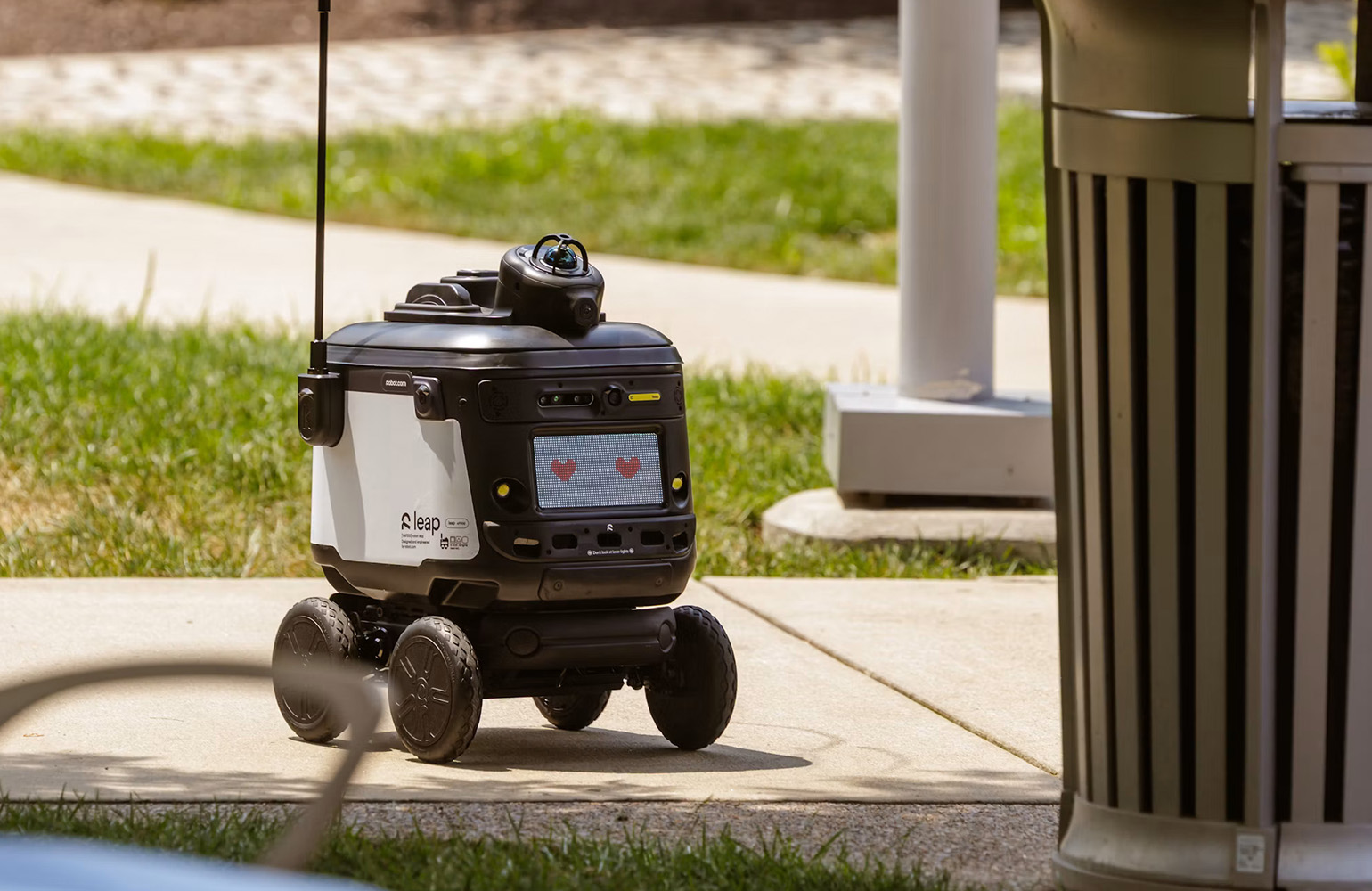

Robot.com announces seven-year Sodexo agreement for sidewalk delivery robots

Robot.com announces seven-year Sodexo agreement for sidewalk delivery robots

2 min read•Sep 6, 2026•
Elena Vasquez
Elena Vasquez

Robot.com has announced a seven-year commercial agreement with Sodexo Group, its largest single enterprise deployment, first reported by Therobotreport. The agreement builds on a partnership that began in 2021 and has expanded across select Sodexo-operated college campuses in North America; separately, R-Kiwi has completed 2.4 million tasks across campuses and city sidewalks.

Robot.com uses Remi, its robot implementation intelligence platform, to improve the economics of implementation. Felipe Chavez Cortes said the platform combines classical robotics, third-party software and advertising technology, letting the company generate revenue from advertising as well as delivery.

Campus deployment strategies are taking different paths. Starship Technologies recently announced plans to wind down its campus deliveries in favor of groceries, while Cortes described campuses as outdoor environments with people but less complexity than urban settings.

Robot.com has deployed more than 500 R-Kiwi delivery robots. To keep them running, it uses a layered approach that includes on-site attention, teleoperation and AI-agent attention; partnerships with Field AI and Physical Intelligence support safety targets as the company enters more challenging environments.

Robot.com plans to add R-Dog, a quadruped that can drop packages, go upstairs and get into autonomous vehicles without vehicle modifications. Most delivery robots require recipients to open a compartment and retrieve items themselves, so R-Dog could deliver a wider range of items.

Those college-campus deliveries are also helping prepare Robot.com for industrial use cases. Cortes said those environments have normal access to Wi-Fi and are more controlled, while the company is introducing industrial robots and humanoids on top of Remi.

Cortes said the company had already completed a quarter of a million hours generating revenue in the first half of the year and aims to reach a million hours per year soon. He linked the decision between wheels and legs to whether humanoids can be made more affordable.

Arizona appeals court vacates manslaughter sentence after AI video

An Arizona appeals court vacated the 10.5-year sentence of Gabriel Horcasitas while upholding his manslaughter conviction, first reported by Nytimes. The case returns to Maricopa County Superior Court for resentencing without the video, after judges found that it presented scripted statements as if the victim himself were speaking in court.

The three-judge panel said the video generated a likeness of Christopher Pelkey’s voice and appearance but did not reflect actual events. It found that allowing and relying on the video made the sentencing fundamentally unfair, and noted that no prior Arizona case had addressed the admissibility of such a depiction at sentencing.

The judges said a victim’s right to speak cannot override a defendant’s right to be sentenced on accurate, reliable information. They said the video collapsed the distinction between the family’s belief about what Pelkey would have said and Pelkey’s own voice and opinions.

The ruling distinguishes family members speaking about Pelkey from a generated likeness that appeared to speak for him.

Pelkey’s sister, Stacey Wales, presented the video during Horcasitas’s sentencing alongside victim-impact statements from family and friends. Wales wrote the script and said her husband and the couple’s longtime business partner helped create the video using Pelkey’s voice from a YouTube video and his face and torso from a funeral-service poster.

Judge Todd F. Lang praised the video as genuine, then imposed the maximum sentence of 10.5 years, more than the nine years prosecutors had sought.

Wales said nobody intended to make the court believe Pelkey was alive or that he had recorded the video before his death. She said she disagreed with the ruling and argued that families use slide shows, collages, hypothetical conversations and poetry to convey grief.

Wales compared the AI video with photography, saying it took 15 years of landmark cases around the 1860s before photography was widely accepted in courts.

The case returns to Maricopa County Superior Court for a new sentencing hearing without the AI-generated video.