
Researchers train a quadruped policy for 22 tasks with 8 teachers

Researchers train a quadruped policy for 22 tasks with 8 teachers

2 min read•Oct 10, 2026•
Priya Nair
Priya Nair

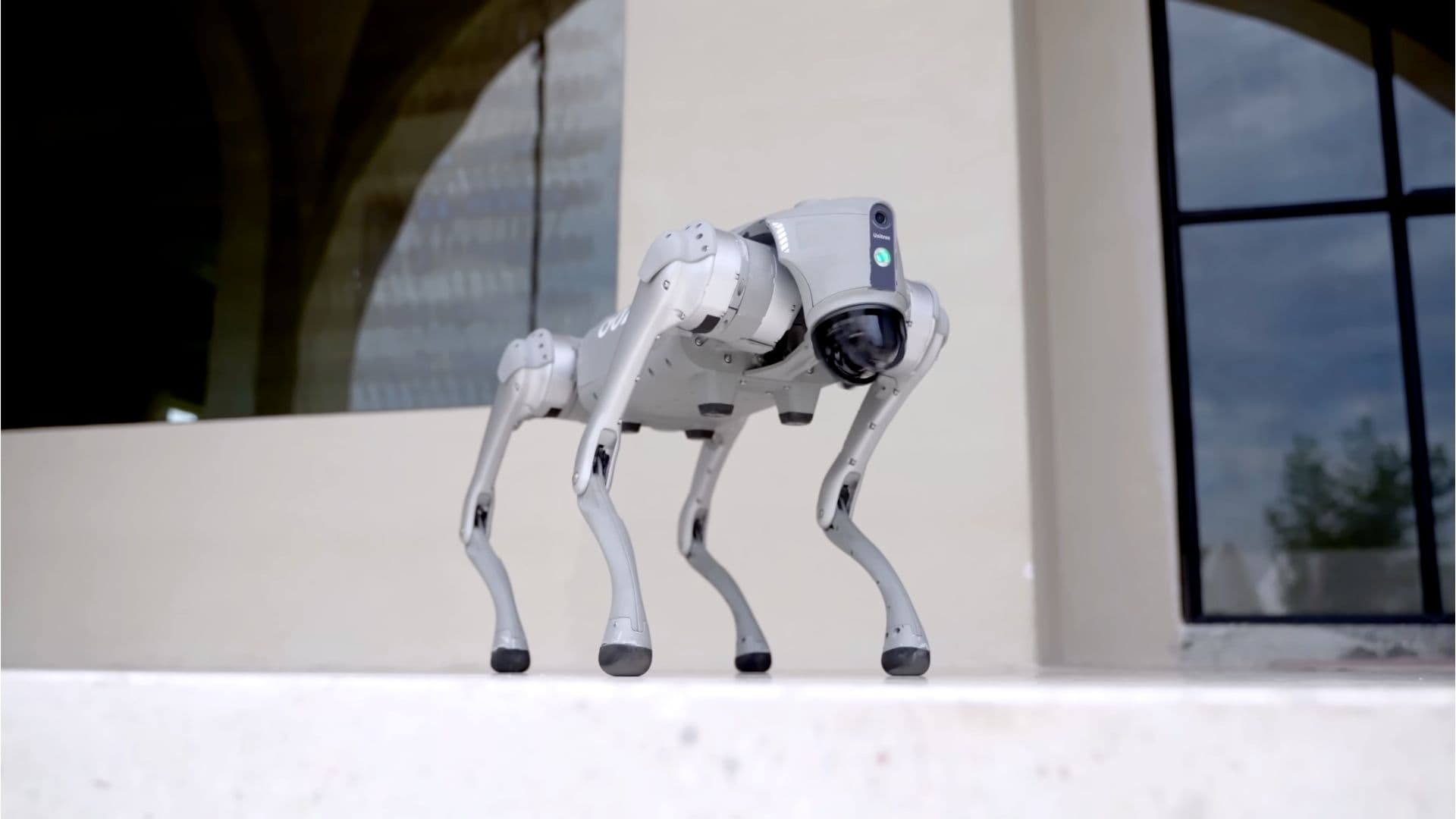
Researchers trained one quadruped policy to perform 22 tasks using eight teachers, in a study first reported by Arxiv. That repertoire includes skills such as walking, digging and hopping, which the method can compose into novel behaviors such as crawling; the resulting policy was deployed on a Unitree B1 quadruped.

The pipeline begins with multiple teacher policies, each trained through reinforcement learning on a narrowly defined task. In the next two stages, multi-teacher distillation uses those teachers to train a student policy, with a combined reinforcement-learning and imitation-learning objective. Adversarial task selection directs training toward the worst-performing task.

Reinforcement learning has enabled legged robots to perform a range of skills in single-task settings, but applications such as farm robotics and space exploration require diverse capabilities. Those include locomotion, digging and close-range surveying; sample inefficiency and gradient conflict between tasks make end-to-end multi-task training difficult.

Evaluations found that the method preserved motion quality and tracked commands more accurately than PPO and distill-then-finetune baselines. In some cases, the student generalized to new tasks without explicit training.

The method concentrates a broad task repertoire in one student policy while each teacher is trained on a narrowly defined task. The resulting policy was deployed on a Unitree B1 quadruped to demonstrate real-world robustness.

Plug-in vehicles reach 32% of global registrations in September

Plug-in vehicles reached 32% of global registrations in September, first reported by Cleantechnica. Battery-electric vehicles accounted for 23% of registrations and set a record at 1.54 million, up 8% year over year, while plug-in hybrids fell 9%; year to date in 2026, BEVs were up 12% and PHEVs down 10%.

Global plug-in registrations rose 3% year over year to around 2.16 million in September, close to the all-time record of 2.17 million set last December.

Year to date, plug-in registrations were up 4% year over year: BEVs grew 12%, while PHEVs fell 10%. Their combined share for 2026 stood at 25%, with BEVs at 18% and PHEVs at 7%. The overall growth rate therefore hides a clear split between the two categories.

The Tesla Model Y led the model rankings with a record 165,000 registrations, up 17% year over year. Tesla Model 3 came second with 65,000, enough to move ahead of Geely Xingyuan and BYD Song despite a 4% annual decline.

BYD Song finished fourth at 54,519 registrations, up 19% and the fastest growth rate among the top five. An export push and the new-generation Ultra body helped lift the model.

At the make level, Tesla had a record 232,000 registrations, up 9% year over year. Toyota reached 61,332 for its fourth record in a row, finishing ahead of Volkswagen’s year-best 58,000 to become September’s best-selling legacy make.