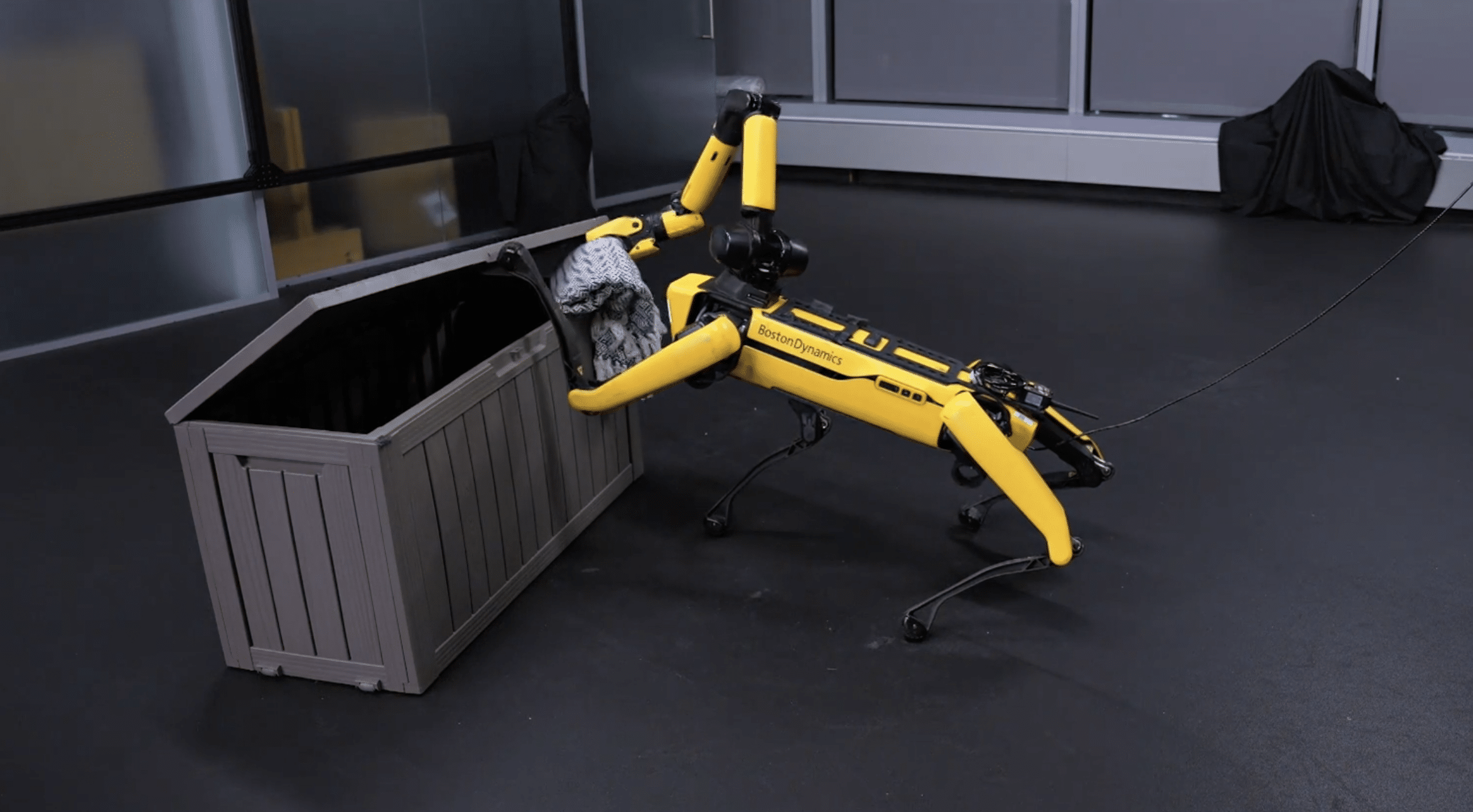

PolyMorphWBC coordinates a quadruped’s arm and base from end-effector trajectories for extended-reach manipulation across four families of 6-DoF mounted arms, first reported by Arxiv. The controller must decide how the base and arm share motion, with that choice depending on mounted-arm morphology; it can execute short-horizon manipulation trajectories beyond the initial fixed-base reach.
The task-level input is a short-horizon end-effector (EE) trajectory that specifies the desired manipulation motion without prescribing how the arm and mobile base realize it. A trajectory-conditioned coordinator uses previewed EE targets to determine base motion; arm-specific inverse kinematics (IK) tracks the current target, and a frozen locomotion backend executes the resulting motion.
PolyMorphWBC uses morphology conditioning derived from the Unified Robot Description Format (URDF), together with online residual-wrench feedback, to support cross-arm reuse. It was trained on procedurally generated arms and structured trajectories both within and beyond fixed-base reach.
In IsaacLab, it achieved 93.95% completion on held-out trajectories and arm morphologies, with 2.30cm position error and 4.81° orientation error. In MuJoCo evaluation against UMI-on-Legs, it reduced end-effector position error by 69–72% and orientation error by 91–97% across four within- and extended-reach trajectories.
The results pair trajectory-error measurements with a physical pick-and-place demonstration. On a physical Go2–ARX5 system, PolyMorphWBC demonstrated language-conditioned extended-reach pick-and-place using EE trajectories from pi_0, without vision-language-action (VLA)-generated base commands.