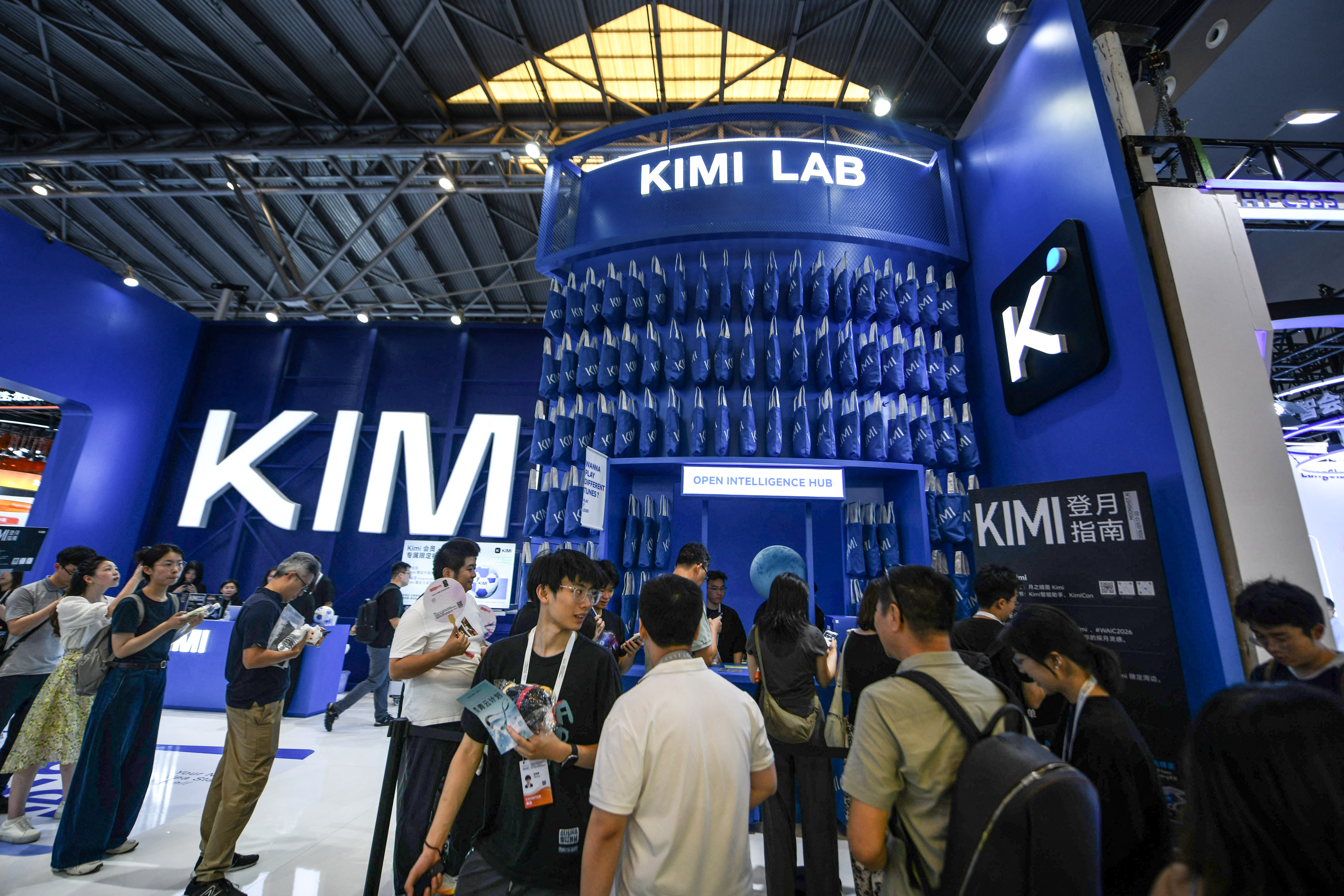

Beijing-based AI startup Moonshot AI released Kimi K3, an open-weight large language model that matches or beats top U.S. models at a fraction of the cost. The launch sent shockwaves through global markets, reigniting fears that U.S. dominance in AI is eroding faster than expected.
- What Kimi K3 Is and How It Performs
- Market Fallout: A Second DeepSeek Moment
- Who’s Who in China’s AI Sector
- Why Chinese Models Are So Much Cheaper
- What This Means for the Industry
- Frequently Asked Questions
- Conclusion
What Kimi K3 Is and How It Performs
Moonshot AI unveiled Kimi K3 on Thursday, claiming the model performs “competitively” with Anthropic’s Fable 5—widely considered one of the most capable publicly available models—and “substantially outperforms” Anthropic’s Opus 4.8 and OpenAI’s GPT 5.6 Sol. The company’s internal benchmarks place K3 among the top three AI models globally, while an independent evaluation from Arena.AI ranks it as the best model currently available, ahead of Anthropic.
At $15 per million output tokens, K3 is more than three times cheaper than Fable 5, which costs $50 for the same level of output. It is also the largest open-weight model ever released, meaning developers can download, inspect, and fine-tune the model freely.
According to Fortune, many industry observers—including Anthropic CEO Dario Amodei and Tesla CEO Elon Musk—had not expected a Chinese lab to release a frontier-level model for at least another six months. K3’s debut compressed that timeline dramatically.
Market Fallout: A Second DeepSeek Moment
The K3 launch rattled investors who had assumed the U.S. could maintain its lead simply by outspending Chinese competitors on compute. A semiconductor selloff already in progress worsened significantly on Friday.

Leading chipmaker TSMC fell 7% despite reporting a 77% jump in quarterly operating profit. SoftBank, often viewed as a proxy for OpenAI, dropped 9%. Z.ai, a Chinese AI startup competing with Moonshot, plunged nearly 30% in Hong Kong trading.
Fears spread to U.S. markets: the Nasdaq 100 fell 1%, Nvidia shares slipped 1.2% (briefly losing its title as the world’s most valuable company to Apple), and Meta shares dropped 2.4%.
The episode echoes the DeepSeek V3 shock of early 2025, when a Chinese model upended assumptions about U.S. AI supremacy and triggered a similar selloff.
Who’s Who in China’s AI Sector
China’s AI ecosystem is a fast-moving mix of tech giants and startups. Moonshot AI, founded in 2023, takes its Chinese name from Pink Floyd’s The Dark Side of the Moon—founder Yang Zhilin’s favorite album. Backed by Alibaba, Tencent, Meituan, and HSG (formerly Sequoia China), the company is reportedly considering a Hong Kong IPO.
Moonshot is not the only challenger. DeepSeek’s V4 model, released in April, offers frontier performance at just $0.87 per million tokens and runs on Huawei-made processors. Z.ai released GLM-5.2 in mid-June shortly after U.S. officials briefly restricted access to Anthropic’s models outside the U.S. Even consumer-internet giant Meituan launched its LongCat 2.0 model last month, trained entirely on Chinese semiconductors.
“The idea that Meituan could train a 1.6 trillion-parameter model on domestic hardware would have been inconceivable in October 2022,” said Paul Triolo, a partner at DGA-Albright Stonebridge Group, referring to the month the U.S. imposed sweeping export controls on AI chips to China.
Why Chinese Models Are So Much Cheaper
Chinese AI has built a global following by undercutting U.S. pricing systematically. DoorDash CTO Andy Fang recently noted that the company is pushing “lower-level work” to Moonshot’s Kimi model, leading to “better quality, cheaper cost.”
Several structural factors drive the price gap:
- Lower power costs: China has invested heavily in power generation and transmission, making data-center expansion easier than in the U.S., where new facilities often face political resistance over grid strain and water use.
- Willingness to sacrifice margins: Chinese companies prioritize capturing market share and establishing models as de facto standards over short-term profits.
- Hardware adaptation: U.S. export controls forced Chinese labs to optimize for less powerful domestic chips. “For the money on an Nvidia chip, they can buy ten local chips from Huawei or other local chipmakers,” said George Chen, a partner at the Asia Group.
- Open-source philosophy: Almost all Chinese AI firms release models under permissive licenses, allowing third parties—including U.S. companies—to host them for free, paying only for GPUs and energy.
China President Xi Jinping affirmed this open-source commitment at the World Artificial Intelligence Conference in Shanghai on July 17, calling for the industry to “seize this rare historic opportunity, encourage open source, openness, cooperation, and sharing.”
What This Means for the Industry
Kimi K3’s arrival has immediate implications for investors, competitors, and the broader tech ecosystem.
For investors: The selloff reflects a growing realization that China’s AI sector is not years behind—it is perhaps months. The narrative that U.S. firms can outspend their way to permanent advantage is cracking. Companies with high exposure to AI compute spending—chipmakers, cloud providers, and big AI model firms—may face continued valuation pressure.
For U.S. AI leaders: Anthropic, OpenAI, and Google now face a competitor that offers comparable performance at one-third the price. While proprietary models have advantages in safety testing and enterprise trust, cost leadership is a powerful weapon. Chinese models are already dominating usage leaderboards on OpenRouter, where all five most-used models this week come from Chinese companies: Tencent, Xiaomi, DeepSeek, MiniMax, and z.ai.
For enterprise customers: The price war is a windfall. Companies like DoorDash are already shifting workloads to cheaper Chinese models. Expect more enterprises to follow, especially for less sensitive tasks where cost savings outweigh concerns about data sovereignty or geopolitical risk.
For regulators: U.S. export controls, intended to slow China’s AI progress, may have inadvertently accelerated it. Constrained by less powerful hardware, Chinese labs optimized efficiency and compatibility with domestic chips. The strategy now seems to be producing models that run on cheap local hardware and undercut U.S. offerings—exactly the outcome the controls were meant to prevent.
Conclusion
Moonshot AI’s Kimi K3 marks another milestone in the rapid acceleration of China’s AI capabilities, delivering frontier-level performance at a fraction of U.S. prices. The market’s sharp reaction signals that investors are recalibrating their assumptions about the pace of Chinese AI catch-up. As cost competition intensifies and open-source models proliferate, the balance of power in AI is shifting faster than many in the West anticipated.