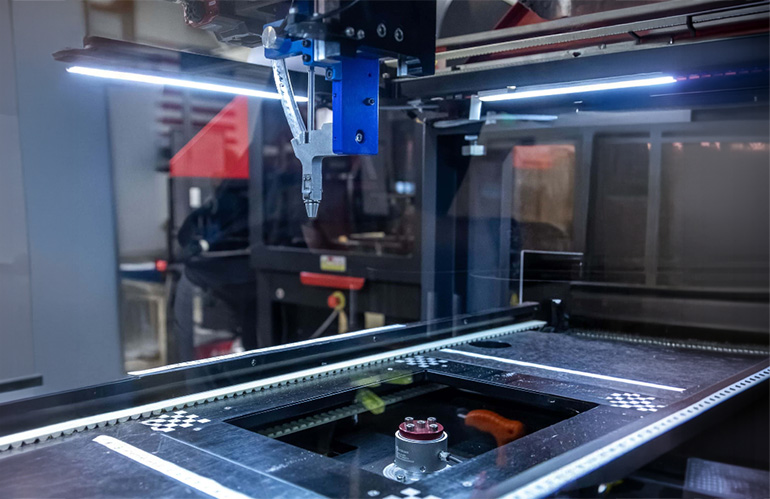

Launchpad Build AI has released a Manufacturing Language Model (MLM) trained on live production data to slash automation design and deployment time by up to 50%. Paired with a gantry assembly robot, the MLM lets factories generate robust robot programs from a photo, video, or CAD file — no robotics engineer required. The move, alongside a new U.S. headquarters and leadership hires, marks a Physical AI push to democratize automation for the 95% of manufacturers that are small and midsize enterprises.
- What Is the Manufacturing Language Model?
- How Does MLM Lower Automation Barriers for Small Factories?
- Inside Launchpad’s Gantry Robot and Digitool Vision System
- What This Means for Buyers: Cost, ROI, and Robot Choices
- Frequently Asked Questions
What Is the Manufacturing Language Model?
The Manufacturing Language Model (MLM) is a specialized AI system built from real assembly-floor data rather than generic internet text. According to CEO Jon Quick, the model packs domain-specific information — gripper tolerances, material characteristics, ideal process parameters — into task-ready packages so that a factory operator can generate a working robot program from a photo, video, or CAD file. Unlike a generalist LLM, MLM does not try to answer everything; it delivers precisely the information required to make a robotic assembly task robust and immediately deployable, as Quick told The Robot Report.
The company, originally founded as Launchpad in 2020 and recently rebranded to Launchpad Build AI, closed an $11 million Series A round backed by investors including Lockheed Martin Ventures, Ericsson Ventures, and the Scottish National Investment Bank. With offices in Edinburgh and now El Segundo, California, the firm has deployments across the U.S. and Europe and is targeting the long‑underserved high‑mix, low‑volume manufacturing segment.
How Does MLM Lower Automation Barriers for Small Factories?
The front‑end diagnostics that historically required weeks of robotics expertise and custom engineering can now be compressed into minutes. By accepting a simple photo or CAD input, the MLM automates the tedious, knowledge‑intensive part of deployment — selecting grippers, calculating tolerances, and sequencing operations — and cuts overall design cycles by up to 50%, Launchpad claims. This directly attacks the cost barrier that has kept automation penetration in high‑mix factories below 3%, even though they represent 95% of the 64,000 U.S. factories and 98% in the U.K.
“Why would I go create everything from scratch?” Quick asked. “I’ve got tolerances that are tested. I’ve got ideal conditions. I’ve got all this information that I should be grabbing that should help inform what I’m doing.” The MLM acts as a curator of accumulated production intelligence, bundling it into an information packet that the robot can execute. This approach sidesteps the need for in‑house automation experts and eliminates large upfront consulting fees, which are the traditional gatekeepers for smaller manufacturers.
Inside Launchpad’s Gantry Robot and Digitool Vision System
The physical side of the equation is a gantry‑based assembly robot called Digitool. It uses real‑time vision to handle part and process variation — a critical capability when you’re running dozens of different products in small batches. The gantry architecture gives it a large work envelope and the stiffness needed for tasks like screwdriving, kitting, and light sub‑assembly, while the vision system allows the robot to adapt to components that may not be precisely fixtured.
Digitool operates in a closed loop with the MLM. As the gantry runs jobs, it feeds back data on cycle times, success rates, and deviations, which continually refine the model’s recommendations. Launchpad says this data flywheel is what allows customers to reach a 99.8% effective rate after proper tuning. Multiple Digital copies can run simultaneously — the company mentions a scenario with 50 digital models gathering production data while also performing simulations and actual customer deployments.
What This Means for Buyers: Cost, ROI, and Robot Choices
Launchpad has not publicly released pricing for the MLM‑plus‑gantry bundle, but conversations with integrators and comparable systems suggest that a fully configured gantry assembly cell with vision typically lands between $30,000 and $60,000 (excluding facility‑specific modifications). The MLM itself will likely be offered as a subscription, an increasingly common model for AI‑powered industrial software.
How does that stack up against other automation paths for assembly? Below is a rough cost‑and‑complexity comparison that includes options buyers frequently evaluate.
| Robot Type | Example Model | Price Range (New) | Programming | Typical Deployment Time | Best For |
|---|---|---|---|---|---|
| Gantry with MLM | Launchpad Build AI (Digitool) | $30,000–$60,000 (est.) + MLM subscription | Self‑programming via photo/CAD | 1–2 weeks (with MLM onboarding) | High‑mix assembly, SMEs |
| Collaborative robot arm | Universal Robots UR5e | $25,000–$35,000 | Drag‑to‑teach or scripting | 2–4 weeks (with integration) | Light assembly, pick‑and‑place |
| Industrial robot | Fanuc LR Mate 200iD | $30,000–$50,000 | Teach pendant, offline programming | 4–8 weeks (with engineering) | High‑speed, high‑precision tasks |
| SCARA robot | Epson T3 | $12,000–$20,000 | Teach pendant, simple I/O | 2–4 weeks | Small part assembly, electronics |
Prices are approximate for new hardware and typical North American installations. Used robots can lower upfront capital by 30–60%.
For buyers who want to start small or equip a pilot line, the used‑equipment market is an efficient on‑ramp. Platforms like Robot Overflow offer a wide selection of used cobots and used industrial robots that can be paired with third‑party vision systems to mimic some of the Launchpad approach — though without the integrated MLM smarts. For high‑mix manufacturers that change parts every day, the self‑programming capability of the MLM could deliver its ROI within a few months simply by eliminating the recurring cost of system integrator calls.
Still, the technology is early. The 3% penetration number that Launchpad cites for high‑mix automation is a reflection of real challenges: frequent changeovers, variable part geometry, and low-volume economics. The MLM attacks the programming bottleneck, but it does not eliminate the need for proper end‑effectors, safety systems, and process engineering. Buyers should view the MLM as a force multiplier for their existing maintenance or engineering staff, not a complete replacement.