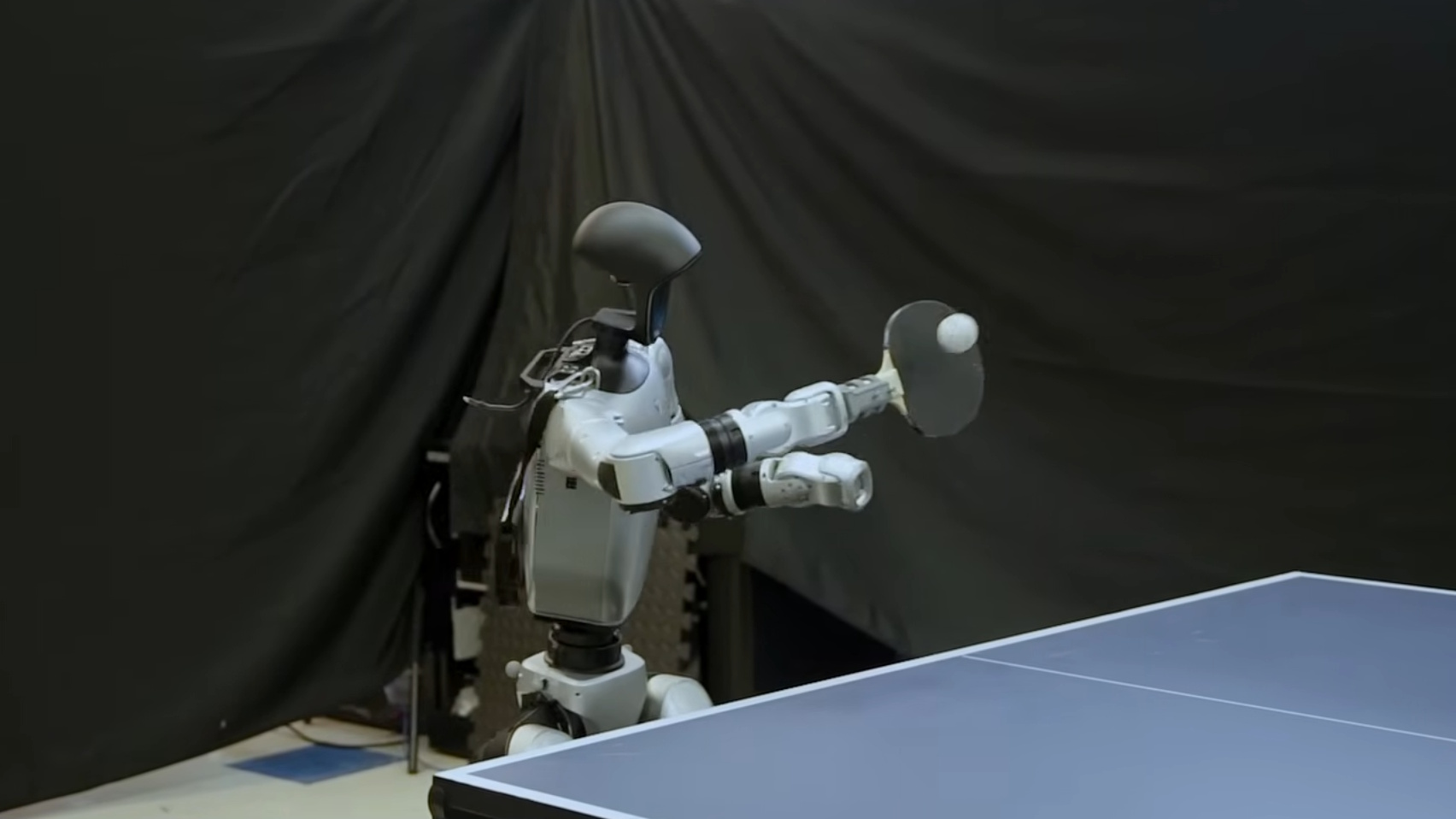

A humanoid table-tennis system separates stroke execution from shot selection, with a ball’s landing target connecting the two, in work first reported by Arxiv. Changing only the target-selection policy produced large differences in game outcomes against three baselines, with the learned strategy winning 89%, 82% and 73% of points.
The landing target serves as the interface between the two tasks. A motor policy maps a requested target to an executable stroke using a model-based strike planner and a learned controller.
Researchers improved the motor policy through self-play in closed-loop rallies, with incoming balls generated by another player rather than only prescribed incoming balls. Targets at this stage were sampled without considering the opponent, so this training improved execution without teaching the system game strategy.
Motor self-play improved both landing accuracy and legal-return rate during rallies. The researchers then froze the entire motor stack and used competitive self-play to train a separate, stroke-level policy to choose landing targets.
Against center, random and away-from-opponent baselines, the learned strategy won 89%, 82% and 73% of points, respectively. Its target choices changed according to the opponent’s position and the previous target, rather than relying only on fixed locations.
Holding the motor stack fixed makes the result a comparison of target selection, not a change to the stroke controller. On hardware, the same execution stack and strategic interface supported complete 11-point games against a recreational human opponent, including multi-stroke rallies with forehand and backhand returns.