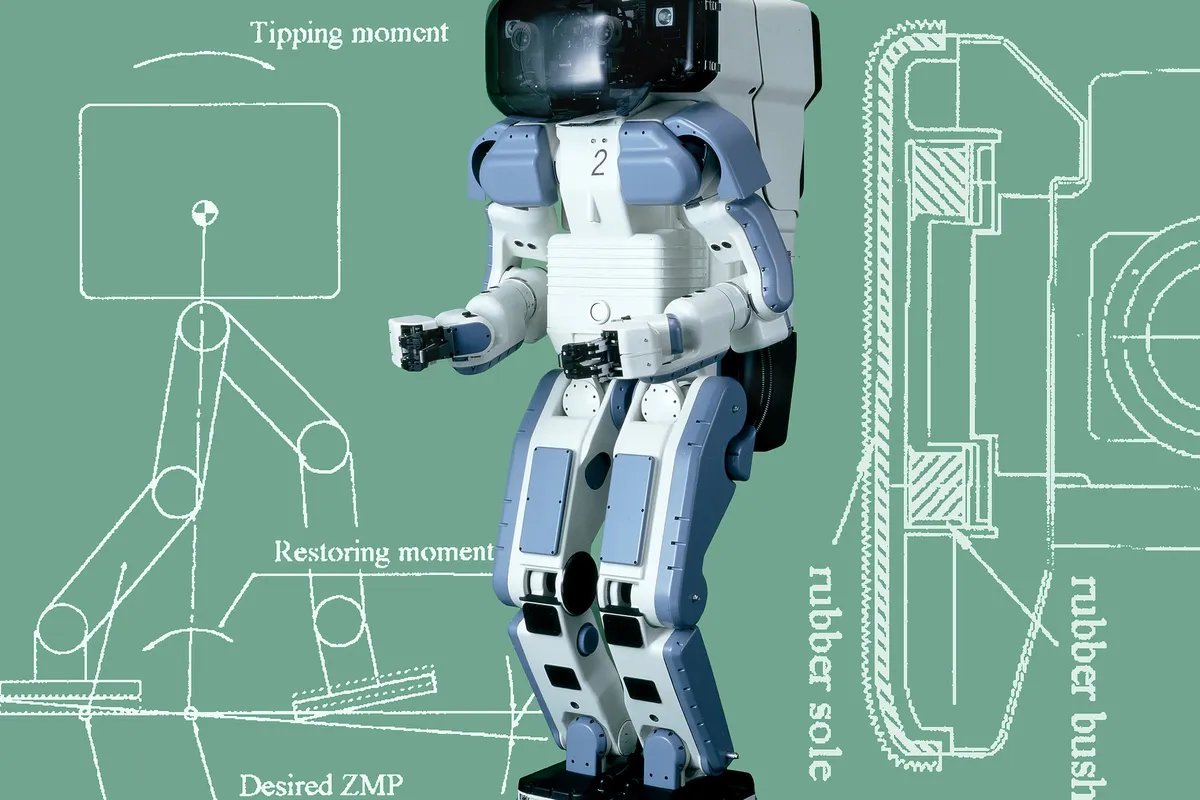

Honda's P2 robot — the first autonomous biped capable of walking without falling — has been designated an IEEE Milestone, 30 years after its 1996 public debut. The recognition marks a pivotal moment: P2's dynamic walking algorithms and onboard computing architecture directly seeded the engineering lineage behind every commercial humanoid robot on the market today.
Last updated: April 2025
Table of Contents
- Why P2 Was the First Real Breakthrough in Bipedal Locomotion
- How Honda Engineered Walking From Scratch
- From P2 to ASIMO to the Commercial Humanoid Era
- 30 Years of Progress: What Has Actually Changed
- What This Means for Robotics Buyers Today
- Frequently Asked Questions
Why P2 Was the First Real Breakthrough in Bipedal Locomotion
Before 1996, no autonomous robot could walk without falling. Every prior attempt — including Waseda University's WABOT-1, built in 1973 — relied on external power sources, external computers, or static walking patterns that kept the robot's center of mass constantly over its feet. The moment any disturbance shifted that balance, the machine toppled.
Honda's Prototype 2 solved a problem that had stumped roboticists for two decades. At 183 centimeters tall and 210 kilograms, P2 used dynamic walking — the same controlled-fall technique humans use — allowing it to stay upright by continuously adjusting its balance rather than freezing in a stable pose between each step. It did this autonomously, with onboard compute, onboard power, and no tether.
That distinction matters more than it sounds. Static walking is computationally simple but physically impractical. A robot that can only stand still between steps cannot navigate a real environment — it cannot recover from a push, descend a ramp, or match human walking speed. Dynamic walking unlocked all of those capabilities simultaneously.
According to IEEE Spectrum, the IEEE Nagoya Section wrote in support of the Milestone nomination: "P2 was not just a technical achievement; it was a catalyst that propelled the field of humanoid robotics forward, demonstrating the potential for robots to interact with and assist humans in meaningful ways."
How Honda Engineered Walking From Scratch
Honda's research team — Kazuo Hirai, Masato Hirose, Yuji Haikawa, and Toru Takenaka — started in 1986 with a deceptively simple premise: build a domestic robot that could navigate a home. That required climbing stairs, passing through doorways, and avoiding furniture. No off-the-shelf solution existed.
Their first step was studying human biomechanics directly, using themselves as models. This generated precise specifications for joint placement, range of motion, and limb proportions. Reality immediately pushed back. Human hips have four joints; the early prototypes had three. Human ankles have three degrees of freedom; the robot managed two. Every simplification created a new instability problem to solve.
The engineering progression tells the story:
| Prototype | Year | Key Achievement |
|---|---|---|
| E0 | 1987 | Bipedal legs only; static walking, 15 seconds per step |
| E1–E3 | 1987–1991 | Dynamic walking algorithms; E3 achieved stable locomotion |
| E4–E6 | 1991–1993 | 6-axis force sensors added; real-time gait adjustment |
| P1 | 1993 | Full humanoid form; external power, 191.5 cm, 175 kg |
| P2 | 1996 | Fully autonomous; internal battery and computer, wireless operation |
The breakthrough that tied it together was a posture-stabilizing control system paired with 6-axis force sensors in each ankle. Those sensors detected ground-reaction forces in real time, feeding data to a local controller that adjusted motor actuator positions continuously. The result was a machine that could feel the ground pushing back and respond — the mechanical equivalent of proprioception.
P2's onboard compute ran four microSPARC II processors on a real-time operating system, controlling arms, legs, joints, and vision processing simultaneously. Its 20-kilogram nickel-zinc battery provided roughly 15 minutes of operation — a severe constraint by today's standards, but a revelation in 1996 when every prior walking robot required a power cable.
From P2 to ASIMO to the Commercial Humanoid Era
P2's public launch in 1996 triggered a cascade across the global robotics research community. Honda followed it with the lighter P3 in 1997 (160 cm, 130 kg), then ASIMO in 2000 — smaller at 130 cm, but capable of running, stair-climbing, and face and voice recognition. Honda retired ASIMO in 2022, its research mission complete.
What P2 actually seeded was not a product line but a proof of concept that unleashed institutional investment worldwide. Boston Dynamics, founded in 1992, began its own bipedal work in the years following P2's demonstration. DARPA's humanoid robotics programs in the 2010s drew directly on the dynamic locomotion frameworks Honda pioneered. The Atlas robot — arguably the most capable research humanoid of the 2010s — used model-predictive control and whole-body dynamics that are intellectual descendants of P2's foundational algorithms.
The commercial inflection arrived in the early 2020s. Figure AI, Agility Robotics, 1X Technologies, and Apptronik all began shipping or taking orders for bipedal robots intended for warehouse and factory deployment. Tesla's Optimus program, announced in 2021, attracted unprecedented mainstream attention. The common thread: every one of these programs builds on the dynamic walking insight Honda demonstrated three decades ago.
30 Years of Progress: What Has Actually Changed
The distance between P2 and a 2025 commercial humanoid is measurable in almost every dimension:
| Capability | Honda P2 (1996) | Modern Commercial Humanoid (2024–25) |
|---|---|---|
| Battery life | ~15 minutes | 4–8 hours (typical) |
| Weight | 210 kg | 55–75 kg (typical) |
| Onboard AI | Rule-based control | Transformer-based vision-language-action models |
| Dexterity | Basic cart-pushing | Multi-finger manipulation, tool use |
| Cost | Research-only | $150,000–$250,000 (commercial units) |
| Deployment | Laboratory | Automotive, logistics, light manufacturing |
What has not changed is the underlying physics. Bipedal robots still fall. Battery energy density remains the binding constraint on runtime. Dexterous manipulation — tasks requiring fine motor control in unstructured environments — remains genuinely hard. The gap between controlled demonstrations and reliable real-world deployment is where the commercial humanoid industry is currently fighting its battles.
The valuations tell their own story. Figure AI raised at a $2.6 billion valuation in 2024. 1X Technologies closed a $100 million Series B. The humanoid robotics market, which barely existed as a commercial category five years ago, is now attracting venture capital at a pace that suggests the industry believes general-purpose bipedal robots are on a near-term commercial trajectory — not a decades-away research goal.
What This Means for Robotics Buyers Today
For buyers evaluating humanoid robots in 2025, the P2 anniversary provides useful calibration. The core locomotion problem Honda solved in 1996 is genuinely solved — modern bipeds walk, climb stairs, and recover from disturbances reliably. The open problems are dexterity, task generalisation, and total cost of ownership across multi-year deployments.
Buyers in manufacturing and logistics should evaluate current offerings against three criteria P2's lineage makes concrete:
- Dynamic stability in unstructured environments — Can the robot handle wet floors, uneven terrain, and unexpected contact? P2's 1996 breakthrough is table stakes; ask for live environment data, not lab demos.
- Manipulation capability relative to your task — Battery-powered bipedal locomotion is solved. Fine manipulation is not. Match the robot's dexterity profile to your actual workflow.
- Software update path — Unlike P2's hardcoded algorithms, modern humanoids receive over-the-air model updates. Understand what the vendor's AI roadmap means for capability improvements post-purchase.
If you're actively evaluating options, browse humanoid robots on Robot Overflow for current commercial listings, or explore used industrial robots if your application doesn't require bipedal mobility.