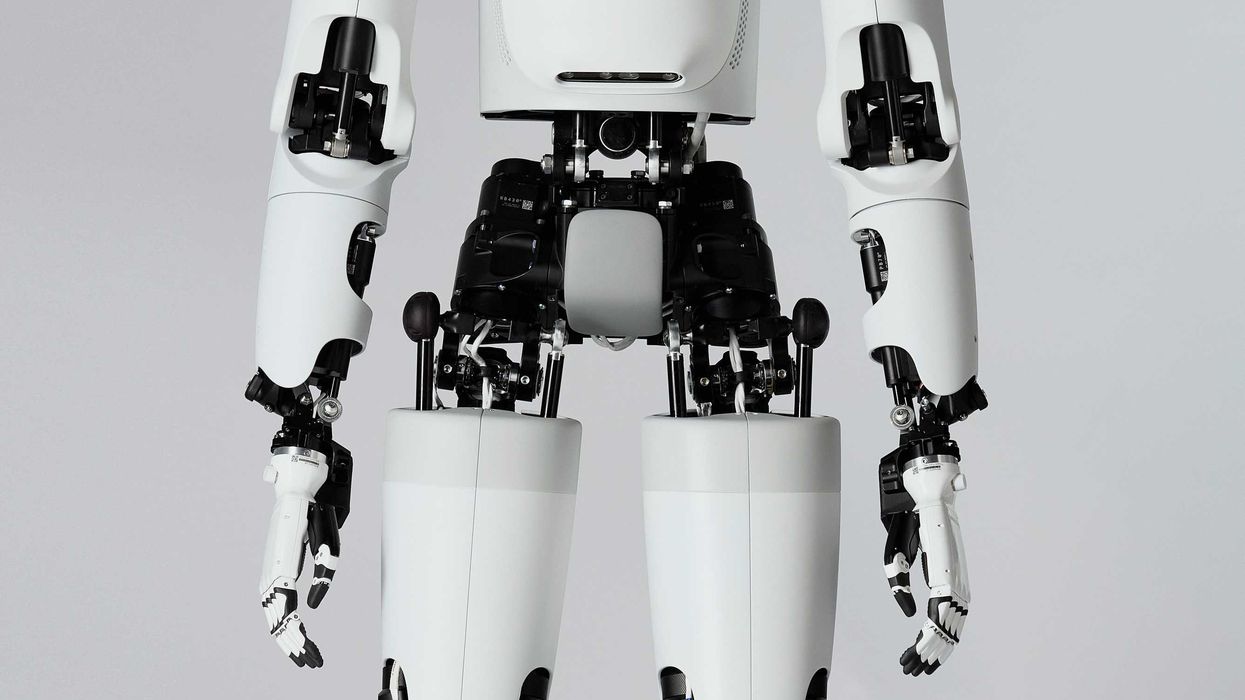

GXO expands Apollo trials; global rollout could reach 1,000 robots

GXO expands Apollo trials; global rollout could reach 1,000 robots

Live•Nov 13, 12:30 PM•2 min read•
Liu Wei
Liu Wei

GXO and Apptronik will expand Apollo trials ahead of a possible global rollout of up to 1,000 robots over four years, first reported by Dcvelocity. Progress depends on successful deployments and meeting agreed performance, safety and operational KPIs; the intended rollout would use a Robotics-as-a-Service model, while an initial North American deployment would start in late 2027.

The trials are due to begin in 2027 and will cover goods-to-person and person-to-goods picking, case and tote movement, packing, and sortation. The companies will validate safety, security and technical requirements for scaled deployment.

Each use case will be assessed and sequenced against jointly agreed productivity, safety and operational KPIs. The trials will also demonstrate how humanoids can work alongside existing automation and GXO team members.

The global rollout ambition is paired with evaluation of each use case. Apptronik CEO and co-founder Jeff Cardenas said the partnership is defining what it takes to put humanoid robots to work in logistics, measured against “real operational KPIs in live facilities.” The intended rollout would use a Robotics-as-a-Service (RaaS) model.

GXO launched a proof-of-concept test in 2024 to find practical warehouse applications for Apptronik’s robots. The deal expanded in 2026 from an initial application in a Georgia DC to additional warehouses in North Carolina and Tennessee.

Under the letter of intent, the initial deployment in North America would start in late 2027.

Six Chinese AI models carry Blackwell initialization fingerprints

Six models from DeepSeek, Moonshot AI, MiniMax and Ant Group carry weight patterns matching NVIDIA Blackwell GPU configurations, first reported by Unemploymentlabs. The evidence points to Blackwell-compatible initialization for those models, but it does not establish where the chips were located, how access was obtained or whether export controls were violated.

The six models are DeepSeek-V4-Flash and V4-Pro, Moonshot AI’s Kimi K3 and K3.1-Pro, MiniMax-M3, and Ant Group’s Ling-3.1-flash. V4-Flash and MiniMax-M3 match the 148-SM B200/B300 layout; the other four match the 152-SM GB200/GB300 layout.

The fingerprints come from initialization patterns preserved in publicly released weights. Recovering the seed and GPU thread layout identifies the hardware that generated starting values, not necessarily every accelerator used later.

Earlier Hopper fingerprints appear in DeepSeek-V3, Kimi K2.5, MiniMax-M2.7 and Ling-3.0-flash. Kimi K2.7-Code is an intermediate case: its Hopper-era weights include a small part matching B200/B300. Blackwell-matching releases include DeepSeek-V4 in April 2026, MiniMax-M3 in June, Kimi K3 in July, Ling-3.1-flash in October and Kimi K3.1-Pro in November.

The release sequence shows a shift in initialization fingerprints across four labs, not proof that entire training runs used Blackwell.

The strongest evidence for the six models ranged from 49 to 1,385 sigma, while the weakest individual test reached 20 sigma. A specially configured AMD MI300X can reproduce the layouts; for V4-Flash, 363 of 377 values that differed between AMD and NVIDIA matched NVIDIA, and none matched AMD. The same test could not settle the other five models, though an AMD explanation is considered very unlikely.

Run estimates for five models put each at roughly 500 to 3,000 Blackwell GPUs over two to three months, assuming the hardware that initialized a model also trained it. At roughly $70,000 per GPU, the largest cluster would cost $150 million to $200 million, and the five final runs together more than half a billion dollars; total lab spending on export-controlled GPUs is likely in the billions.

A U.S. license is required to export these Blackwell chips to China, and none has been reported.

The newest readable models from Alibaba (Qwen), Zhipu (GLM), Tencent, Xiaomi and StepFun still matched Hopper. Meituan says LongCat-2.0 was trained entirely on AI ASIC superpods, and its released weights showed no NVIDIA fingerprint.