
Google DeepMind uses Gemini 4 Argon to train Apptronik’s Apollo from video

Google DeepMind uses Gemini 4 Argon to train Apptronik’s Apollo from video

2 min read•Oct 23, 2026•
Carlos Mendez
Carlos Mendez

Google DeepMind demonstrated a video-based training method for Apptronik’s Apollo humanoid using Gemini 4 Argon, first reported by Roboticsandautomationnews. Google DeepMind says the pipeline can cut simulation work that normally takes weeks of manual effort to a few hours, reducing the engineering time needed to teach robots new physical skills.

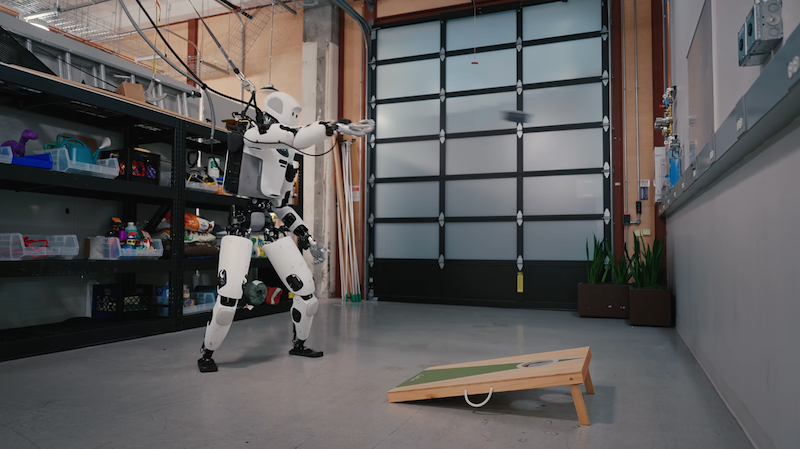
During an internal test, Argon watched raw video of a person playing cornhole. It analyzed the environment, mapped spatial coordinates and calculated the whole-body joint movements needed to perform the task.

Argon then autonomously generated simulation code, and the learned behavior was transferred to Apollo. Google DeepMind says the humanoid landed seven consecutive shots during a real-world trial.

Google DeepMind calls the method a “Video-to-Sim-to-Real” pipeline. Apollo’s seven-shot result comes from the real-world trial, while the claimed time reduction applies to simulation work.

The demonstration is intended to show how general-purpose AI models could reduce the manual engineering needed to teach robots new physical skills. Google also positions Argon for complex engineering, scientific, coding and business tasks.

Google DeepMind also tested Argon on its Embodied Reasoning benchmark, or ERQA, which measures reasoning about physical and spatial problems in 3D environments. Google says Argon scored 87 percent.

Google says the model has been used on projects ranging from optimizing large software codebases to quantum computing, nuclear fusion and life-sciences research. Gemini 4 Argon is now being made available through Google’s AI products and Gemini API.

Plug-in vehicles reach 32% of global registrations in September

Plug-in vehicles reached 32% of global registrations in September, first reported by Cleantechnica. Battery-electric vehicles accounted for 23% of registrations and set a record at 1.54 million, up 8% year over year, while plug-in hybrids fell 9%; year to date in 2026, BEVs were up 12% and PHEVs down 10%.

Global plug-in registrations rose 3% year over year to around 2.16 million in September, close to the all-time record of 2.17 million set last December.

Year to date, plug-in registrations were up 4% year over year: BEVs grew 12%, while PHEVs fell 10%. Their combined share for 2026 stood at 25%, with BEVs at 18% and PHEVs at 7%. The overall growth rate therefore hides a clear split between the two categories.

The Tesla Model Y led the model rankings with a record 165,000 registrations, up 17% year over year. Tesla Model 3 came second with 65,000, enough to move ahead of Geely Xingyuan and BYD Song despite a 4% annual decline.

BYD Song finished fourth at 54,519 registrations, up 19% and the fastest growth rate among the top five. An export push and the new-generation Ultra body helped lift the model.

At the make level, Tesla had a record 232,000 registrations, up 9% year over year. Toyota reached 61,332 for its fourth record in a row, finishing ahead of Volkswagen’s year-best 58,000 to become September’s best-selling legacy make.