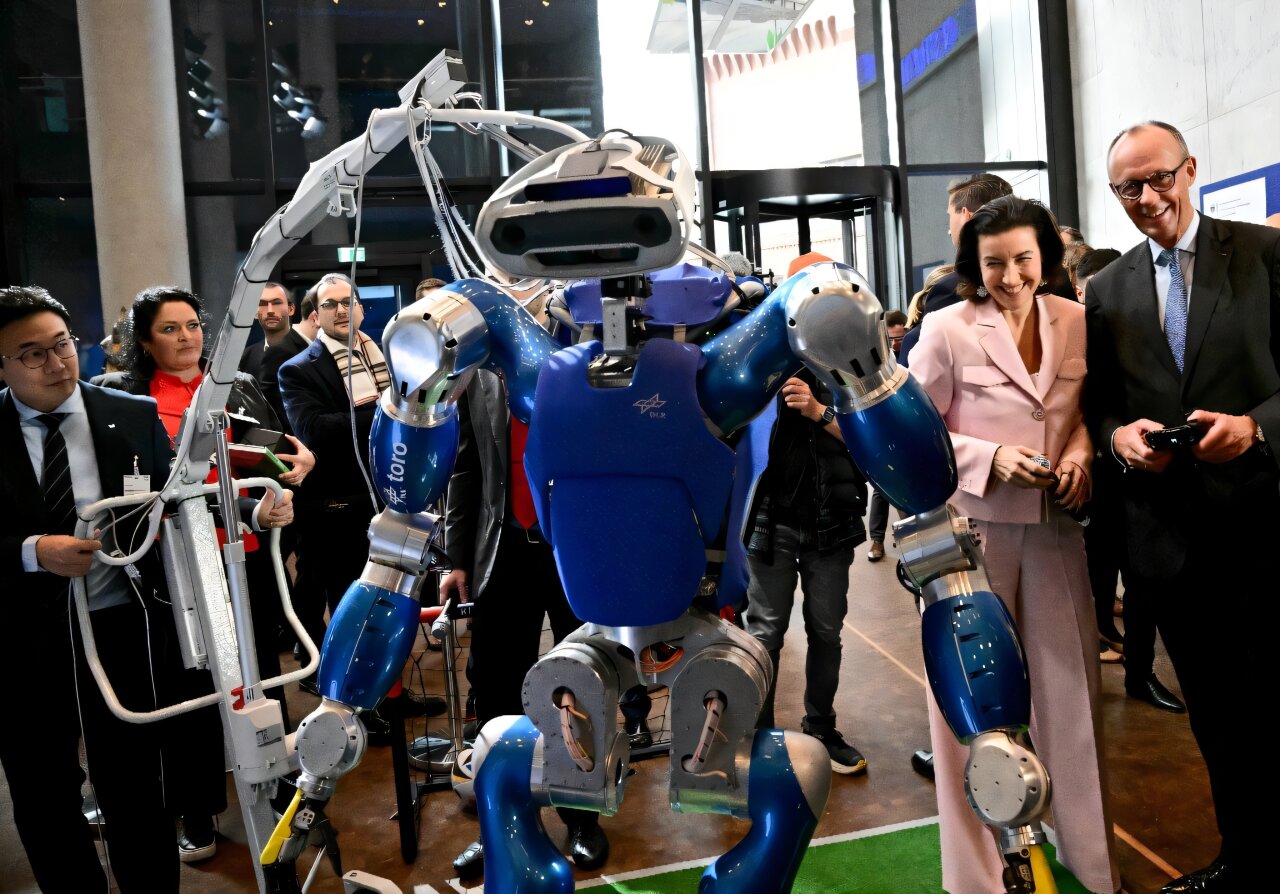

Europe showcased AI-powered robots for household assistance, recycling and logistics at the European Parliament, first reported by Techxplore. The event underscored a gap between Europe’s research strengths and the political will and funding experts say it needs to build a larger robotics industry, as the United States and China scale faster.
Four human-assistance robots designed by France’s INRIA research institute, the German Aerospace Centre and others cleared a breakfast table in 10 minutes. One tidied cupboards and wiped surfaces, while the others put orange juice and milk in the fridge, discarded empty packaging and loaded the dishwasher.
The robots moved slowly and sometimes required a few attempts. INRIA’s Serena Ivaldi said that approach is deliberate because the machines must operate in human environments without startling the people they help, making precision more important than speed.
A multi-jointed robotic arm developed by France’s CEA research agency dismantled an electric battery model for recycling. KYON, a quadruped developed by the Italian Institute of Technology for logistics, bent its legs to pick up a package and took several steps to deliver it to a human.
ETH Zurich’s Transformer switched from four legs to two without losing balance, returned to all fours and climbed up and down stairs. Together, the demonstrations paired practical tasks with the commercialization problem identified by EU lawmaker Axel Voss: Europe is often good at inventing technologies but too slow to turn them into global companies.
Portuguese robotics researcher Pedro Lima said Europe has generated much of the science and research behind some successful cases in China and the United States, but lacks political will and funding. Voss separately warned that the United States and China are scaling faster while capital is flowing elsewhere.
China has invested heavily in humanoid robots; at the World Robot Games in Beijing, one of its machines broke Jamaican legend Usain Bolt’s record for the 100-meter dash.
Alin Albu-Schaeffer, coordinator of the EU-funded euROBin network that organized the event, said Europe should have a robotics industry branch as large and important as the current automotive industry within 10 years. He added that Europe could capture one-third of the global intelligent robotics market by then.