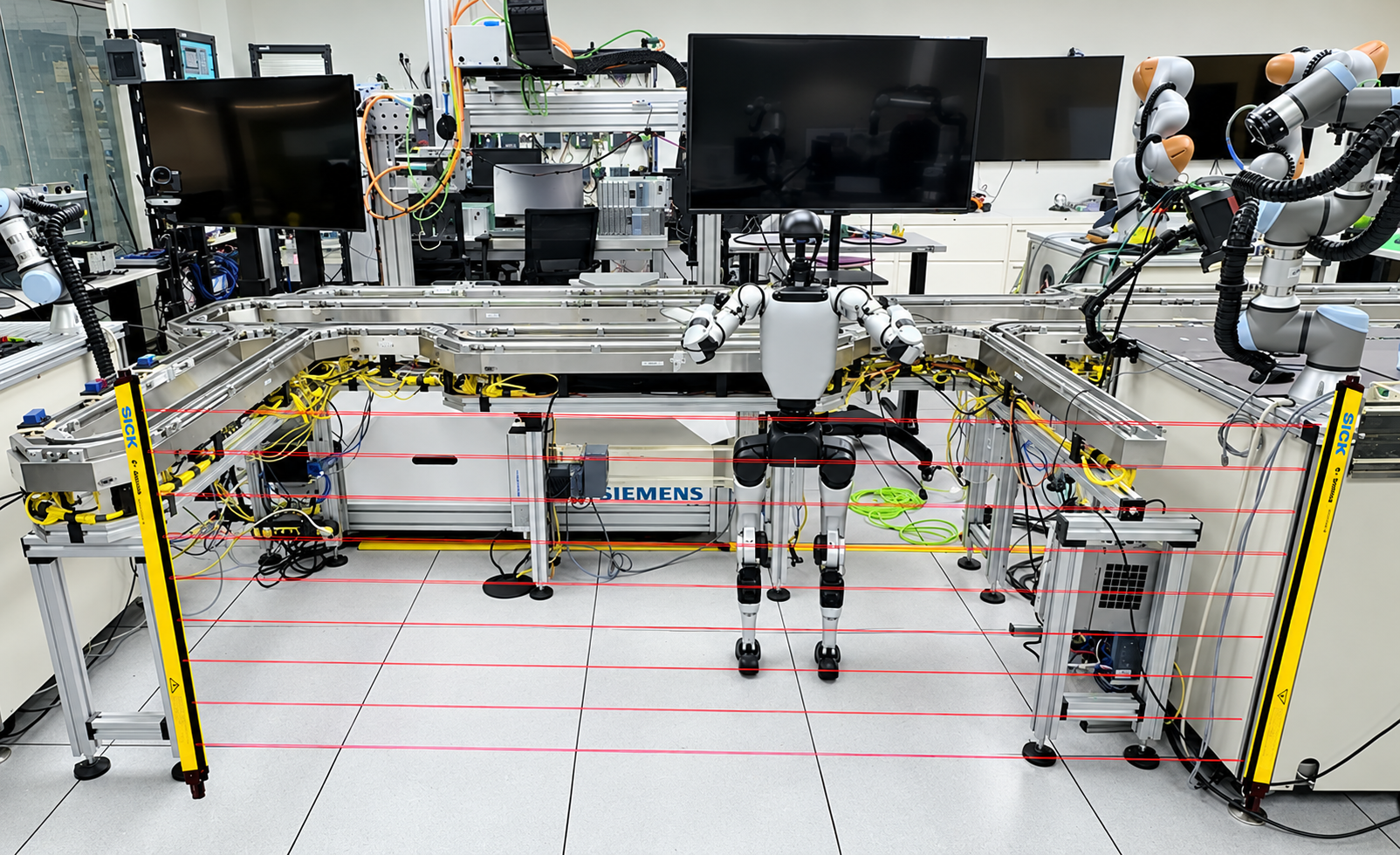

Carnegie Mellon University and Siemens developed PRISM, a method for assessing humanoid robots’ safe stoppability, first reported by Ri. Cutting power can make a humanoid collapse and potentially harm itself or anything it falls on; returning it to a neutral position can also be unsafe near people or obstacles, on slippery or uneven surfaces, or while it holds an object.
Emergency-stop (E-stop) mechanisms are the de facto standard for robot safety, and many robots have a big, easily accessible red button. On an industrial robot mounted in place, pressing an E-stop cuts power and halts all motion; a humanoid needs power to balance and control its joints.
Roboticists have sought to move humanoids into a neutral position before powering them down. In the CMU study, that meant standing with arms hanging down; further steps, such as attaching a support harness, could then allow operators to power down safely.
But the neutral-position fallback can itself be risky around people or other obstacles, on slippery or uneven surfaces, or while the robot holds an object. That makes safe stopping a question of context as well as of halting motion.
Simulations let researchers examine environments and activities that might impede a stop, including rare but critical states, without damaging a robot. They named the resulting method Proactive Refinement of Importance-sampled Stoppability Monitor (PRISM), which defines conditions for safe stoppability and a safety envelope beyond which a humanoid might not stop safely.
PRISM is currently designed for a human controller: it monitors humanoids and alerts operators when a robot may be unable to stop safely. Project lead Yifan Sun, a robotics Ph.D. student, said humanoids could eventually use the method themselves to recognize high-risk situations and avoid or minimize time outside the safety envelope.
Siemens demonstrated PRISM using a commercially available robot a bit more than four feet tall. Researchers found it enabled proactive safety monitoring and could support certification of fail-safe behaviors, a particular interest of Siemens.
The research will be presented at IROS 2026, the International Conference on Intelligent Robots and Systems, Sept. 27-Oct. 1 in Pittsburgh.