
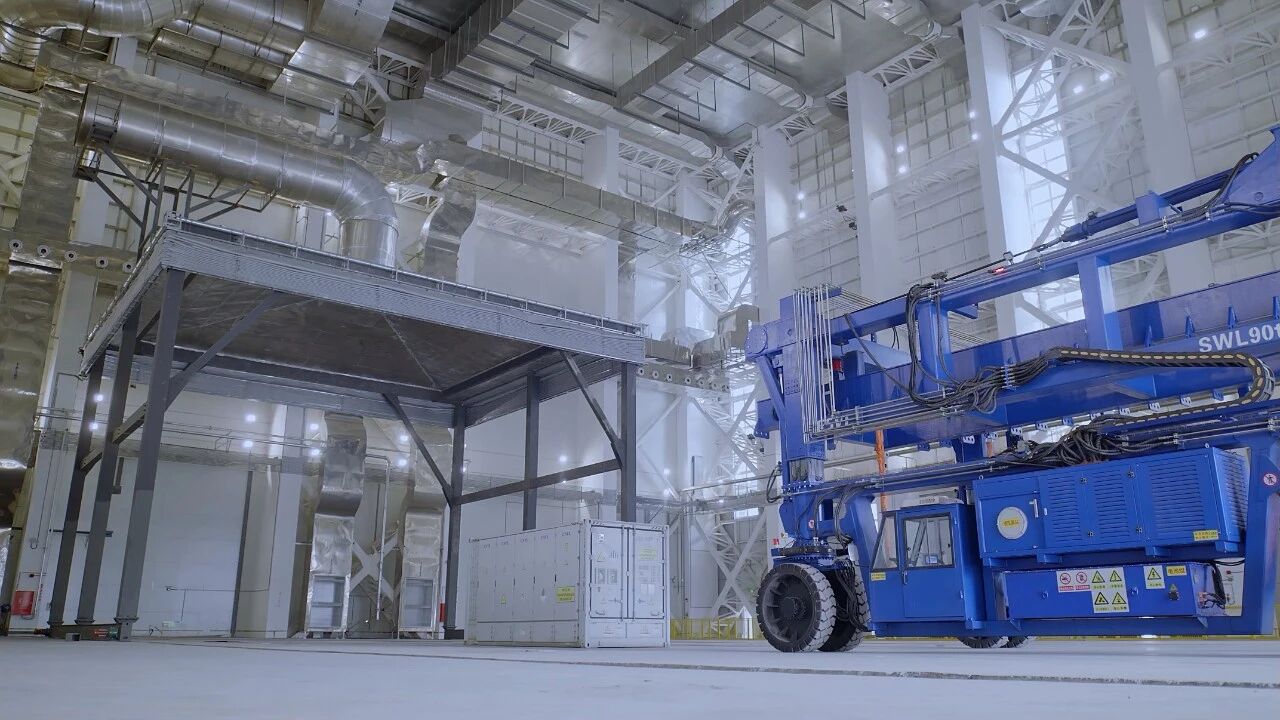
CATL has opened the Xiamen Energy Storage Validation Research Institute, a 10-hectare testing facility it calls the largest and most comprehensive in the world. The $440 million site is designed as an open platform for energy storage companies to validate complete systems under real-world operating conditions.
- What CATL Built
- Why System-Level Testing Matters
- Market Implications for the Energy Storage Industry
- What’s Next for CATL and the Industry
- What This Means for the Industry
- Frequently Asked Questions
- Conclusion
What CATL Built
The Xiamen Energy Storage Validation Research Institute spans 10 hectares and represents an investment of roughly RMB 3 billion ($440 million). CATL said the facility is the first one-stop platform capable of testing not just individual components but entire energy storage systems and station-level configurations.
The institute houses five specialized laboratories:
- Grid integration – simulating connection to national and regional power grids under various load conditions.
- High-voltage safety – testing insulation, arc protection, and power electronics at elevated voltages.
- Thermal safety and combustion – running thermal runaway simulations and fire containment tests.
- Environmental reliability – exposing systems to temperature extremes, humidity, salt spray, and vibration.
- Electromagnetic compatibility – ensuring equipment doesn’t interfere with nearby electronics and withstands external interference.
CATL has positioned the facility as an open, shared resource for global energy storage players. According to TechNode, the company intends to move the entire sector beyond component-level verification toward full-system validation.

Why System-Level Testing Matters
Historically, energy storage certification has focused on individual components—battery cells, modules, and power converters. But modern grid-scale installations rely on complex interactions between thousands of cells, thermal management systems, power electronics, and control software. A cell that passes a UL listing can still fail catastrophically when integrated into a poorly designed system.
CATL’s Xiamen facility addresses this gap by replicating real-world conditions. A station-level test can simulate years of charging and discharging cycles in weeks, expose the system to grid anomalies, and push thermal safety to failure points. For utilities and project developers, such validation reduces insurance costs, accelerates permitting, and builds confidence in deploying large-scale storage.
The investment also signals CATL’s recognition that energy storage is shifting from a “battery business” to an “integration business.” System integrators now compete on software intelligence, thermal safety, and grid response, not just cell energy density.

Market Implications for the Energy Storage Industry
CATL already dominates the global battery market, holding roughly 37% of the electric vehicle battery market and a growing share of stationary storage. The Xiamen testbed strengthens its hand with customers—utilities, EPC contractors, and renewable developers—who can now validate complete systems under one roof without sending components to multiple labs.
Competitors such as BYD, LG Energy Solution, and Samsung SDI will need to match or form partnerships to offer comparable full-system testing. Smaller players may find it cheaper to use CATL’s open platform than to build their own, potentially locking them into CATL’s testing protocols and, by extension, its supply chain.
The facility also raises the bar for safety standards globally. Regulators in Europe, the U.S., and Australia have been tightening grid-storage safety requirements after several high-profile battery fires. CATL’s ability to conduct systematic thermal and combustion testing could help set de facto industry benchmarks, especially in markets where national standards are still evolving.
What’s Next for CATL and the Industry
CATL has not announced a timeline for commissioning the first full-system validation projects at Xiamen, but the facility is already operational. The company said it will invite “global energy storage players” to use the platform, though pricing and access terms have not been disclosed.
In the broader context, the Xiamen testbed aligns with CATL’s push into software and services. In recent months, the company has launched a digital twin platform for battery lifecycle management and expanded its battery-as-a-service offerings. The testing facility could become a revenue stream itself, offering certification services that command premium fees.
The industry is also watching for potential synergies with CATL’s fast-growing production base. The company’s 190 GWh of annual battery cell capacity (and plans for over 300 GWh by 2027) gives it a scale advantage in supplying test-validated storage solutions that exceed competitors’ capabilities.
What This Means for the Industry
For investors: The Xiamen facility is a long-term competitive moat. CATL is not just building a testbed; it is creating a credibility infrastructure that competitors will struggle to replicate at similar cost. Investors in energy storage should watch for other large-scale testing investments from C-level players, as safety validation becomes a key differentiator in procurement.
For competitors: Chinese rivals like BYD and Gotion High-Tech, plus global players like Tesla (which operates its own validation labs in Lathrop, California), now face a scale disadvantage. The Xiamen facility’s open platform could force a standard: if large utilities require CATL-issued system certifications, alternative vendors must either invest in comparable facilities or convince regulators to accept their own testing.
For the tech industry broadly: Reliable, low-cost energy storage is the backbone of renewable grid integration and data center backup power. Systematic validation reduces project risk, accelerates deployment, and ultimately lowers the cost of clean energy. For hyperscalers building AI data centers, high-quality battery storage can replace diesel generators for short-duration backup, cutting both carbon and operating costs.
The Xiamen testbed also signals the maturation of the energy storage sector. Just as semiconductor fabs invest billions in wafer testing cleanrooms, battery giants are now building specialized infrastructure that treats validation as a core manufacturing step, not an afterthought.
Conclusion
CATL’s Xiamen testbed marks a significant leap in energy storage validation, moving the industry from piecemeal component checks to integrated system‑wide certification. With a $440 million investment and an open‑access model, the facility gives CATL a powerful tool to shape safety standards and win customer trust. As grid‑scale storage becomes a critical piece of the global energy transition, validation infrastructure like this will be as important as manufacturing capacity in determining who leads the market.