
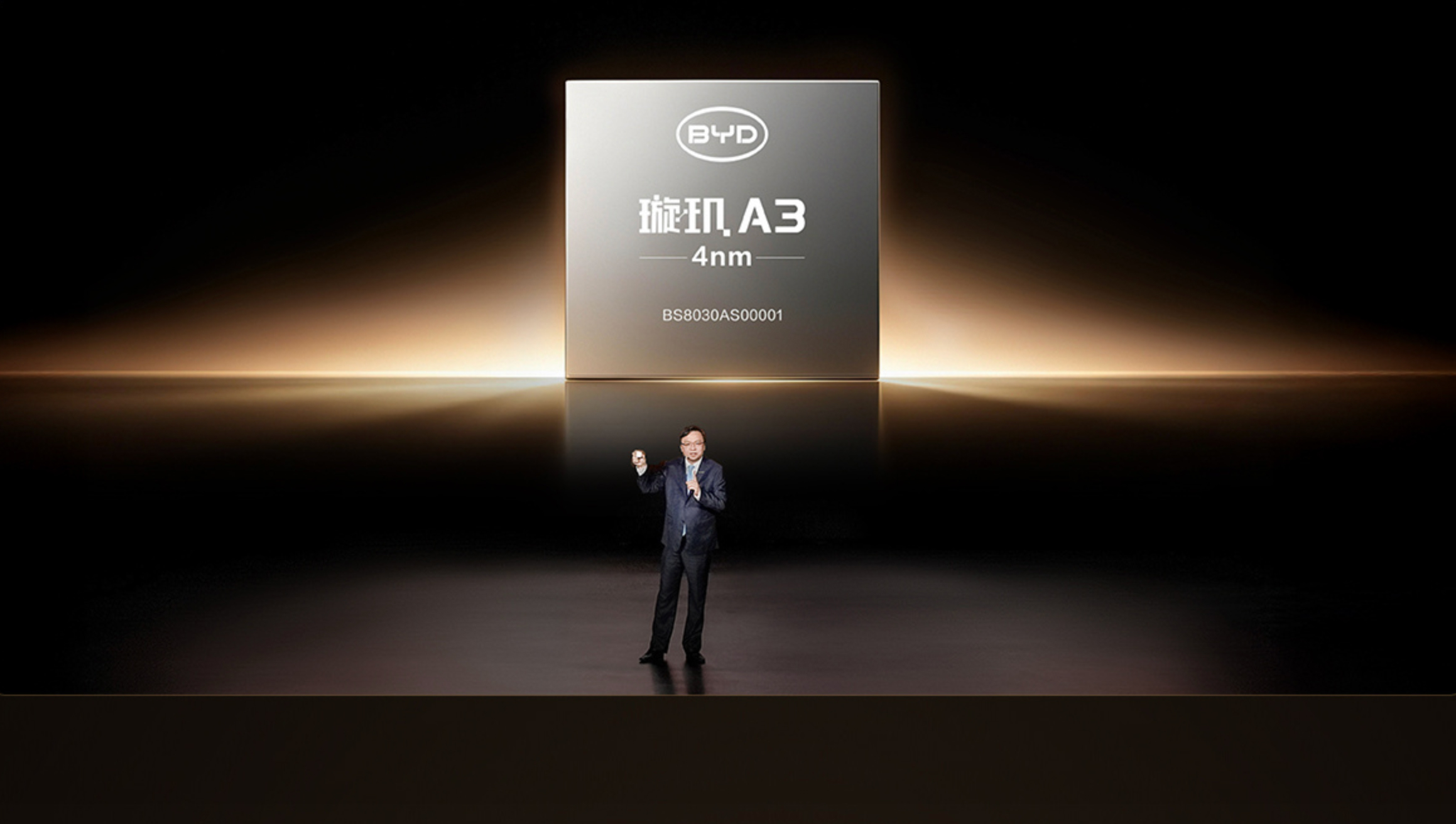
BYD today launched the Xuanji A3, a 4nm autonomous driving chip that the company claims is China's first of its kind. The chip has entered mass production and supports L3 and L4 autonomous driving capabilities, marking a significant step in the automaker’s push to vertically integrate its own driving hardware.
- What Happened
- Why It Matters
- Market and Competitive Implications
- What This Means for the Industry
- What’s Next
- Frequently Asked Questions
What Happened
At an event in China, BYD founder and chairman Wang Chuanfu unveiled the Xuanji A3 — a system-on-chip built on a 4nm process that the company says is the first such autonomous driving chip developed domestically. The chip is already in volume production, delivering combined computing power above 2,100 TOPS when used in a three-chip configuration.
BYD revealed that it now employs a chip R&D team of more than 7,000 people, with cumulative investments exceeding 100 billion yuan ($13.9 billion). The company operates four major chip research and development centers that have been working on the Xuanji project.
According to TechNode, which reported the launch, the Xuanji A3 supports both L3 and L4 levels of autonomous driving — a threshold that allows hands-free driving on highways and in certain urban conditions, though regulatory approval for these features varies by market.
Why It Matters
BYD is the world’s largest new energy vehicle maker by sales, but it has historically relied on external suppliers for advanced driver-assistance chips — primarily NVIDIA’s Orin and Thor platforms. The Xuanji A3 represents a strategic pivot to in-house silicon, giving BYD tighter control over its autonomous driving roadmap and potentially lowering per-vehicle costs as volume scales.
The 4nm node is significant because it puts BYD on par with leading-edge chip makers like TSMC and Samsung in terms of process technology for automotive chips. Most competing automotive SoCs are still produced on 5nm or 7nm processes. A smaller node means better power efficiency and higher transistor density, both critical for running complex AI driving models in real time.
BYD’s move also mirrors a broader trend among Chinese automakers. NIO and XPeng have both developed in-house chips for autonomous driving, though neither has yet claimed a 4nm part in mass production. If BYD can deliver on its performance promises, it could leapfrog rivals and reduce its dependence on foreign chip suppliers — a vulnerability that has grown more pressing amid escalating US-China technology tensions.
Market and Competitive Implications
The Xuanji A3 directly challenges NVIDIA’s dominance in the Chinese automotive chip market. NVIDIA’s Drive Orin system-on-chip delivers about 254 TOPS per chip, while its next-generation Thor promises up to 2,000 TOPS — comparable to BYD’s three-chip solution. However, BYD’s integrated approach means it can optimize the chip for its own vehicles without sharing margins with a third-party supplier.

For other Chinese EV makers considering proprietary chips, BYD’s aggressive investment — $13.9 billion and 7,000 engineers — raises the barrier to entry. Few automakers can match that scale. Meanwhile, suppliers like Mobileye (an Intel subsidiary) and Horizon Robotics also face increased competition as BYD pulls more functions in-house.
There is also a geopolitical angle. The US has restricted Chinese companies’ access to advanced chip-making equipment and certain AI accelerators. BYD’s ability to design and produce a 4nm chip — likely through a partnership with a domestic foundry such as SMIC — demonstrates that Chinese industry can still achieve leading-edge nodes despite export controls. However, questions remain about the chip’s actual performance and manufacturing yields at scale.
What This Means for the Industry
For investors, BYD’s chip push signals that the company is willing to make long-term, capital-intensive bets on vertical integration. This could improve margins over time if BYD replaces expensive purchased chips with its own silicon. But the upfront R&D cost is enormous — more than $13.9 billion — and it will take years to recoup.
Competitors such as Geely, Great Wall Motor, and smaller EV startups now face a strategic choice: follow BYD down the in-house path or continue relying on third-party suppliers. The latter is faster but leaves them vulnerable to supply constraints and price increases. BYD’s move may accelerate a wave of domestic chip development among Chinese automakers.
For the broader tech industry, the Xuanji A3 is validation that automotive-grade AI chips can be designed for cutting-edge process nodes by companies outside the traditional semiconductor ecosystem. It also underscores the growing convergence of the auto and semiconductor industries. More automakers are likely to treat chip design as a core competency, not just a procurement function.
What’s Next
BYD has not disclosed which vehicle models will first feature the Xuanji A3, nor a timeline for when L3 and L4 features will be enabled via over-the-air updates. Regulatory approval is another variable: China has not yet fully legalized L3 or L4 operation on public roads, though several cities have issued pilot permits.
The company may also consider selling the Xuanji A3 to other automakers. Wang Chuanfu hinted during the launch event that the chip platform could be opened to third parties, which would directly put BYD in competition with NVIDIA and Mobileye as a supplier. However, no formal details were provided.
On the technology roadmap, a follow-up chip on a smaller node — possibly 3nm — is likely in development, given the size of BYD’s chip team. The company also continues to invest in silicon photonics and other advanced packaging techniques that could further boost performance.
Conclusion
BYD’s Xuanji A3 marks a significant milestone in the automaker’s vertical integration strategy and China’s broader semiconductor ambitions. By developing and mass-producing a 4nm driving chip with over 2,100 TOPS of compute, BYD is positioning itself as both a carmaker and a chip company — a move that will pressure suppliers and competitors alike. The next few quarters will show whether BYD can match the performance, reliability, and cost targets it has set for its homegrown silicon.