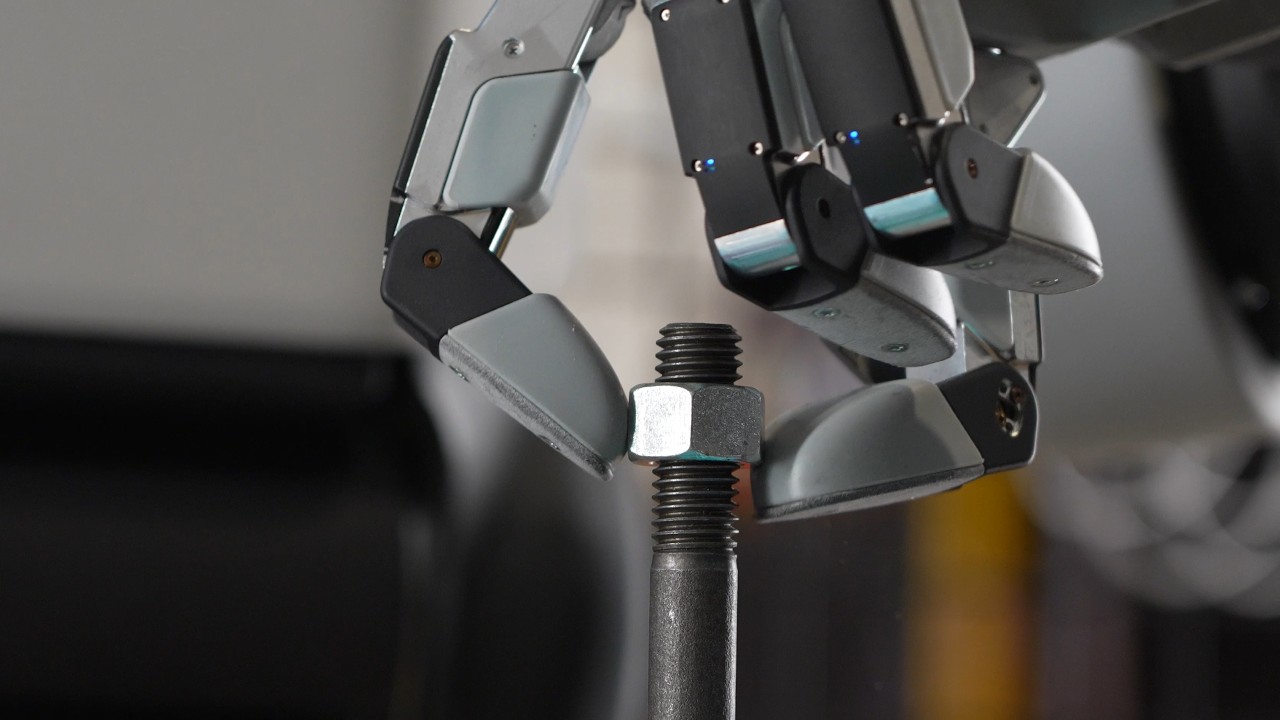

Boston Dynamics unveiled a four-finger, 13-degree-of-freedom hand for its Atlas humanoid, designed for tool use and mass manufacturing, first reported by Therobotreport. That shifts the hand's focus from grasping a wide variety of objects to manipulating them and using tools, with 13 degrees of freedom versus seven on earlier versions.
Previous Atlas hands had seven degrees of freedom and were designed to grasp a large variety of objects; the new hand shifts the focus to manipulating them. The thumb has four degrees of freedom, while each of the other three fingers has three.
Atlas mechanical engineer Dylan Thrush said the team decided a pinky’s added dexterity and tasks did not justify three more degrees of freedom, size, power consumption and actuator complexity. Before the design was finished, Zachary Jackowski asked team members to tape their pinky and ring finger together for a day and report what they could not do; the team agreed the robot hand did not need a pinky.
The hand can slide its thumb’s fingertip along the length and across the width of the other fingers, make pinch grasps between the thumb and any other finger, and form tripodal grasps. The listed capabilities also range from in-hand reorientation and slip recovery to handling tools while pressing their triggers, including drills, power torque drivers, grinders, nail guns and welding torches.
The joints use direct actuation with a single actuator type; the actuators are fully encapsulated, with no fragile cables crossing joints. The hand is similar in size to a large human hand, and Boston Dynamics said several unique actuation technologies maintained strength similar to the previous hand. Dense pressure tactile sensors cover the fingertips and palm and pick up small contact signals.
Boston Dynamics considers reinforcement learning in simulation essential to dexterous manipulation. Human demonstrations capture visual complexity, the company said, but wearable devices do not capture the high-rate closed-loop control and force regulation involved in fast, agile manipulation. Rigid-drive actuation and a backdrivable transmission, together with controls innovation to compensate for cogging and friction, make it possible to simulate the hand with high dynamic fidelity, the company said. Boston Dynamics said initial results show promising sim-to-real transfer in dynamic tasks; behaviors trained in simulation with domain randomization run on hardware using only high-rate actuator proprioception for feedback.