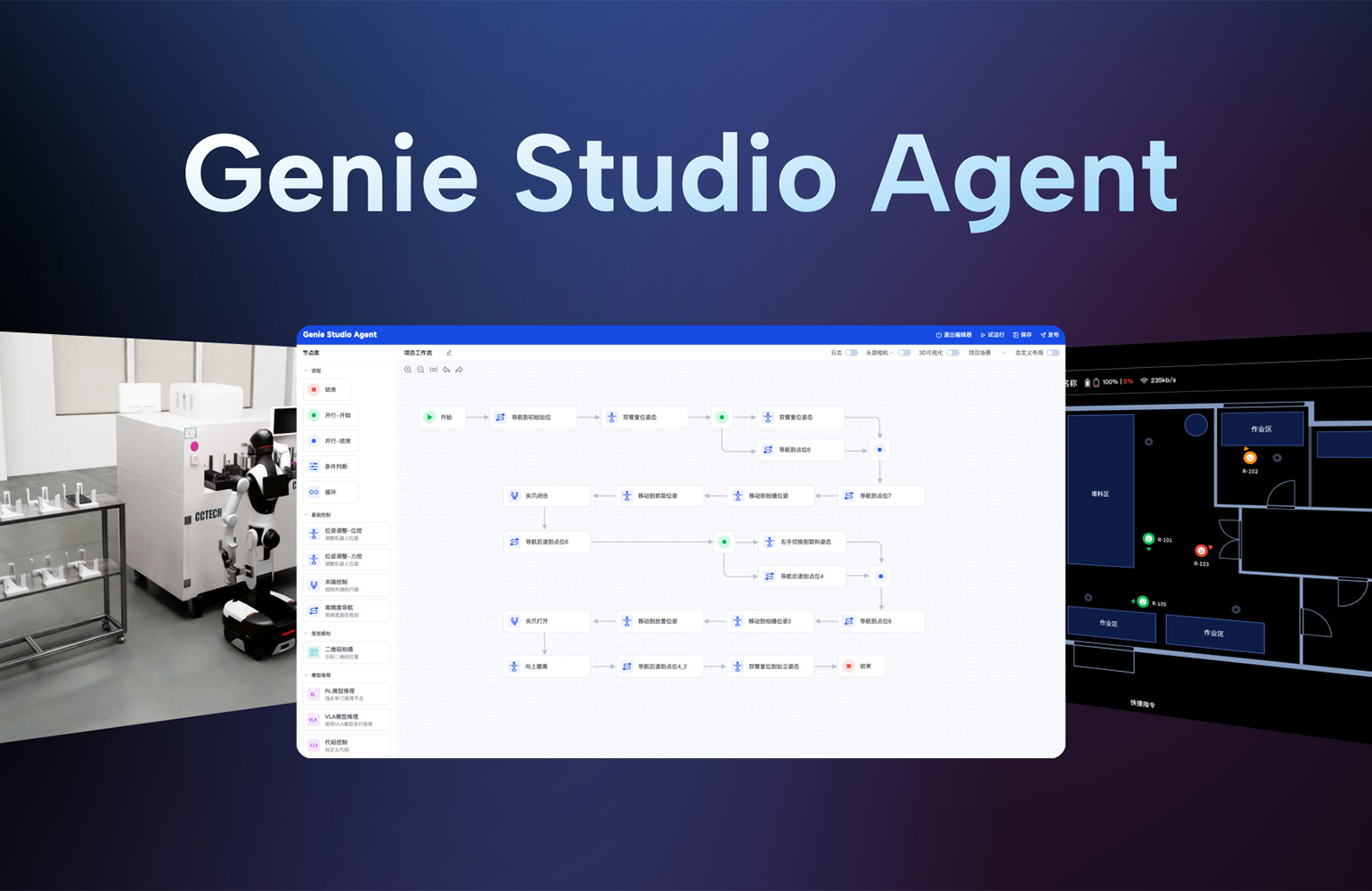

AGIBOT has launched Genie Studio Agent, a zero-code platform that lets non-engineers build, simulate, and deploy robot applications through a drag-and-drop interface. Already validated in semiconductor wafer handling with Huatian Technology, the platform targets the deployment bottleneck that has quietly slowed humanoid and industrial robot scaling — even as the underlying AI models have surged ahead.
Table of Contents
- What is AGIBOT Genie Studio Agent?
- The Four Core Capabilities
- Real-World Proof: Semiconductor Deployment
- What This Means for Robotics Democratisation
- Frequently Asked Questions
What is AGIBOT Genie Studio Agent?
Genie Studio Agent is a full-lifecycle software infrastructure for robot deployment — covering Vision-Language-Action (VLA) model integration, reinforcement learning, perception, motion control, and navigation — accessible through a visual, no-code interface. It sits on top of AGIBOT's existing SDK stack and is designed to let operators, system integrators, and domain experts configure and launch robot workflows without writing a single line of code.
This is a meaningful shift. The robotics industry has spent years solving the capability problem: can the robot perceive, plan, and act reliably? The answer, increasingly, is yes. But deploying that capability at scale — across factories, workshops, and logistics facilities — still demands custom engineering cycles, scenario-specific development, and costly on-site debugging. Each new site effectively restarts the process.
According to The Robot Report, AGIBOT designed Genie Studio Agent explicitly to break this pattern, shifting the company's go-to-market model from project-based deployments to ecosystem-driven scaling.
The strategic lineage matters here. In 2025, AGIBOT launched Genie Studio, a developer platform covering data collection, model training, evaluation, and deployment for VLA models. Genie Studio Agent is the downstream layer — the bridge between trained model and running robot — aimed at the audience that never had access to the first platform.
The Four Core Capabilities
Genie Studio Agent is built around four distinct technical pillars. Together they address the full arc from workflow design to long-term operational stability.
| Capability | Function | Key Benefit |
|---|---|---|
| No-code workflow orchestration | Drag-and-drop node editor for assembling perception, navigation, VLA, and RL components | Shifts development control from engineers to domain users |
| Simulation-first deployment | 3D reconstruction and virtual validation before production rollout | Eliminates first-deployment risk; robots arrive pre-validated |
| Real-world reinforcement learning | Continuous strategy refinement via force control and visual feedback | Robot performance improves in-operation, not just at training time |
| End-to-end monitoring | Unified visualisation of data, system states, and anomalies | Shifts maintenance from reactive to proactive |
The no-code orchestration layer is the most visible feature — perception, motion control, navigation, VLA models, and RL toolchains are each encapsulated as reusable components. Users connect them visually rather than integrating them programmatically. The analogy is closer to Zapier for enterprise software than to traditional ROS-based pipeline development — though unlike Zapier, the underlying execution layer handles real-time physical control, which is where the analogy breaks down. Latency, sensor fusion, and hardware-specific quirks still live beneath the surface; Genie Studio Agent abstracts them rather than eliminating them.
The simulation-first deployment pillar is arguably the more technically significant. Historically, robots are deployed and then debugged. Genie Studio Agent inverts this: 3D scene reconstruction lets users validate task execution, path planning, and object interactions in a virtual replica of the target environment before a single robot enters production. This directly addresses the cost structure that makes large-scale rollouts prohibitive — every hour of on-site debugging in a live manufacturing environment is exponentially more expensive than the same work done in simulation.
The real-world reinforcement learning component takes this further. Rather than treating deployment as a fixed end state, the platform treats it as the beginning of a continuous improvement loop. Robots refine grasping and placement strategies through real-time feedback, combining force sensing and visual perception. This shifts the operational model from instruction-based execution to self-optimising behaviour — a distinction that will matter enormously to buyers evaluating long-term total cost of ownership.
Real-World Proof: Semiconductor Deployment
AGIBOT has already deployed Genie Studio Agent in a production environment, not just a controlled demo. The partnership with Huatian Technology — a major player in semiconductor packaging and testing — involved a full wafer handling workflow: high-precision pose adjustment, navigation through complex facility layouts, force-controlled grasping, and RL-driven placement, all integrated into a single execution pipeline.
Wafer handling is a deliberately demanding proving ground. Semiconductor packaging requires sub-millimetre positional accuracy, clean-room protocol compliance, and zero tolerance for dropped or damaged components. If the platform can handle orchestrated multi-stage workflows in this environment, the bar for most industrial automation scenarios is lower by comparison.
AGIBOT has not published quantitative throughput or error-rate figures from the Huatian deployment, which limits independent evaluation at this stage. What the deployment does confirm is that the architecture is production-viable rather than purely conceptual — a distinction that separates Genie Studio Agent from a number of zero-code robotics tools that remain in perpetual beta.
The platform is designed as an open ecosystem: system integrators and industry partners can build on top of its capabilities, extending AGIBOT's reach without requiring direct engineering involvement at every new deployment site. This is the mechanism through which "ecosystem-driven scaling" actually happens — standardised deployment templates reduce each new integration to configuration rather than construction.
What This Means for Robotics Democratisation
The competitive implications of Genie Studio Agent extend well beyond AGIBOT's own product line. The deployment barrier has historically acted as a moat for large systems integrators — companies that generate substantial revenue from the custom engineering work that each new robot installation requires. A platform that compresses or eliminates that work changes the economics for everyone in the value chain.
For robot buyers — particularly mid-market manufacturers who lack in-house robotics engineering teams — zero-code deployment platforms could be the deciding factor when comparing humanoid and industrial robot options. The question shifts from "can we technically deploy this robot?" to "can our operations team actually run it?"
For humanoid robot platforms specifically, this is urgent. The leading humanoids are advancing rapidly at the hardware and model level, but real-world deployments remain limited in number. If you're evaluating options in the humanoid robot market, deployment complexity is as significant a factor as payload or locomotion capability — and Genie Studio Agent directly targets that friction.
For the broader competitive landscape, AGIBOT's move signals a platform strategy rather than a product strategy. The company is positioning itself not just as a robot manufacturer but as the operating layer through which robot applications are built and scaled. This is the same transition Boston Dynamics made with Orbit, and that Intrinsic (Alphabet's robotics software subsidiary) has been pursuing for several years. The race is no longer just about which robot has the best hardware — it is about which platform developers and integrators choose to build on.
For teams currently evaluating industrial automation options, the emergence of no-code deployment layers changes the total cost calculation significantly. Integration costs that historically exceeded hardware costs are now the primary target for compression.