

Two Chinese humanoid robots – the XPENG Robotics Iron and the Fourier GR‑1 – represent opposite ends of the humanoid spectrum: a cutting‑edge prototype with immense degrees of freedom versus a production‑ready workhorse that can already be put to work. This comparison breaks down every dimension that matters – from payload and battery life to software ecosystems and availability – to help you decide which one fits your lab, factory, or research programme.
XPENG Iron vs Fourier GR-1: Specs Compared
| Specification | XPENG Robotics Iron | Fourier GR-1 |
|---|---|---|
| Price (Base) | Undisclosed | $125,000 |
| Price (Configured) | Undisclosed | Up to $170,000 |
| Height | 173 cm | 165 cm |
| Weight | 70 kg | 55 kg |
| Payload | 20 kg | 50 kg |
| Max Speed | 5.8 km/h | 5 km/h |
| Battery Life | 4 hours | 2 hours |
| Degrees of Freedom | 72 | 40 |
| IP Rating | Not published | Not published |
| Onboard Compute | XPENG‑designed processing (details undisclosed) | Fourier proprietary compute |
| Sensors | Intel RealSense D435i depth camera, LiDAR, tactile hands | RGB‑D camera, optional LiDAR |
| SDK Languages | Undisclosed (prototype stage) | C++, Python |
| ROS2 Support | Unknown | Supported |
| Autonomy Software | Basic SLAM demonstrated; no fleet‑management stack | ROS2‑based autonomy; API available |
| Safety Certs | Not published | Not published |
| Availability | Enterprise‑only prototype; not for sale | Pre‑order available; lead times on inquiry |
| Warranty/Support | Not available | Direct manufacturer warranty & support |
The biggest delta is payload: the GR-1 lifts 2.5× more than the Iron. On pure specs, the Iron wins on agility and endurance, but the GR-1 dominates practical industrial capability.
XPENG Robotics Iron: High‑DOF Dexterity Prototype
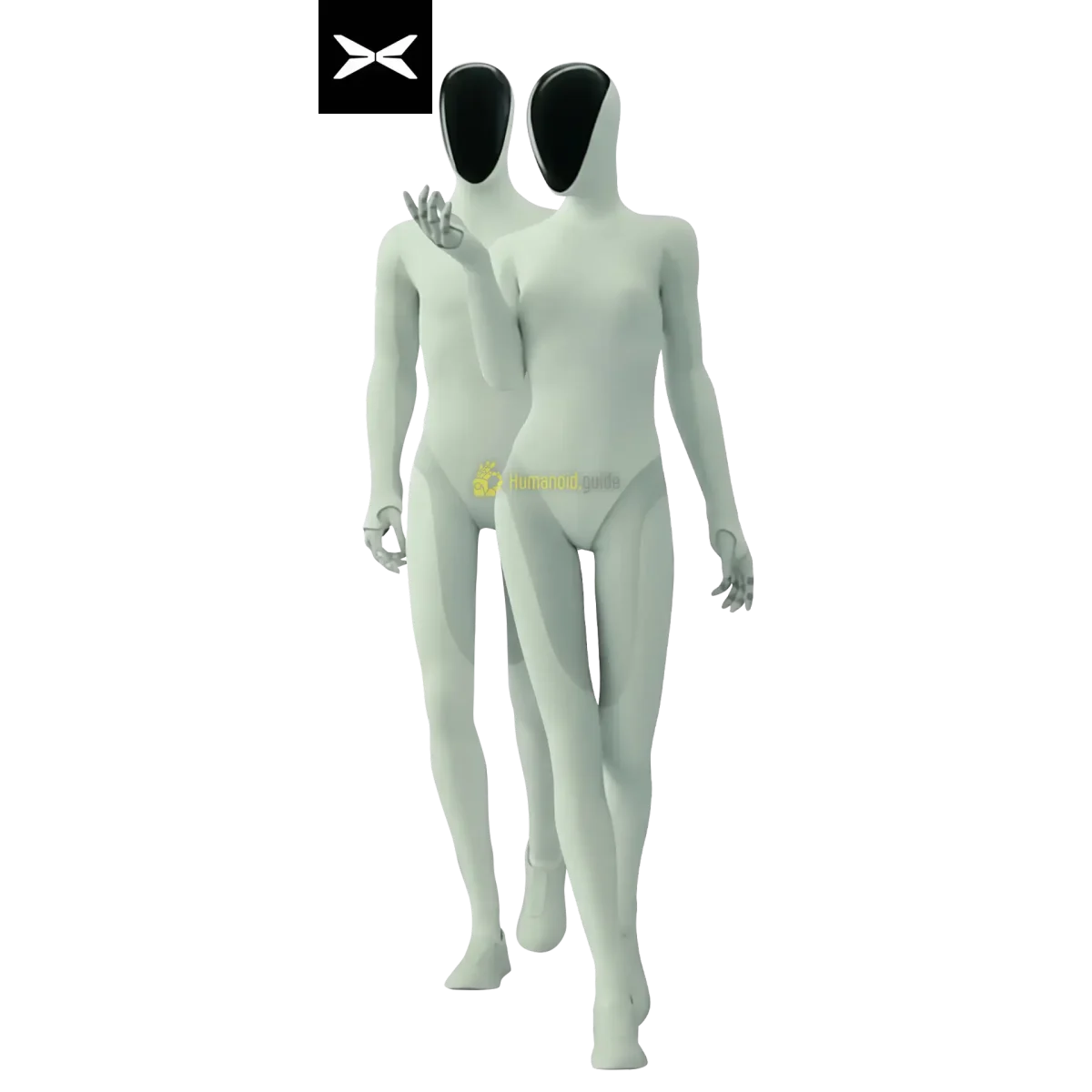
Unveiled in November 2024 by XPENG Robotics (Guangzhou, China), the Iron is a full‑size humanoid engineered for advanced dexterity and whole‑body manipulation. With 72 degrees of freedom – among the highest in any humanoid – it aims to replicate human‑like motion in factories and, eventually, in household settings. The robot stands 173 cm tall, weighs 70 kg, and integrates Intel RealSense D435i depth cameras, LiDAR, and custom tactile hands. Its 4‑hour battery life and 5.8 km/h walking speed suggest a strong balance of mobility and runtime. However, the Iron remains a pre‑production prototype; pricing, SDK details, and mass‑production timelines are all undisclosed. As of mid‑2026, it is shown only in XPENG’s own manufacturing pilots.
Fourier GR-1: Commercial Payload King
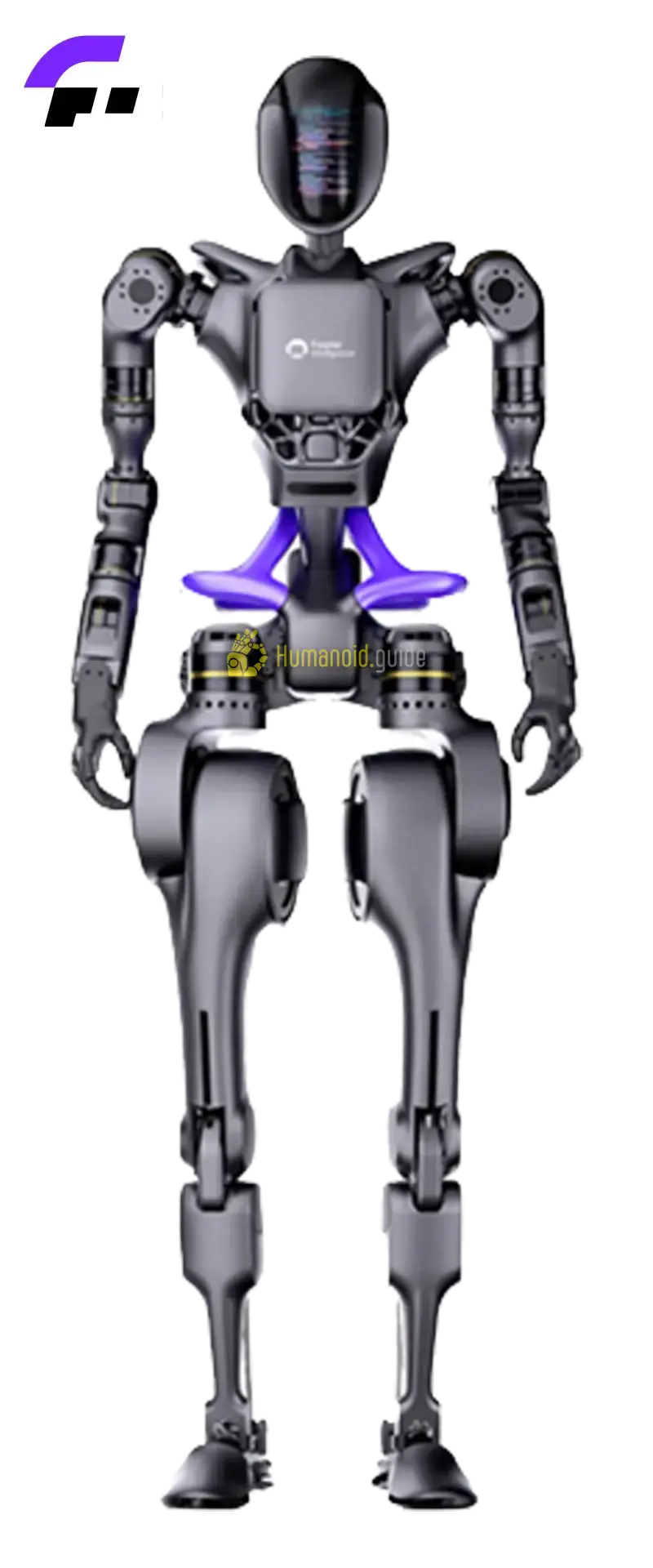
Launched in 2023 by Fourier Intelligence (Shanghai, China), the GR-1 is a commercially available humanoid that prioritise payload and scalability. At 165 cm and just 55 kg, it lifts 50 kg – more than double its own weight – making it one of the most capable humanoids for industrial handling tasks. It carries 40 degrees of freedom, a 5 km/h top speed, and a 2‑hour battery, which is sufficient for many shift‑based tasks. Crucially, Fourier has built a mature software stack with C++ and Python SDKs, ROS2 support, and direct factory warranty. Pre‑orders are open now, with pricing estimated between $125,000 and $170,000 depending on sensor and end‑effector configurations.
Price & Total Cost of Ownership
Fourier GR-1 offers a clear purchasing path: a base unit starts at about $125,000, with fully configured versions reaching $170,000. A 3‑year total cost of ownership (TCO) can be roughly estimated by adding $15,000–$25,000 per year for support contracts, software updates, and spare parts, yielding a TCO around $180,000–$270,000. Fourier also accepts direct purchase orders and can provide leasing options through its sales team.
For the XPENG Iron, no price, configurator, or TCO figure is available. As an enterprise‑only prototype, it is not yet a purchasable product. Any TCO estimate would be speculative. Organisations interested in evaluating the Iron must work directly with XPENG Robotics under an NDA; pricing may be disclosed only as part of a development partnership.
Winner: Fourier GR-1 – it has a transparent price and a predictable ownership model. The Iron cannot be compared on cost.
Performance & Specs Head‑to‑Head
Payload
The GR-1’s 50 kg payload massively outperforms the Iron’s 20 kg. This makes the GR-1 immediately useful for lifting heavy parts, palletising, or tool handling. The Iron’s lower payload reflects its focus on precision manipulation rather than brute strength.
Winner: Fourier GR-1 for heavy‑lifting industrial applications.
Speed & Mobility
Both robots walk at comparable speeds: 5.8 km/h for the Iron and 5 km/h for the GR-1. The difference is marginal in practical terms; neither humanoid is designed for high‑speed locomotion.
Winner: Tie – within operational tolerance.
Battery Life
The Iron’s 4‑hour battery offers twice the runtime of the GR-1’s 2‑hour battery. For continuous operation in a research lab or light industrial shift, the Iron’s endurance is a significant advantage. The GR-1 may require mid‑shift battery swaps or tethered operation for longer tasks.
Winner: XPENG Iron for untethered runtime.
Degrees of Freedom
72 DOF versus 40 DOF is a huge gap. The Iron’s extra joints – particularly in its dexterous hands and torso – enable rich manipulation and full‑body coordination that the GR-1 cannot match. For tasks requiring fine motor control, the Iron is the more capable platform once it matures.
Winner: XPENG Iron for dexterity.
Software & SDK Ecosystem
The Fourier GR-1 ships with a proven developer ecosystem: C++ and Python SDKs, full ROS2 integration, and an active support team. This opens the door to rapid prototyping, custom application development, and integration into existing automation stacks.
XPENG has not yet published any SDK, API, or ROS2 bridge for the Iron. As a pre‑production platform, third‑party development is not yet possible. Organisations that need to start coding today will face a dead end with the Iron.
Winner: Fourier GR-1 – a mature, ready‑to‑use software environment.
Autonomy & Sensors
The Iron carries Intel RealSense D435i depth cameras, LiDAR, and tactile feedback hands – a sensor suite that hints at advanced SLAM and dexterous object manipulation. Demos at XPENG’s factory show basic autonomous navigation, but no fleet‑management or multi‑robot coordination has been demonstrated.
The GR-1 relies on an RGB‑D camera with optional LiDAR expansion. Its autonomy features are built on ROS2 and can be extended by the user, though out‑of‑the‑box advanced navigation is less ambitious than the Iron’s intended capability.
Winner: XPENG Iron in sensor richness (on paper); Fourier GR-1 in practical, extendable autonomy today.
Build Quality & Durability
Neither manufacturer publishes an IP rating or formal durability data. The Iron’s higher weight (70 kg vs 55 kg) suggests a more robust frame, but this is unverified outside of lab conditions. The GR-1’s lighter build and modular joint design have proven reliable in several university pilot deployments, though no long‑term industrial durability figures are public.
Winner: Tie – insufficient data for a conclusive winner.
Which Should You Buy? XPENG Iron vs Fourier GR-1 by Use Case
- Choose the XPENG Iron if…
- You are an R&D lab exploring full‑body humanoid motion, dexterous manipulation, and high‑DOF control.
- You can wait 12–18 months (or longer) for a commercial release and are willing to collaborate directly with XPENG.
- 4‑hour runtime and advanced sensors are more important than immediate availability or payload.
- Choose the Fourier GR-1 if…
- You need a humanoid that lifts heavy loads (up to 50 kg) for manufacturing, logistics, or research.
- You require a robot that is available now, with an open SDK, ROS2, and manufacturer support.
- You want a predictable price and the ability to scale your fleet.
- Choose neither if…
- You have a strict budget below $100,000 – both are premium platforms.
- You require IP65+ for harsh environments; neither is rated.
- You need a proven industrial track record with hundreds of deployed units – both are still early in deployment.
Real‑World Deployments & Track Record
XPENG Iron: The robot has been demonstrated in XPENG’s own vehicle manufacturing plants, performing assembly and material‑handling tasks under controlled conditions. No third‑party deployments, unit sales, or independent operating hours have been reported as of mid‑2026.
Fourier GR‑1: Fourier Intelligence has shipped units to several research institutions and automation partners, though exact numbers are not public. Early adopters have validated the API and payload performance in lab settings. However, there are no publicly documented large‑scale production lines running the GR‑1 around the clock.
SDK, Software & Developer Ecosystem
The Fourier GR-1’s software suite is a decisive differentiator. With native C++ and Python libraries and full ROS2 support, developers can interface with the robot’s joints, sensors, and autonomy stack immediately. This reduces integration time and allows teams to build custom applications from day one.
The Iron, by contrast, remains a black box from a software standpoint. Without published APIs, simulation models, or an ROS bridge, prospective developers cannot evaluate the platform’s software capabilities. Organisations that depend on an open architecture should treat this as a major limitation until XPENG ships a public SDK.
Support, Warranty & Availability
Fourier GR-1: Available for pre‑order worldwide through Fourier’s direct sales channels. Standard warranty and technical support are included; extended service contracts are negotiable. Lead times depend on configuration but are typically measured in weeks, not years.
XPENG Iron: Currently not for sale. Enterprise‑only prototype access is granted on a case‑by‑case basis, with no warranty or support commitment. Organisations should anticipate NDA‑encumbered evaluations and uncertain delivery schedules.
Conclusion & Recommendation
The XPENG Iron showcases where humanoid robotics is heading – 72 DOF, 4‑hour endurance, and an impressive sensor suite – but it is not a product you can buy or rely on today. The Fourier GR-1 is the tangible opposite: a high‑payload, ROS2‑ready humanoid that ships with a clear price tag and manufacturer backing. For any industrial or research application that demands hardware now, the GR-1 is the smart, low‑risk bet. Lock in a pre‑order for the GR-1 to start development today; keep the Iron on your radar as a future dexterity platform once it reaches production.
Comments