

Verdict: Unitree G1 vs Unitree H2 at a Glance The Unitree G1 starts at $13,500 and fits compact labs and classrooms with its 127–132 cm height, 35 kg weight, and 3 kg payload. The full‑size Unitree H2 starts at $29,000, stands 182 cm tall, weighs 70 kg, lifts 7 kg, and runs for 3 hours per charge. For most research, education, and light manipulation tasks the G1 delivers better value; choose the H2 when your application demands a human‑scale form factor, higher payload, or longer runtime.
The Unitree G1 and Unitree H2 are both bipedal humanoid robots from Unitree Robotics, yet they target fundamentally different workspaces and buyers. The G1 is the company’s compact, entry‑level platform — affordable enough to fit a university lab budget. The H2 is its full‑size, more powerful successor to the H1, priced to sit between the G1 and premium competitors. This article compares every detail that matters when you’re deciding which Unitree humanoid to put on your floor: price configurations, real‑world specs, handling, software, and the day‑to‑day ownership experience. By the end you’ll know exactly which model fits your lab, factory pilot, or classroom — and where the hidden trade‑offs lie. (Both robots are available on Robot Overflow: Unitree G1 and Unitree H2.)
Quick Verdict: Who Wins?
- Best overall value — Unitree G1. For less than half the H2’s base price you get a programmable, ROS2‑ready humanoid that handles the vast majority of research and education tasks.
- Best for research & education — Unitree G1. Compact size, lower weight, and multiple configuration tiers (Base, EDU, Ultimate) make it the safest, most cost‑effective teaching tool.
- Best for industrial‑scale pilot tasks — Unitree H2. A 7 kg payload, 3‑hour battery, and full 182 cm stature let it replicate human‑height assembly and logistics workflows.
- Best budget pick — Unitree G1 (Base). At $13,500 it remains the most affordable ROS2‑capable humanoid you can buy today.
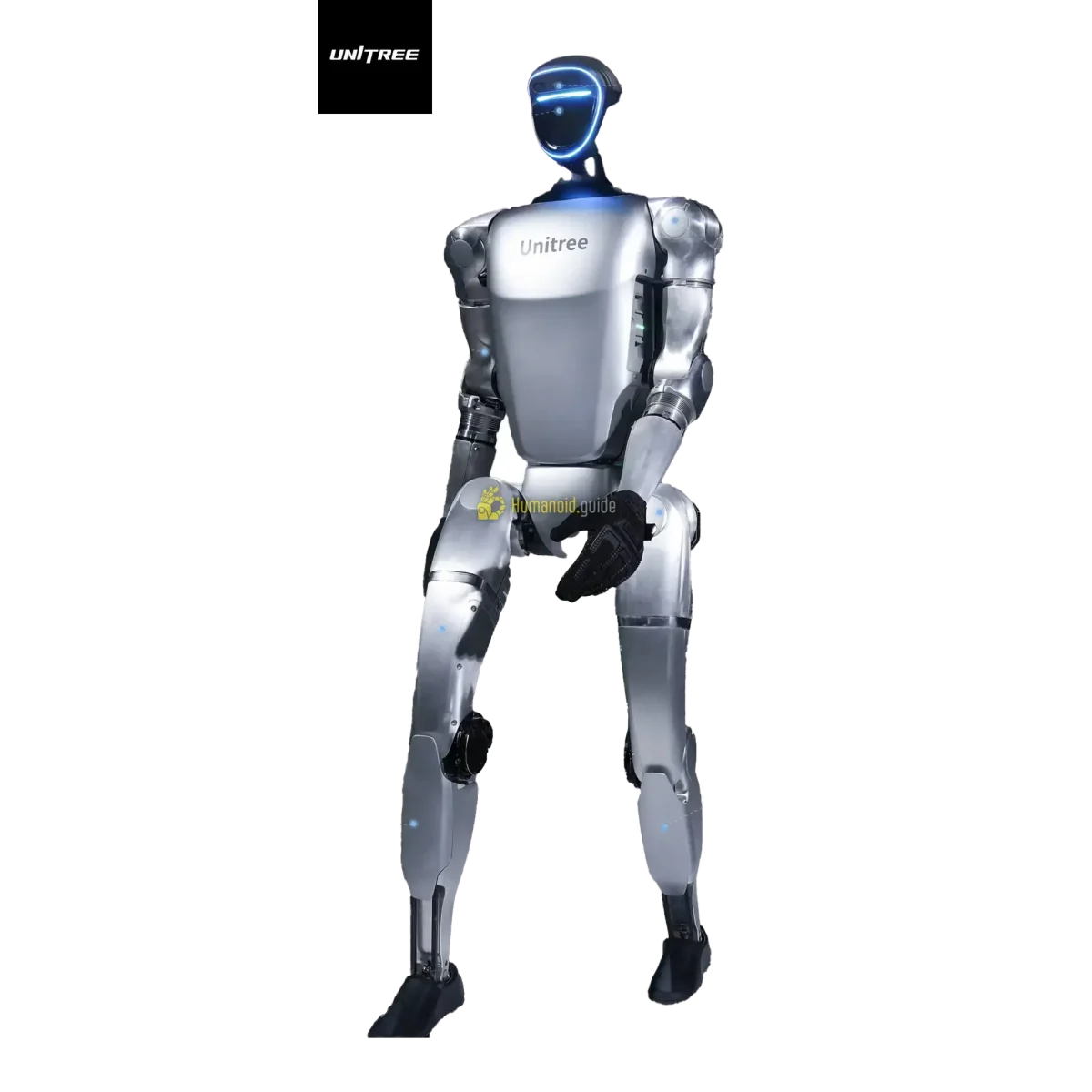
Unitree G1 vs Unitree H2: Specs Compared
The side‑by‑side table below captures the hard numbers you need. Both robots share Unitree’s latest joint‑actuation technology and ROS2 support; the differences in size, payload, runtime, and price define which use‑cases each serves best.
| Specification | Unitree G1 | Unitree H2 |
|---|---|---|
| Price (base) | $13,500 | $29,000 |
| Price (configured) | Up to $73,900 | Up to $60,000 |
| Weight | 35 kg | 70 kg |
| Height | 127–132 cm | 182 cm |
| Payload | 3 kg (arm end‑effector) | 7 kg (arm end‑effector) |
| Max speed | 7.2 km/h | 5.4 km/h |
| Battery life | 2 hours | 3 hours |
| Degrees of freedom | 23–43 (config dependent) | 31 |
| IP rating | IP54 | Undisclosed |
| Onboard compute | Jetson Orin NX | Undisclosed (expected ≥ Jetson Orin) |
| Sensors/LiDAR | Intel RealSense D435i, optional 3D LiDAR | Undisclosed |
| SDK languages | C++, Python, ROS2 | C++, Python, ROS2 (expected) |
| ROS2 support | Yes (Unitree ROS2 driver) | Yes (confirmed) |
| Autonomy/fleet | Unitree SDK; limited fleet mgmt | Unitree SDK; fleet capabilities TBA |
| Safety certs | CE, FCC (IP54) | Pending (pre‑order) |
| Availability | In production, shipping now | Pre‑order; first shipments April 2026 |
| Warranty/support | 1‑year standard; enterprise optional | Expected 1‑year (details TBA) |
The biggest deltas leap out immediately: the H2 costs 115 % more at base level but doubles the payload and adds a full hour of battery life. The G1 is quicker on its feet, but the H2’s 70 kg mass and larger frame suggest it’s built for heavier, longer‑duration tasks — a classic trade‑off between affordability and muscle.
Unitree G1: Compact, Research‑Friendly Humanoid

Unitree Robotics, headquartered in Hangzhou, launched the G1 in 2024 as its most accessible bipedal platform. Unlike towering full‑size humanoids, the G1 stands just over four feet tall and weighs only 35 kg — light enough that two people can carry it up a flight of stairs without a hoist. The robot ships with a Jetson Orin NX compute module and an Intel RealSense D435i depth camera, with an optional 3D LiDAR for SLAM. Configurations range from a bare‑bones 23‑DOF Base model to the fully‑loaded Ultimate variant with 43 degrees of freedom, dexterous hands, and expanded sensor packages. At $13,500 for the base configuration, the G1 undercuts virtually every other ROS2‑capable humanoid on the market, making it the go‑to choice for university labs, STEM outreach programs, and companies conducting early‑stage manipulation research. Unitree has shipped hundreds of units since launch, and the G1 is now a familiar sight at robotics competitions and academic conferences worldwide.
Unitree H2: Full‑Scale Humanoid for Industry‑Scale Pilots
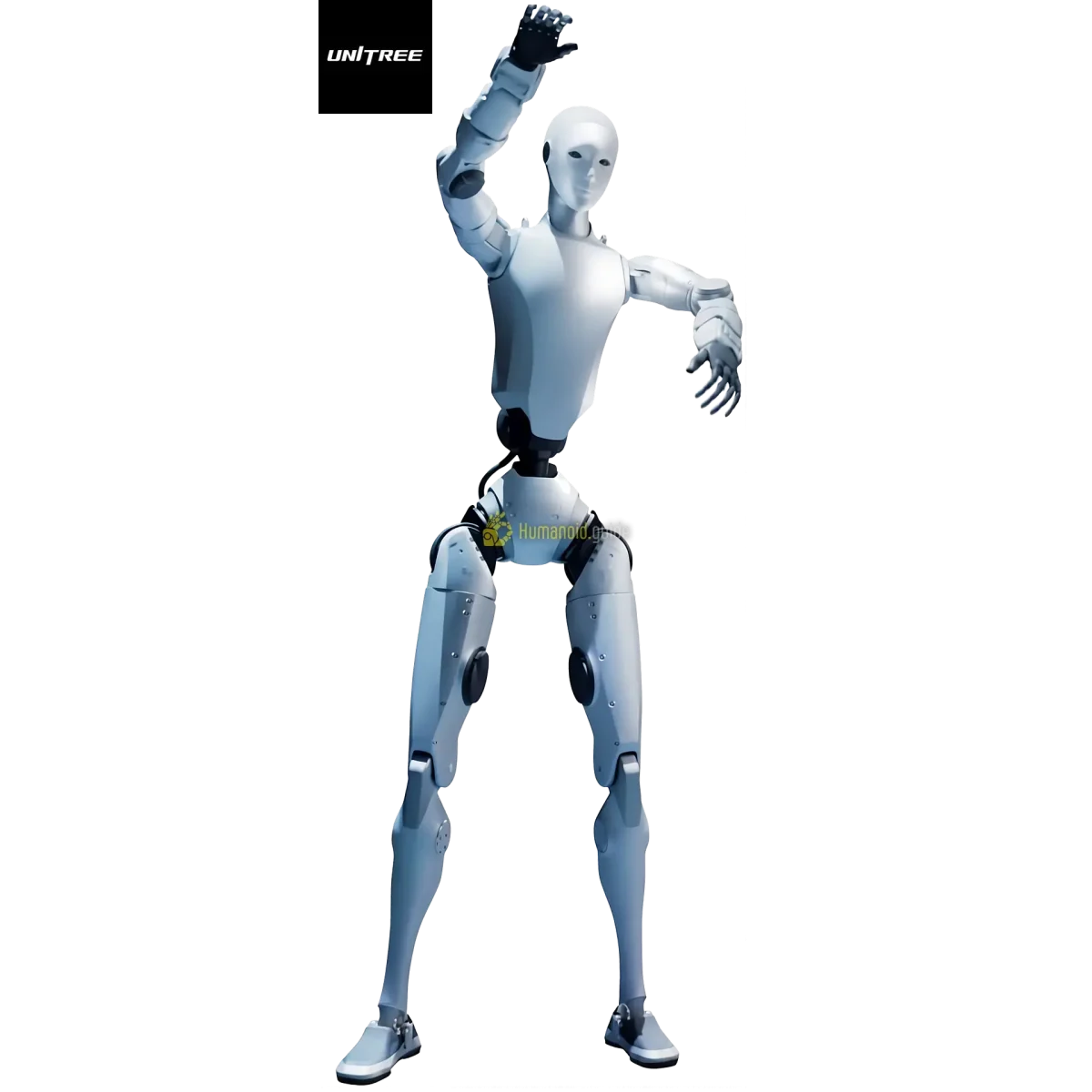
Announced in 2025 as the successor to the record‑breaking H1, the Unitree H2 scales the humanoid blueprint up to 182 cm and 70 kg — the same height and weight ballpark as an average adult male. The arms now offer 7 DOF each, a significant upgrade over the H1, enabling more natural manipulation and tool use. A bionic head with expressive facial features rounds out the more human‑like appearance. Underneath, Unitree claims a 31‑DOF architecture (likely 6 per leg, 7 per arm, plus torso/head), a payload of 7 kg, and a 3‑hour battery — figures that position the H2 as a direct competitor to mid‑range industrial humanoids. With a starting price of $29,000, the H2 aims to fill the gap between the budget G1 and premium‑priced Western platforms. As of mid‑2026, the H2 is available for pre‑order only, with initial shipments expected in April 2026; no large‑scale deployment data exists yet, though early demos at trade shows have showcased box‑carrying and valve‑turning tasks.
Price & Configurations
Both robots span wide configuration ranges, but the cost trajectories differ sharply.
- Unitree G1 Base ($13,500): 23 DOF, basic arms, no LiDAR, educational software license.
- Unitree G1 EDU ($22,000–$40,000 approx.): 29–35 DOF, advanced hands, optional LiDAR, richer SDK.
- Unitree G1 Ultimate (up to $73,900): 43 DOF, full sensor suite, high‑precision hands, enterprise support.
- Unitree H2 base ($29,000): 31 DOF, 7‑DOF arms, bionic head, standard compute.
- Unitree H2 configured (up to $60,000): likely adding sensor packages, enhanced compute, and fleet management software; exact breakdowns not yet public.
Winner: Unitree G1 offers dramatically more entry‑level flexibility — you can start at $13,500 and scale up. The H2 demands a $29K minimum buy‑in, putting it out of reach for many academic budgets.
Performance & Specs
Payload
G1’s 3 kg per arm is adequate for picking up light objects (a water bottle, a small tool), but it cannot handle the 5–7 kg industrial totes and parts that the H2 can. Winner: H2, by a clear margin for any material‑handling application.
Speed
G1’s 7.2 km/h top walking speed beats the H2’s 5.4 km/h. However, both are bipeds; sustained walking speed in real environments is usually lower. Winner: G1, for speed‑sensitive navigation tasks.
Battery Life
G1 provides 2 hours of runtime, H2 delivers 3 hours — a 50 % advantage that reduces downtime in continuous‑operation pilots. Winner: H2.
Degrees of Freedom
The G1 can be configured up to 43 DOF (Ultimate), exceeding the H2’s fixed 31 DOF. Those extra DOF mainly go into dexterous hands and additional waist/head joints, useful for fine manipulation research. In its base 23‑DOF trim the G1 is less articulated than the H2. Winner: Tie — G1 Ultimate offers more articulation, H2 offers more in the base price.
Software & SDK Ecosystem
Both robots run Unitree’s proprietary SDK with C++ and Python APIs, and both are fully integrated with ROS2 through the official Unitree ROS2 driver. Simulation support — via NVIDIA Isaac Sim and Gazebo — is available for the G1 and expected to carry over to the H2. The G1 benefits from a larger user community, a growing collection of open‑source ROS2 packages, and well‑documented setup guides (many written by university labs). The H2, being newer, has a smaller knowledge base, though its software will almost certainly converge with the G1’s as the platform matures.
Winner: G1, for its established community, proven ROS2 driver, and extensive third‑party tutorials. The H2 will catch up, but early adopters should expect lighter documentation.
Autonomy & Sensors
The G1’s sensor suite is well‑documented: Intel RealSense D435i depth camera, optional 3D LiDAR, and an IMU for state estimation. The H2’s sensor complement has not been fully disclosed; Unitree has hinted at a similar camera‑LiDAR stack but no concrete details yet. Both platforms support Unitree’s perception SDK for object detection and SLAM, though advanced autonomy features (fleet coordination, dynamic obstacle avoidance) are still in active development across the Unitree line. Currently, neither robot ships with an “out‑of‑the‑box” autonomous task framework — integrators must build or adapt their own.
Winner: G1, purely because its sensor specs are transparent and the community has validated them. The H2’s sensor suite remains an open question.
Build Quality & Durability
The G1 carries an IP54 rating, meaning it’s protected against limited dust ingress and splashing water — suitable for indoor lab environments and light outdoor use. The H2’s IP rating has not been published, though its 70 kg mass and metal‑body construction (visible in press images) suggest a more robust frame destined for factory floors. Both robots use Unitree’s in‑house joint actuators with hollow‑shaft motors, which have proven reliable across the company’s quadruped and humanoid lines. Operating temperature range is not specified for either model, but standard indoor assumptions (0–40 °C) likely apply.
Winner: H2 (projected) — the heavier, larger build and likely higher‑torque joints give it an edge for industrial wear and tear. The G1 is properly sealed for a lab, but it’s not a factory workhorse.
Price & Total Cost of Ownership
Comparing sticker prices is only half the story. A three‑year total cost of ownership (TCO) must include software subscriptions, spare parts, and the cost of any downtime.
- G1 Base 3‑year TCO: ~$16,000 (hardware $13,500, plus ~$2,500 for software updates and basic spares).
- G1 Ultimate 3‑year TCO: ~$80,000 (including enterprise support and advanced sensor maintenance).
- H2 Base 3‑year TCO (estimated): ~$34,000 (hardware $29,000, ~$5,000 software/support/spares, assuming warranty and parts availability match G1’s structure).
- H2 Configured 3‑year TCO: likely $70,000+.
No lease or RaaS (Robot‑as‑a‑Service) programs have been announced for either model, though Unitree’s enterprise support plans include extended warranties and priority spare‑parts shipping for G1 Ultimate buyers; similar packages are expected for the H2.
If you need a humanoid now and have a tight budget, the G1 is the only sensible choice. If your application demands a 7 kg payload and a full‑size stature, the H2’s higher upfront cost may be justified by the greater per‑charging‑hour work output.
Winner: Unitree G1 on pure value. The H2 is cost‑competitive among full‑size humanoids, but it’s still 2× the price for capabilities that many buyers won’t need.
Which Should You Buy? Unitree G1 vs Unitree H2 by Use Case
- Choose the Unitree G1 if…
- You’re outfitting a university lab or STEM classroom — $13,500 buys a real bipedal platform with ROS2.
- Your research focuses on reinforcement learning, bipedal locomotion, or light manipulation (picking ≤3 kg objects).
- Space is tight: at 127–132 cm and 35 kg, the G1 can share a bench with undergraduate projects.
- You want a platform with a large user community, code examples, and proven reliability.
- Choose the Unitree H2 if…
- Your pilot project mimics human‑height assembly, logistics, or inspection tasks — the 182 cm stature and 7 kg payload let you test real‑world workflows.
- You need longer runtimes (3 hours) for continuous‑operation demonstrations.
- You’re willing to accept pre‑order risk and lighter documentation in exchange for a more capable baseline.
- Choose neither if…
- You need an industrial‑grade humanoid with a proven 10,000‑hour duty cycle — both Unitree models are still in the “proof‑of‑concept” to “pilot” maturity band.
- Your payload requirement exceeds 7 kg — consider full‑size industrial arms or a dedicated cobot instead.
Real‑World Deployments & Track Record
The G1 has been adopted by a broad set of early users: university research groups in Europe, North America, and Asia; robotics clubs; and at least one international humanoid soccer league. Unitree has not published official shipment numbers, but industry estimates suggest several hundred units are in the field as of mid‑2026, with some labs logging hundreds of hours of autonomous walking and manipulation. Deployment examples include locomotion benchmarking at the University of Edinburgh and a multi‑robot coordination demo at ICRA 2025.
The H2, by contrast, has no public deployment track record yet. Pre‑orders opened in late 2025; first units are scheduled to ship in April 2026. Early footage from Unitree shows the H2 carrying boxes and using tools, but no independent labs have reported long‑term usage data. Buyers should expect a “pioneer” experience — documentation will improve, but you’ll be among the first to push the platform beyond the factory.
SDK, Software & Developer Ecosystem
Unitree provides a unified software stack across its product line. Features include:
- C++ and Python SDKs with full joint‑level control, IMU streaming, and camera access.
- Official ROS2 driver (tested on Humble and Rolling) that exposes topics for odometry, joint states, and camera feeds.
- Simulation models for Isaac Sim and Gazebo, publicly available for the G1 and expected for the H2.
- Perception libraries for object detection and simple SLAM, though many labs implement their own perception pipelines.
The G1 benefits from a year‑plus head start: its ROS2 packages are stable, and the community has contributed teleoperation interfaces and reinforcement‑learning environments. The H2 will inherit much of this ecosystem, but early adopters should budget time for driver integration and calibration.
Support, Warranty & Availability
- Unitree G1: In full production. Lead time is typically 4–8 weeks for standard configurations, with enterprise support options available for 24/7 assistance and faster spare‑parts delivery. Standard warranty: 1 year.
- Unitree H2: Currently pre‑order only. First shipments expected April 2026. Unitree has not yet released a detailed warranty or support plan, but a 1‑year baseline and enterprise upgrade path are likely, mirroring the G1’s structure. Purchasing is via Unitree’s direct sales channel or authorized resellers; Robot Overflow can assist with both models.
Comments