

The defining tension in the humanoid robotics market today is between an affordable, available platform and an aspirational prototype that never reached the market. The Unitree G1 is a production humanoid from Hangzhou, China, with a base price of $13,500 and configurations scaling to $73,900, while the Tesla Optimus Gen 1 is a 2023‑era concept by Tesla that showed 20 kg payload and 28 degrees of freedom but never shipped to customers. This article compares every dimension that matters — specs, price, software, real‑world deployments, and total cost of ownership — to help engineers, procurement managers, and researchers decide which path to take.
- Best overall humanoid you can actually buy: Unitree G1 — the only option on the market, with three configurable tiers and a shipping product.
- Best for research & universities: Unitree G1 Base or EDU — affordable, ROS2‑ready, and repairable.
- Best for light industrial pilots: Unitree G1 Ultimate — up to 43 DOF, NVIDIA Jetson Orin, and 3 kg payload with integrated sensing.
- Best vision of future dexterity (not purchasable): Tesla Optimus Gen 1 — 20 kg payload floor‑lifting and 28 DOF, but never sold.
- Best budget pick: Unitree G1 Base — $13,500, the lowest entry point for a full‑size humanoid.
Unitree G1 vs Tesla Optimus Gen 1: Specs Compared
| Feature | Unitree G1 | Tesla Optimus Gen 1 |
|---|---|---|
| MSRP (base) | $13,500 | Undisclosed / N/A |
| Price (configured) | $73,900 (Ultimate) | N/A |
| Availability | In production, direct purchase | Enterprise‑only prototype; discontinued |
| Height | 127 cm – 132 cm | 173 cm |
| Weight | 35 kg | 73 kg |
| Payload | 3 kg (two arms) | 20 kg |
| Max speed | 7.2 km/h | 2 km/h (walking demonstration) |
| Battery life | 2 hours | 4 hours (target) |
| Degrees of freedom | 23–43 (config‑dependent) | 28 |
| IP rating | Not published | Not published |
| Onboard compute | NVIDIA Jetson Orin (EDU/Ultimate); ARM‑based (Base) | Tesla FSD computer (custom) |
| Sensors | 4× fisheye cameras, Intel RealSense D435i depth, Livox LiDAR, IMU | Cameras, ultrasonic sensors, IMU (speculative) |
| SDK / ROS2 | Unitree SDK (Python, C++), ROS2 support | No public SDK |
| Autonomy features | Visual SLAM, autonomous navigation, whole‑body control | Proof‑of‑concept walking, object lifting |
| Safety certifications | Not published | Not published |
| Warranty / support | 1‑year warranty, documented service channels | None (prototype) |
The spec table makes the dynamic clear: the G1 is a real product with published prices, shipping hardware, and a developer ecosystem, while Optimus Gen 1 is a high‑payload concept that left no commercial footprint. The only undisputed win for Optimus is raw payload — 20 kg versus the G1’s 3 kg — but without a purchase path, that advantage remains theoretical.
Unitree G1: Affordable, Available Humanoid for Research & Pilots
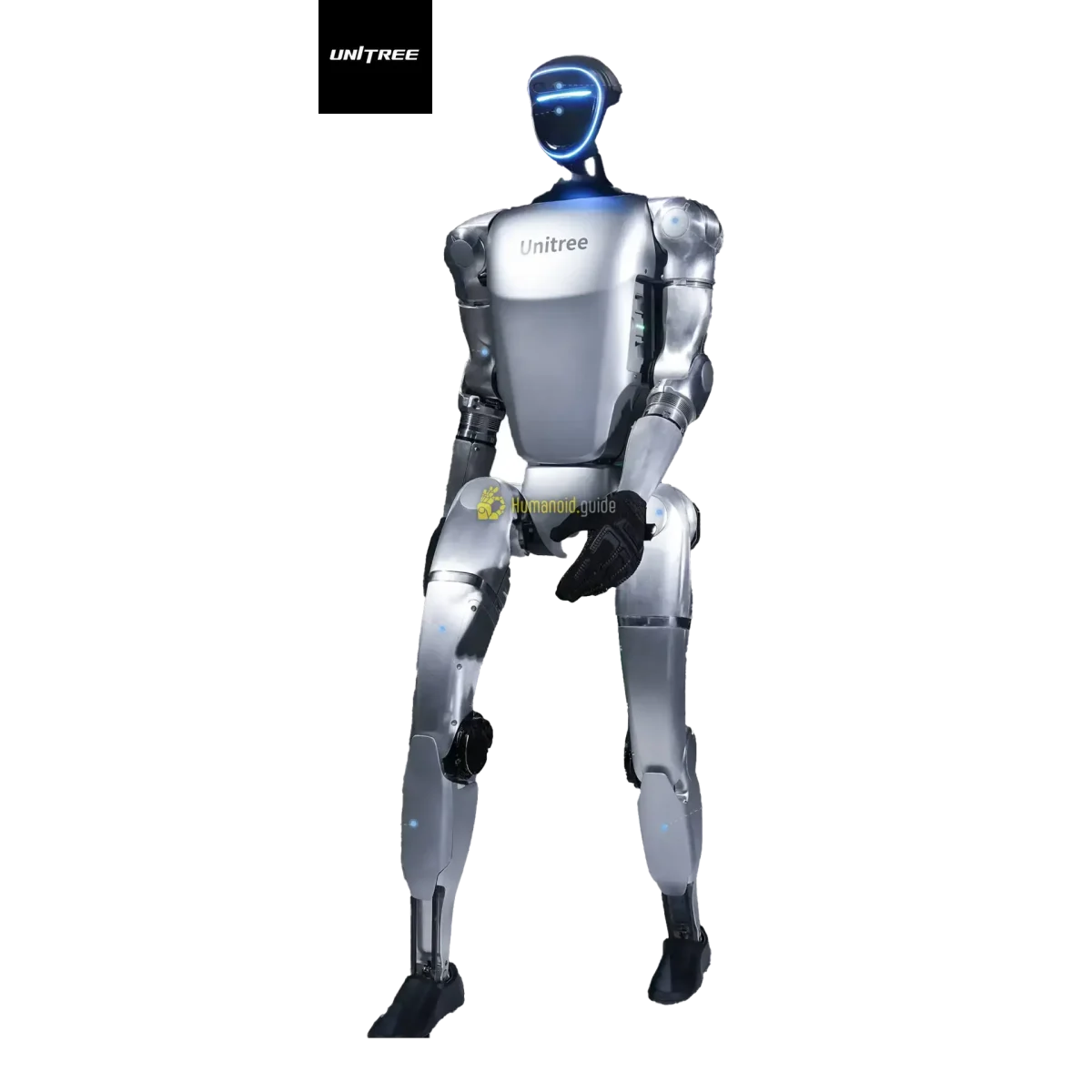
Launched in 2024 by Unitree Robotics, the G1 is a production‑ready bipedal platform that has shipped to universities, R&D labs, and integrators across North America, Europe, and Asia. Three configurations span a wide budget range: the Base model (23 DOF, $13,500) provides full walking, sensing, and SDK access; the EDU (up to 29 DOF, ~$43,900) adds an NVIDIA Jetson Orin module, a larger battery, and expanded IO; and the Ultimate (43 DOF, $73,900) includes dexterous hands, enhanced whole‑body torque control, and full autonomy software. All variants run a single 35 kg chassis that stands 127–132 cm tall, can walk at up to 7.2 km/h, and carries a 3 kg payload. The G1 is sold with a one‑year warranty and supported by a growing community of developers who use Unitree’s Python/C++ SDK and native ROS2 drivers.
Tesla Optimus Gen 1: Tesla’s First Humanoid Prototype (Discontinued)
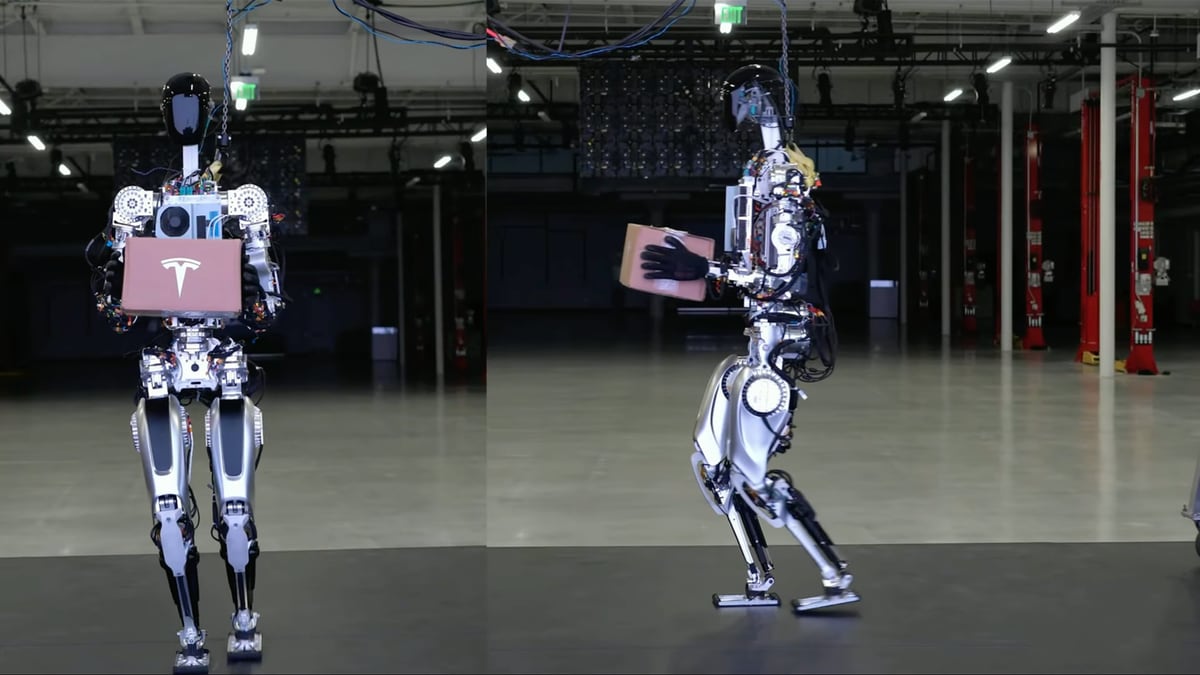
Tesla’s Optimus Gen 1, shown at Tesla AI Day 2022 and briefly in 2023, was a 73 kg, 173 cm tall prototype that demonstrated walking, box lifting, and basic manipulation. It boasted 28 degrees of freedom, a claimed 20 kg payload capacity, and a target 4‑hour battery life — numbers that, on paper, greatly exceeded most early‑2020s humanoids. However, Tesla never offered Gen 1 for sale, and all units remained inside Tesla’s own engineering labs. The platform was succeeded by Optimus Gen 2 (2023) and Gen 3 (2025), rendering Gen 1 a historical reference. No SDK, ROS2 support, or third‑party deployment data exist for Gen 1. The robot’s primary value today is as a vision of Tesla’s manufacturing‑focused humanoid strategy; it offers zero practical purchasing or deployment possibilities.
Price & Configurations
The G1’s pricing model is transparent and scalable: $13,500 for the Base, a mid‑tier EDU that retails for approximately $43,900, and the fully‑loaded Ultimate at $73,900. Discounts for educational institutions are unofficially reported, and a small secondary market for used EDU units has appeared at $10,000–$60,000. In contrast, Optimus Gen 1 had no price. Tesla’s internal targets speculated a future mass‑manufactured cost of $20,000–$30,000, but no unit was ever sold or listed. Winner: Unitree G1 — it is the only robot here with an MSRP, purchasing channels, and a price‑to‑capability ratio that can be evaluated.
Performance & Specs
Payload, Speed & Size
The G1 carries 3 kg across two arms and can move at 7.2 km/h, making it one of the fastest humanoids available. Optimus Gen 1’s 20 kg payload is in a different league, but its 2 km/h walking speed was slow and only shown in controlled demos. The G1’s compact 127–132 cm stature suits confined spaces; Optimus’ 173 cm height and 73 kg mass demand a larger operating envelope. Winner: Unitree G1 for speed and deployable mobility; Tesla Optimus for payload capability on paper, but this cannot be verified off‑Tesla premises.
Battery Life & Runtime
Unitree rates the G1 at 2 hours of continuous walking and manipulation; hot‑swappable batteries are not yet standard. Tesla claimed Optimus Gen 1 could run for 4 hours on a single charge, a figure never independently validated outside Tesla. Real‑world G1 users report 1.5–2 hours with moderate workloads, giving the G1 a modest but actual runtime advantage in the field. Winner: Unitree G1 — a genuine 2‑hour operational cycle beats an unverified 4‑hour target.
Degrees of Freedom & Dexterity
The G1 starts at 23 DOF (legs plus basic arms) and scales up to 43 DOF in the Ultimate variant, which includes dexterous hands with individual finger actuation. Optimus Gen 1 had 28 DOF, heavily concentrated in the arms and hands, designed for large‑object manipulation. In practice, the G1 Ultimate’s 43 DOF hand system, demonstrated in Unitree videos, provides more fine‑manipulation potential than the early Optimus prototype ever showed publicly. Winner: Unitree G1 — its modular DOF ceiling surpasses the fixed 28 of Gen 1.
Autonomy & Sensors
The G1 comes with a robust sensor suite: four fish‑eye cameras, an Intel RealSense D435i depth camera, a Livox Mid‑40 LiDAR, and an IMU, all fused for visual SLAM and autonomous navigation. Tesla’s Gen 1 relied solely on camera‑based perception (presumably using Tesla’s FSD computer), but the company never disclosed the exact sensor stack or demonstrated autonomous navigation in an unstructured environment. Unitree’s G1 can map and navigate rooms, avoid obstacles, and follow waypoints out of the box. Winner: Unitree G1 — a published, tested sensor suite with real SLAM performance beats opaque, unverified autonomy.
Build Quality & Durability
The G1 is built around an aluminum alloy frame and uses Unitree’s own high‑torque joint actuators (M107 and M108 series) tested for millions of cycles. It lacks an official IP rating, but anecdotal reports from research labs indicate resilience to light dust and indoor water splashes. Optimus Gen 1’s construction was never detailed beyond “metal and plastic,” and there are no third‑party durability assessments. Because the G1 is a shipping product with accessible spare parts and a warranty, it provides tangible build confidence. Winner: Unitree G1 — real‑world longevity and serviceability outweigh a prototype whose long‑term reliability is unknown.
Price & Total Cost of Ownership
A three‑year TCO for the G1 Base is approximately $15,500, including one out‑of‑warranty repair and shipping; an Ultimate config might reach $78,000 over the same period. Software updates, ROS2 extensions, and community support are free, and no mandatory subscription exists. Because Optimus Gen 1 was never sold, its TCO is undefined — but any hypothetical deployment would have required Tesla‑exclusive service, proprietary tooling, and unknown support costs. The G1’s open architecture keeps total lifecycle expenses predictable and low. For organizations that must budget with real numbers, the G1 stands alone. Winner: Unitree G1.
Which Should You Buy? Unitree G1 vs Tesla Optimus Gen 1 by Use Case
- Choose the Unitree G1 if you are a university lab, an R&D department, or an integrator who needs a real, programmable, bipedal platform that can be purchased with a PO, shipped in weeks, and supported by public documentation and a warranty.
- Choose the Unitree G1 if your budget is under $75,000 and you require ROS2 integration, SLAM autonomy, and the ability to customize grippers or sensors.
- Choose the Unitree G1 if you want to run human‑robot interaction studies, locomotion research, or light pick‑and‑place pilots without waiting for a product that may never materialize.
- Choose neither (and wait) if payloads above 3 kg are non‑negotiable and you can wait 12–24 months for next‑generation humanoids from Figure, Apptronik, or Tesla’s later Optimus generations to become purchasable.
- Do not plan a deployment around Tesla Optimus Gen 1 — it is a discontinued prototype with no path to acquisition.
Real‑World Deployments & Track Record
Unitree has sold at least 500 G1 units since its 2024 launch (based on industry estimates and ship‑date tracking), with confirmed placements at MIT, ETH Zurich, and multiple Chinese robotics institutes. Researchers have published papers using the G1 for whole‑body control and teleoperation. The G1 EDU and Ultimate are actively used in NVIDIA Isaac Sim workflows. Conversely, Tesla Optimus Gen 1 was confined strictly to Tesla’s own Fremont and Austin facilities; no external entity ever received a unit. A few curated videos showed it walking unassisted and lifting a box, but no independent validation of those capabilities exists. In any procurement analysis, actual shipped units and peer‑reviewed usage decisively favor the G1. Winner: Unitree G1.
SDK, Software & Developer Ecosystem
Unitree provides a mature SDK with Python and C++ APIs, a ROS2 driver maintained on GitHub, and integration with Isaac Sim, Gazebo, and MuJoCo for simulation. The developer community runs an active Discord server and forum, and Unitree’s official documentation covers joint‑level control, whole‑body impedance, and SLAM configuration. Developers can SSH into the onboard Orin computer and modify the Linux‑based OS. Tesla, by contrast, never released an SDK or ROS2 interface for Gen 1, and the proprietary FSD‑based software stack remains locked inside Tesla’s walls. For any team that needs a program to, extend, or research with the robot, the G1’s open toolchain is an insurmountable advantage. Winner: Unitree G1.
Support, Warranty & Availability
The G1 is available for direct purchase through Unitree’s international sales team, with typical lead times of 4–8 weeks depending on configuration. It carries a one‑year hardware warranty and offers paid extended support contracts. Spare parts — including joint modules, cameras, and batteries — can be ordered directly. Tesla Optimus Gen 1 was never offered for sale, so no warranty, service framework, or supply chain existed. The contrast is stark: with the G1, a buyer can place a PO today; with Optimus Gen 1, there is no mechanism to acquire hardware. Winner: Unitree G1.
Comments