

TL;DR Verdict: The Unitree G1 ($13,500–$73,900) is the clear winner for research, education, and lightweight manipulation development, packing 23–43 degrees of freedom into a humanoid platform 97% cheaper than Atlas. The Boston Dynamics Atlas ($420,000 enterprise-only) dominates industrial heavy-lifting with a 50 kg payload, 56 DOF, 4‑hour battery, and rugged all‑electric actuation. Choose the G1 for budget‑friendly humanoid exploration; back Atlas if your facility needs to sling 50 kg repetitively in production with elite durability.
Heavy‑lift industrial humanoid vs affordable research platform — that’s the core tension of the Unitree G1 vs Boston Dynamics Atlas comparison. In 2026, both robots represent opposite ends of the humanoid spectrum: one offers a sub‑$20K entry point with swappable configurations, the other a factory‑grade machine that costs as much as a house. This article breaks down every dimension that matters for buyers — price, payload, speed, DOF, software ecosystem, real‑world deployments, and total cost of ownership — so you can decide which robot, if either, belongs in your lab or on your line.
- Best overall value: Unitree G1 — starts at $13,500, configurable up to 43‑DOF, ROS2‑native.
- Best for heavy payload & industrial harshness: Boston Dynamics Atlas — 50 kg payload, 56 DOF, 4‑hour battery, all‑electric.
- Best for university research & prototyping: Unitree G1 — open SDK, NVIDIA Jetson Orin upgrade path, extensive sensor suite.
- Best budget pick: Unitree G1 Base (23 DOF) at $13,500 — the most affordable bipedal humanoid you can actually buy.
Unitree G1 vs Boston Dynamics Atlas: Specs Compared
| Specification | Unitree G1 | Boston Dynamics Atlas |
|---|---|---|
| Price (base) | $13,500 | $420,000 (enterprise‑only) |
| Price (configured max) | $73,900 (G1 EDU Ultimate) | ~$420,000 (pilot pricing) |
| Height | 127–132 cm | 150 cm |
| Weight | 35 kg | 89 kg |
| Payload | 3 kg | 50 kg |
| Max speed | 7.2 km/h | Up to 8 km/h (mixed‑terrain) |
| Degrees of freedom | 23 (Base) to 43 (Ultimate) | 56 (full‑body) |
| Battery life | 2 hours | 4 hours |
| IP rating | Not published | Not published (likely rugged) |
| Onboard compute | Up to NVIDIA Jetson Orin (EDU) | Proprietary (not disclosed) |
| Sensors (standard) | Intel RealSense D435i, 3× TOF, IMU | Stereo cameras, LiDAR, TOF, IMU |
| SDK languages | C++, Python | C++, Python (via Spot SDK lineage) |
| ROS2 support | Yes, Ubuntu 22.04 | Yes, via Boston Dynamics API |
| Autonomy / fleet | Open‑source SLAM, optional AutoWalk | Proprietary SLAM, maybe Orbit |
| Availability | In stock, shipping globally | Limited enterprise pilot batches |
| Warranty / support | 1‑year manufacturer warranty | Enterprise SLA (custom contracts) |
Data sourced from manufacturer spec sheets and public disclosures as of June 2026. “Not published” indicates the manufacturer has not disclosed the figure; do not assume a value.
Unitree G1: The Modular, Affordable Humanoid
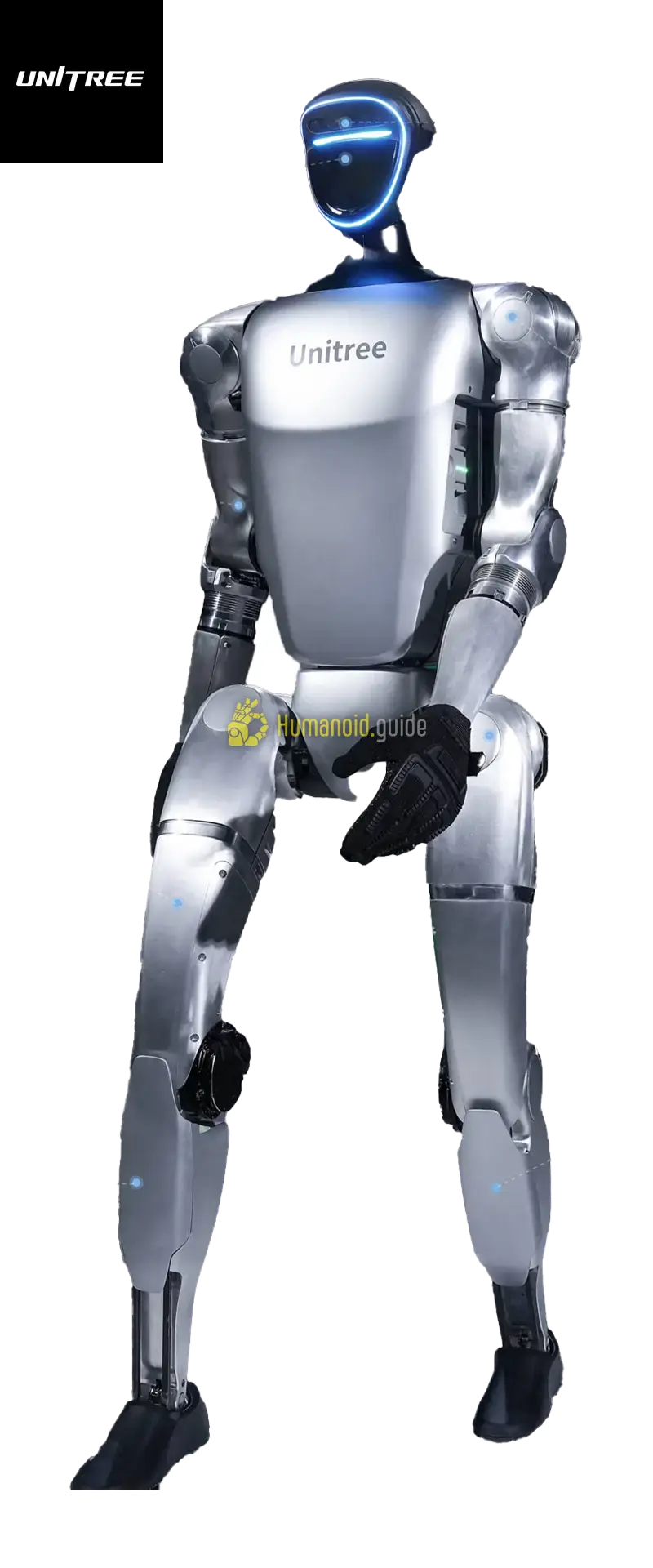
The Unitree G1, launched in 2024 by Unitree Robotics of Hangzhou, China, is the most aggressively priced humanoid on the market. Three configurations span a wide capability band: the Base (23 DOF) at $13,500, the EDU (up to 43 DOF with hands and expanded compute) at $43,900+, and the Ultimate ($73,900) that adds even more sensor and processor headroom. Standing 127–132 cm tall and weighing 35 kg, the G1 fits comfortably in a lab corner, moves at 7.2 km/h, and runs for 2 hours on a charge. Its modular joint design and open ROS2‑native software make it a darling of academic research, STEM outreach, and early‑stage manipulation development. Despite its Chinese origin, the robot ships worldwide and is readily available for purchase through Unitree’s store and dealers.
Winner (in overview): The G1 wins for accessibility, modularity, and price — a humanoid that can be ordered online with a credit card, a feat no other full‑sized biped matches.
Boston Dynamics Atlas: The Heavy‑Lift, All‑Electric Titan
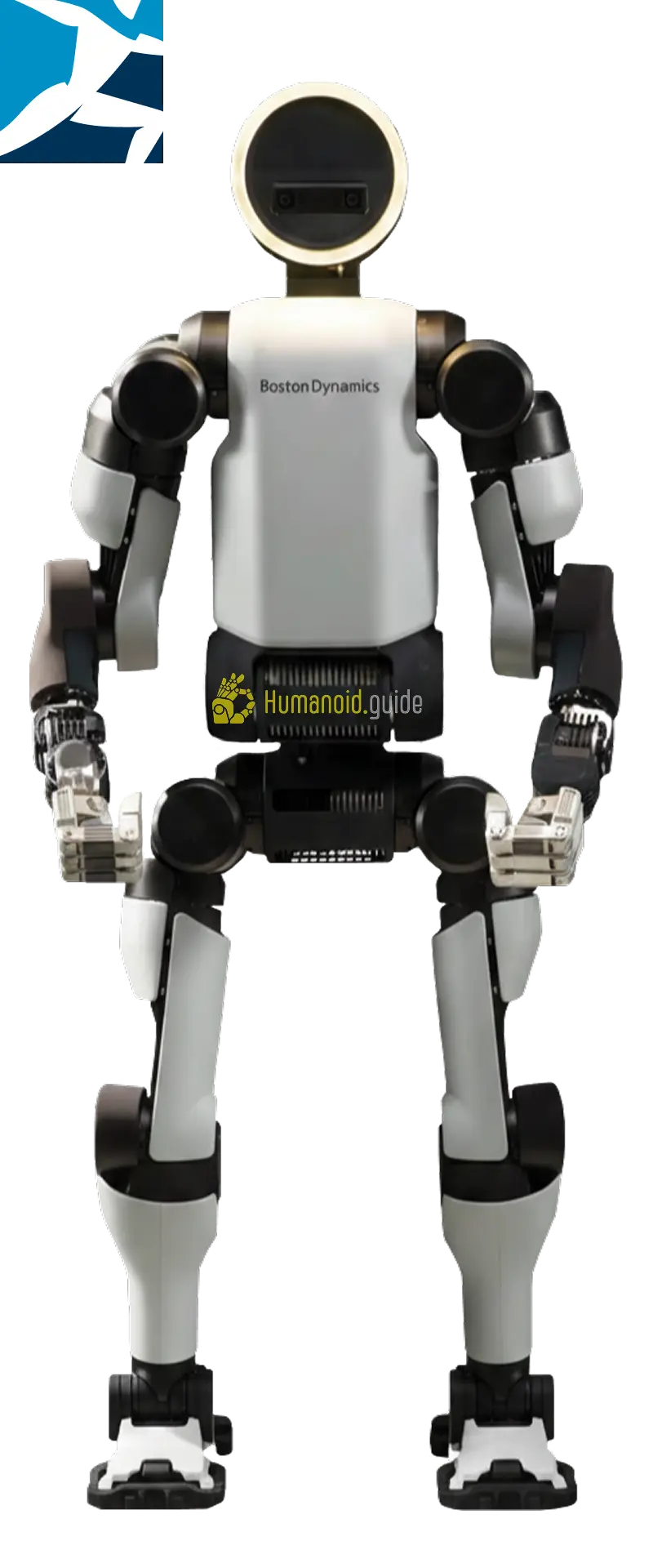
Boston Dynamics Atlas (all‑electric, unveiled fully at CES 2026) is the US‑based pioneer’s flagship humanoid, priced at $420,000. Built for industrial material handling, Atlas stands 150 cm, weighs 89 kg, and carries an eye‑opening 50 kg payload — enough to lift castings, whole pallets, or heavy tooling. Its 56 degrees of freedom, coupled with decades of Boston Dynamics’ control algorithms inherited from Spot and the hydraulic retirements, delivers a level of whole‑body stability and dynamic motion that no other humanoid approaches. Battery life doubles the G1’s at 4 hours, and the all‑electric architecture eliminates hydraulic hassle. Availability remains limited to enterprise pilot programs; mass‑scale purchasing is not possible today. Atlas’s real‑world deployment data is sparse, but the company has shown factory‑floor demos lifting automotive parts.
Winner (in overview): Atlas wins for brute payload, endurance, and the sheer pedigree of Boston Dynamics’ motion control — a genuine industrial‑grade humanoid.
Price & Configurations
The price chasm between these two robots defines the comparison. A fully optioned Unitree G1 Ultimate (43 DOF) costs $73,900 — less than one‑fifth of a single Atlas. The base G1 at $13,500 is so low that a lab could buy a fleet of six for the same budget as one Atlas and still have money left for compute clusters.
Atlas’s $420,000 sticker is for a base configuration; any custom payload integration, extended service contract, or sensor upgrade adds cost. Boston Dynamics sells exclusively to enterprises and integrators, requiring a statement‑of‑work and often a multi‑year support agreement. No leasing or robot‑as‑a‑service (RaaS) option has been announced publicly, though industry insiders expect it.
Winner: Unitree G1 — nothing approaches its price‑to‑degree‑of‑freedom ratio.
Performance & Specs
Payload
The biggest differentiator: G1 lifts 3 kg, while Atlas hoists 50 kg. That’s a 16× gap. For academic object‑grasping and light pick‑and‑place, 3 kg is sufficient; for automotive parts, palletizing, or construction material handling, 50 kg is the floor. Winner: Atlas.
Speed
Both bots target walking speeds around 7–8 km/h. The G1’s 7.2 km/h is on par with a brisk walk; Atlas reaches 8 km/h, though such speeds in an industrial setting are rarely used for safety. Neither robot outruns a jogger. Winner: Atlas, by a slim margin, but essentially tied.
Battery Life
G1’s 2‑hour endurance limits it to short research sessions before swapping batteries — which are hot‑swappable. Atlas’s 4‑hour battery supports continuous production shifts, cutting downtime. Winner: Atlas, by a comfortable margin.
Degrees of Freedom (DOF)
The G1 maxes out at 43 DOF (hands, wrists, neck), offering impressive dexterity. Atlas packs 56 DOF, distributing more freedom across the torso, legs, and arms, enabling the whole‑body tumbling and recovery moves Boston Dynamics is famous for. More DOF generally means finer control and shock absorption. Winner: Atlas.
Software & SDK Ecosystem
Both platforms speak C++ and Python, but their philosophies diverge. Unitree provides a lightweight SDK, ROS2 nodes, and an EDU model that ships with Ubuntu 22.04 and an NVIDIA Jetson Orin for edge AI. Researchers can dive straight into Gazebo or Isaac Sim with published URDF models.
Boston Dynamics offers a mature Spot‑derived SDK, gRPC APIs, and the Scout fleet management platform. While ROS2 integration exists, the stack leans toward enterprise‑grade autonomy with features like Autowalk and map‑based missions. The community around Atlas is tiny because few can afford it; G1’s academic user base will grow faster, driving more public code and tutorials.
Winner: Unitree G1 for openness and community growth; Atlas for industrial fleet maturity. In an R&D context, G1 takes the prize.
Autonomy & Sensors
G1 comes with an Intel RealSense D435i depth camera, three time-of-flight (TOF) modules, and an IMU — a solid sensor suite for SLAM and environment mapping. The EDU variant adds NVIDIA Orin to run local AI inference. Unitree supplies an open‑source SLAM pipeline and AutoWalk, allowing pre‑programmed routes.
Atlas sports a proprietary sensor head (stereo cameras, LiDAR, TOF) optimized for high‑speed whole‑body perception and obstacle avoidance. Its SLAM algorithms, honed from years of DARPA challenges and Spot, are unmatched in dynamic terrains. However, the sensor details are guarded; integrators get only API access.
Winner: Atlas for industrial‑grade perception and obstacle handling; G1 for transparent, hackable pipelines. For raw capability, Atlas wins.
Build Quality & Durability
Neither robot publishes IP (ingress protection) ratings, a common omission in humanoids. Atlas, built with aircraft‑grade aluminum and composite shells and validated in thousands of simulated drops, shows higher structural toughness. The all‑electric actuators eliminate hydraulic leaks and maintenance headaches. G1’s plastic‑composite housing and 3‑D printed parts are sufficient for lab floors and demos but won’t survive a muddy construction site. Weight matters: Atlas’s 89 kg mass helps it absorb impacts but demands careful floor‑loading consideration.
Winner: Atlas — designed for production‑floor abuse rather than benchtop experiments.
Price & Total Cost of Ownership
Looking beyond the sticker price, a three‑year Total Cost of Ownership (TCO) paints an even starker picture:
- Unitree G1 EDU (3 yrs): $43,900 (robot) + ~$2,000 software licenses + ~$2,500 spare batteries/parts + no mandatory support contract ≈ $48,400.
- Boston Dynamics Atlas (3 yrs): $420,000 (robot) + likely $60,000–$120,000 enterprise support contract + sensor calibrations + spares ≈ $520,000+.
An organization could field eleven G1 EDU units for the TCO of one Atlas. This makes the G1 the obvious choice for any lab running parallel experiments, while Atlas is a capital investment that only makes sense when a 50 kg payload is a firm requirement and downtime costs are extreme.
Winner: Unitree G1 — an order‑of‑magnitude TCO advantage.
Which Should You Buy? Unitree G1 vs Boston Dynamics Atlas by Use Case
Choose the Unitree G1 if: - You’re a university lab, a STEM classroom, or an AI startup exploring humanoid manipulation. - Your research focuses on grasping, visual SLAM, or human‑robot interaction with lightweight objects. - Budget is under $100K, and you want to scale to multiple robots. - You need an open, hackable platform with active community support. - You want a humanoid today — G1 ships within weeks.
Choose the Boston Dynamics Atlas if: - Your factory or warehouse requires moving 50 kg parts reliably shift after shift. - You need a robot that can tumble, recover, and operate on uneven terrain with minimal intervention. - You have a designated safety zone, a trained integration team, and a six‑figure robotics budget. - Uptime and ruggedness trump cost.
Choose neither if: - Your payload exceeds 50 kg; look at industrial manipulators or cobot‑based gantries. - You expect a fully autonomous, general‑purpose humanoid — both are still platform‑oriented and require significant programming. - IP67 rating is non‑negotiable; neither robot qualifies today.
Real‑World Deployments & Track Record
Unitree G1: Unitree has shipped hundreds of G1 units globally since 2024 to universities (including MIT, Tsinghua, ETH Zurich) and research institutions. No large‑scale production deployments have been announced; the robot is primarily used in academic labs for locomotion and manipulation research. A 2025 workshop video showed a G1 picking a 1 kg object from a table — a promising but early demonstration.
Boston Dynamics Atlas: Real‑world deployment data remains under wraps. At CES 2026, the company showed Atlas autonomously picking an automotive brake rotor and placing it on a conveyor, but this was a staged demo. Boston Dynamics has not disclosed any paid pilot customers or operating‑hour milestones. The enterprise pilot program is ongoing; sources familiar with the program indicate limited batches (under 10 units) in early 2026.
Both robots lack deep, publicly documented production‑hour data. G1’s academic footprint gives it a slight transparency edge, while Atlas’s industrial readiness is inferred from demo robustness rather than filed‑factory metrics.
SDK, Software & Developer Ecosystem (Deep Dive)
The developer experience around these two platforms will determine their long‑term value.
- Unitree G1 SDK: Lightweight Python and C++ wrappers over Unitree’s joint controllers, with full ROS2 Humble support on Ubuntu 22.04. The official GitHub repo includes launch files for Gazebo and real‑time teleoperation. A growing Discord and GitHub community shares custom nodes, though the ecosystem is still nascent compared to ROS‑Industrial staples like UR. The EDU variant’s Jetson Orin AGX lets you deploy TensorRT‑optimized models directly on the robot for edge perception.
- Boston Dynamics Atlas SDK: Based on the Spot Core API, using gRPC and protobuf for low‑latency control and state streaming. Boston Dynamics supplies a Python client library and early‑access tools for path planning. While the API is robust, documentation is currently limited to enterprise partners. The company’s Scout fleet management software supports multi‑robot coordination, but no public pricing exists for an Atlas‑level Scout tier.
Winner for developer friendliness: Unitree G1 — its open‑source posture and affordable hardware guarantee a faster community‑driven feedback loop, generating more public code repositories and tutorials.
Support, Warranty & Availability
- Unitree G1: Standard one‑year manufacturer warranty, with extended warranties available. Unitree ships directly from China to major markets; typical lead time is 2–4 weeks. Spare parts can be ordered through Unitree’s online store. Support is primarily via email and forums; no on‑site SLA is offered.
- Boston Dynamics Atlas: Sold exclusively through enterprise sales, with a negotiated support contract that likely includes on‑site maintenance, preventive service, and guaranteed response times. Warranty terms are confidential. Lead time depends on pilot allocation; general availability is not expected before 2027. Spare parts and repairs are handled through Boston Dynamics’ service network.
Winner: Unitree G1 for immediate availability; Atlas for mission‑critical support infrastructure (though at enterprise cost).
Comments