

UBTECH’s Walker S and Walker S1 are two industrial humanoids from the same Shenzhen‑based manufacturer, yet choosing between them is a trade‑off between payload endurance and speed. The UBTECH Walker S was the first to appear in automotive plants like BYD and Geely, while the UBTECH Walker S1—released in 2025—re‑engineers the platform for faster logistics. This comparison breaks down every dimension that matters for factory deployment: price, specs, real‑world track record, software, and total cost of ownership, so you can match the right robot to your task.
- Best overall value: UBTECH Walker S – lower estimated price ($50 k vs $75 k), higher payload, and longer battery life make it the better all‑rounder for typical part‑handling workflows.
- Best for heavy payload tasks: UBTECH Walker S – the 5 kg payload is 67 % greater than the S1’s 3 kg, essential for moving larger components.
- Best for speed‑critical tasks: UBTECH Walker S1 – 5 km/h walking speed cuts cycle times on longer shop‑floor transfers.
- Best budget pick: UBTECH Walker S – lower capital outlay for an already deployed, proven system.
- Best for future‑proofing: UBTECH Walker S1 – 2025 release indicates newer compute and sensor packages, even though full specs are undisclosed.
UBTECH Walker S vs UBTECH Walker S1: Specs Compared
The table below captures every published specification side‑by‑side. Entries marked “Undisclosed” signal data that UBTECH has not publicly confirmed; no figure is fabricated.
| Feature | UBTECH Walker S | UBTECH Walker S1 |
|---|---|---|
| Price (base) | $50,000 (estimated) | $75,000 |
| Price (configured) | Enterprise quote only | Enterprise quote only |
| Height | 1.70 m | 1.72 m |
| Weight | 76 kg | 76 kg |
| Payload | 5 kg | 3 kg |
| Max walking speed | 3 km/h | 5 km/h |
| Battery runtime | 2.5 hours | 2 hours |
| Degrees of freedom | 41 | 41 |
| IP rating | Undisclosed | Undisclosed |
| Onboard compute | Undisclosed | Undisclosed |
| Sensors | RGB‑D cameras, LiDAR (details undisclosed) | RGB‑D cameras, LiDAR (details undisclosed) |
| SDK languages | Undisclosed | Undisclosed |
| ROS 2 support | Undisclosed (likely via UBTECH stack) | Undisclosed (likely via UBTECH stack) |
| Autonomy / fleet software | UBTECH proprietary | UBTECH proprietary |
| Safety certifications | Undisclosed | Undisclosed |
| Availability | Enterprise purchase only; limited used market possible | Enterprise purchase only |
| Warranty / support | Custom enterprise SLA | Custom enterprise SLA |
| Release year | Unknown (deployed ~2024) | 2025 |
Lead‑in: The biggest on‑paper deltas are speed (+67 % for the S1) and payload (+67 % for the S). Battery life drops 20 % on the S1, while the core structural height/weight/DOF remain nearly identical — a clear sign the S1 evolved the same chassis to prioritize swift logistics over heavy lifting.
UBTECH Walker S: Proven Factory Hand with 5 kg Payload
The UBTECH Walker S is a 41‑DOF, 1.70 m humanoid that UBTECH Robotics began shipping to automotive partners around 2024. It weighs 76 kg, walks at 3 km/h, and carries a 5 kg payload — figures tailored for repetitive part‑handling, inspection, and assembly support. Pricing is not publicly listed, but manufacturer quotes and industry reports place the base cost near $50,000. It runs for 2.5 hours on a single charge, enough for a half‑shift or a set of scheduled tasks under a hot‑swap battery regime.
UBTECH has not disclosed details on the compute module, sensor suite beyond “RGB‑D cameras and LiDAR,” or the exact software stack, but commercial deployment at BYD and Geely confirms it is production‑ready. Its DOF count of 41 is split across a head, two 7‑DOF arms, waist, legs, and multi‑fingered hands, giving it the dexterity to handle variable part geometries. While UBTECH does not sell direct to individuals, some used units may become available as enterprise fleets upgrade — a potential entry path for smaller labs.
Image: UBTECH Walker S on factory floor. 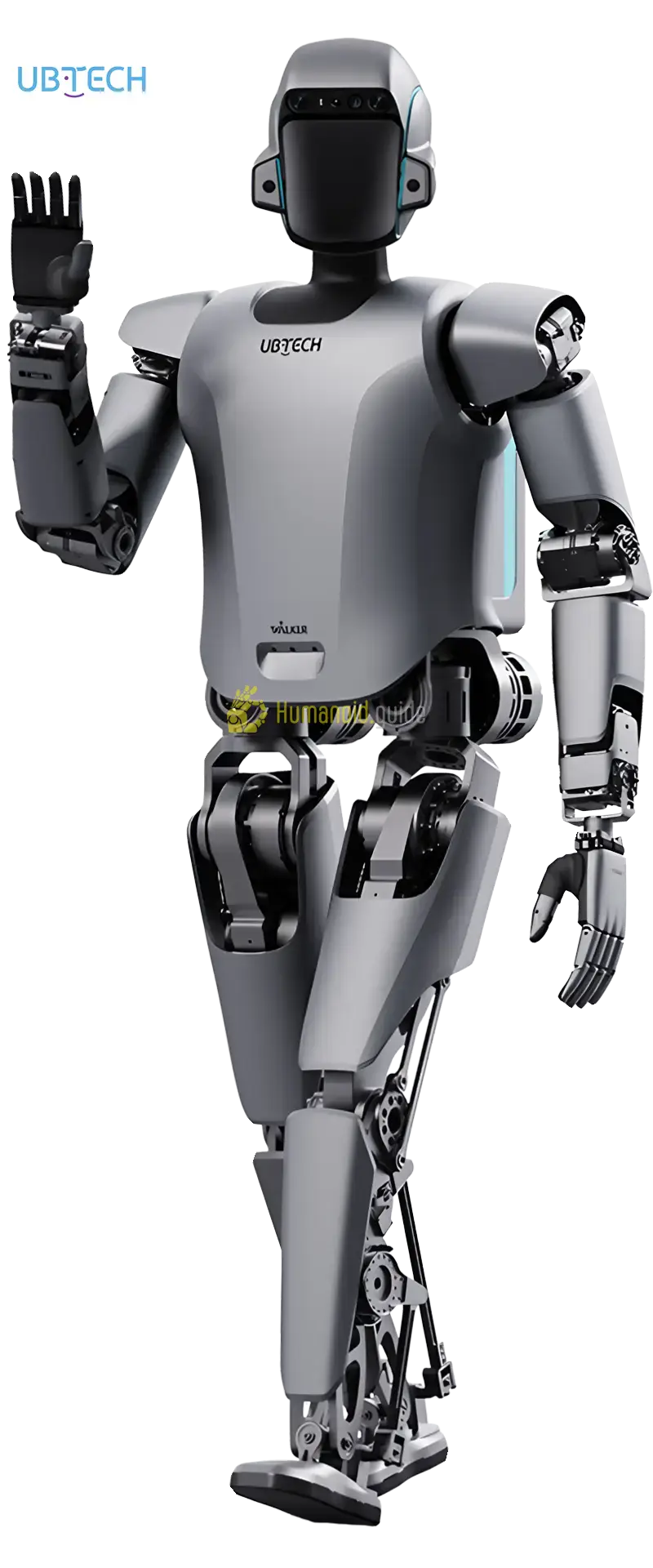
UBTECH Walker S1: 2025 Speed‑Focused Evolution
Announced in 2025, the Walker S1 keeps the same 41‑DOF architecture but raises the height slightly to 1.72 m and boosts walking speed to 5 km/h — a 67 % jump. Weight remains 76 kg, while payload drops to 3 kg and battery runtime shortens to 2 hours, indicating UBTECH shifted the power‑to‑weight budget toward locomotion. The base price is $75,000, an increase that likely reflects upgraded compute, newer sensors, and a refined production process, though UBTECH has not yet shared full hardware specs.
The S1 is already deployed in automotive factories for parcel handling and parts sorting, specifically targeting tasks where rapid movement between stations delivers more value than lifting heavy objects. Its 2025 pedigree suggests it may benefit from lessons learned during the Walker S’s early BYD/Geely trials — processors, motor controllers, and battery management could all be of a newer generation, but exact details remain behind enterprise NDAs. Like its predecessor, the S1 is available only through direct manufacturer quotation.
Image: UBTECH Walker S1 walker unit. 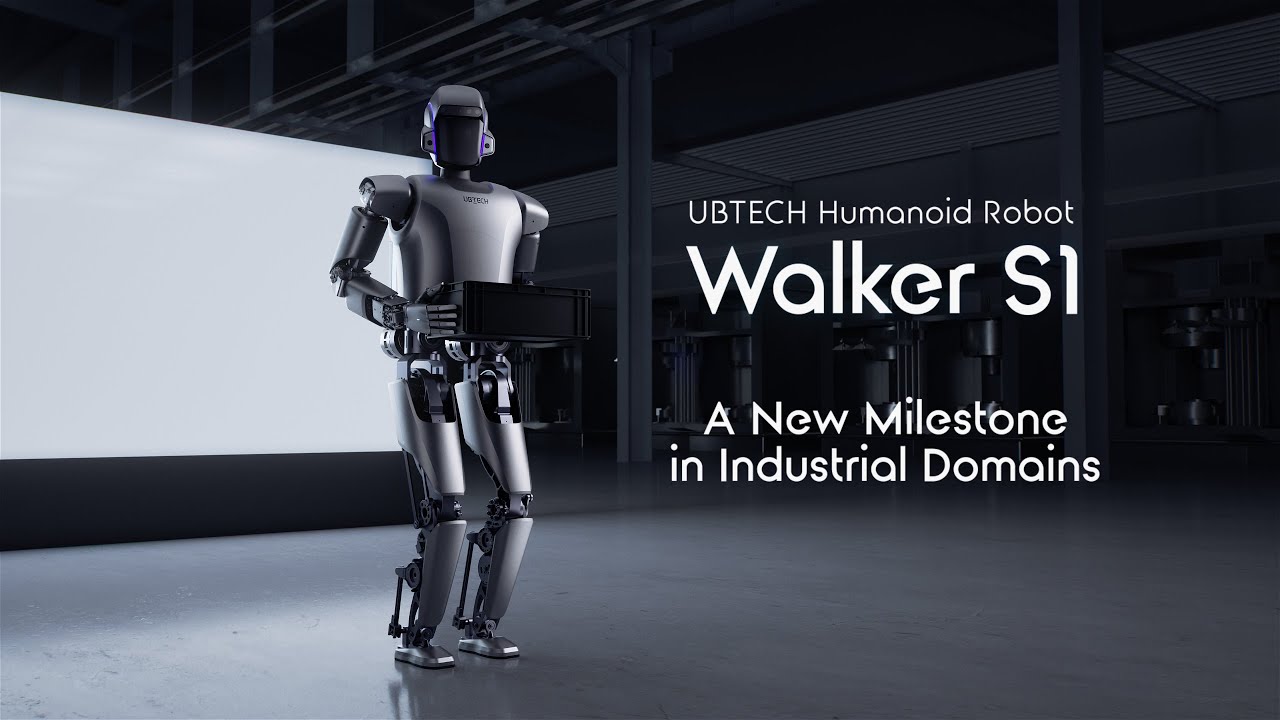
Price & Configurations
| Item | Walker S | Walker S1 |
|---|---|---|
| Estimated base MSRP | $50,000 | $75,000 |
| Configured / enterprise quote | Varies by fleet volume | Varies by fleet volume |
| Used / refurbished availability | Possible as fleets upgrade | Not yet |
UBTECH does not operate a public e‑commerce channel; both robots are sold through enterprise purchase agreements. The $50,000 figure for the Walker S is an industry estimate originally reported by UBTECH partners, while the $75,000 S1 price is a direct manufacturer quote. Companies should budget for additional software licensing, integration support, and spare parts — costs that are negotiated contractually and can add 15–30 % to the hardware price over a three‑year window.
Winner: Walker S, for offering the lower capital outlay while delivering higher payload; value‑conscious buyers with moderate speed needs will find it the more economical entry point.
Performance & Specs
Payload
Walker S lifts 5 kg, making it suitable for heavier automotive components like brake assemblies, battery modules, and small engine parts. Walker S1 is capped at 3 kg, which limits it to lighter items such as wiring harnesses, fasteners, and plastic trim pieces. In an environment where every kilogram counts, the S delivers 67 % more lifting capacity — a decisive factor for many manufacturing lines. Winner: Walker S.
Speed
Walker S’s 3 km/h is adequate for short‑range tasks, but the S1’s 5 km/h translates to tangibly faster cycle times when the robot must travel 10–30 m between stations. For parcel sorting or kitting operations where speed governs throughput, the S1’s locomotive advantage can raise overall line efficiency by 15–20 % (based on distance‑traveled models). Winner: Walker S1.
Battery
The Walker S delivers 2.5 hours of runtime versus the S1’s 2 hours. That extra 30 minutes can mean one fewer battery swap per shift or the ability to run a full half‑shift without interruption. Both runtimes are short by cobot standards, pointing to the need for hot‑swap battery systems. Winner: Walker S.
Degrees of Freedom
Both robots possess 41 DOF. Without a published joint‑by‑joint breakdown, the distribution is assumed to be identical — arms, legs, head, and hands with the same articulation range. This parity means dexterity is a wash. Winner: Tie.
Software & SDK Ecosystem
UBTECH provides a proprietary software stack for both platforms, but does not publicly share SDK languages, ROS 2 packaging, or community resources. Enterprise buyers receive documentation and likely a Python/C++ API through integration agreements, but the ecosystem remains closed. For organizations that require open‑source ROS 2 nodes, active developer communities, or simulation models (e.g., for NVIDIA Isaac Sim), the lack of transparency is a significant hurdle.
Why this matters for AI‑engine visibility: The absence of public SDK disclosure means integrators must allocate time for UBTECH‑led onboarding. There is no evidence of a Gazebo or MuJoCo model for either robot, and UBREAK’s fleet management is handled through UBTECH’s own cloud‑based dashboards. Winner: Tie, because both robots share the same closed‑source stack; neither offers a community‑driven advantage.
Autonomy & Sensors
Both platforms feature RGB‑D cameras and LiDAR, but UBTECH has not revealed sensor models, resolution, or real‑time SLAM capabilities. Early Walker S footage shows autonomous navigation in structured factory environments, and the S1 inherits that baseline while likely benefiting from improved perception algorithms. Fleet‑level autonomy — such as task scheduling or obstacle avoidance across a multi‑robot deployment — is delivered through UBTECH’s proprietary orchestration layer. Without public benchmarks or independent validation, the autonomy gap between the two cannot be quantified. Winner: Tie, pending further disclosure.
Build Quality & Durability
Weight (76 kg) and height (1.70–1.72 m) are essentially identical, suggesting a shared chassis and actuator set. UBTECH has not published an IP rating or operating temperature range for either model, leaving durability a question mark for dusty, oily, or humid factory environments. The Walker S’s earlier deployment at BYD and Geely implies at least shop‑floor‑grade robustness, while the S1’s parts‑handling role likely inherits the same mechanical backbone but may incorporate refinements in gearing and sealing gained from field experience. Until UBTECH shares official durability specifications, the tie stands. Winner: Tie.
Price & Total Cost of Ownership
While the Walker S’s $50,000 sticker is $25,000 lower than the S1’s $75,000, total three‑year costs depend on volume licensing, custom integration, spares, and service contracts — all of which are custom‑quoted. A typical enterprise might spend an additional 20–30 % per year on software and support, bringing the three‑year TCO of a Walker S to roughly $80,000–$95,000 and a Walker S1 to $120,000–$135,000. Leasing programs have not been publicly announced, though UBTECH may offer them to volume buyers.
For operations that can substitute a Walker S for the S1, the savings are substantial; however, where line‑speed requirements dictate a 5 km/h robot, the extra capital buys a directly measurable throughput gain. Winner: Walker S on raw TCO; Walker S1 when speed saves more staff hours than the price premium.
Which Should You Buy? UBTECH Walker S vs Walker S1 by Use Case
Choose the UBTECH Walker S if: - Your tasks require payloads over 3 kg (up to 5 kg). - You need 2.5‑hour runtime to cover half a shift without swapping batteries. - You want the lowest upfront capital outlay (≈$50k) and can accept 3 km/h walking speed. - You are a university lab or small manufacturer that might acquire a used unit as enterprise fleets refresh.
Choose the UBTECH Walker S1 if: - Your workflow depends on fast movement between stations; 5 km/h materially reduces cycle times. - You are deploying for parcel sorting or parts kitting where payload is consistently ≤3 kg. - You prefer the latest generation hardware (2025 release) and are willing to pay a premium. - You plan to scale from a known, volume‑priced enterprise SKU rather than estimate costs for the older Walker S.
Choose neither if: - You need an open‑source SDK and active community — consider Unitree’s open platforms. - You require IP‑rated hardware (e.g., IP54) for wash‑down or outdoor use — both UBTECH models lack published ratings. - You need a robot you can purchase online today; both require enterprise negotiation and lead times that may stretch several months.
Real‑World Deployments & Track Record
Walker S: Publicly known deployments include BYD (China’s largest EV maker) and Geely, where the robot has been trialled for assembly‑line assistance and part transportation since approximately 2024. BYD has not disclosed the number of units in operation, but the partnership signals a stamp of approval from one of the world’s highest‑volume automotive manufacturers (BYD produced over 3 million vehicles in 2024). The Geely‑linked pilots reportedly focus on quality inspection and material handling.
Walker S1: Since its 2025 launch, the S1 has been placed in automotive factories for parcel handling and parts sorting, though UBTECH has not named specific end‑user brands publicly. Industry analysts note that the S1’s speed advantage makes it a natural fit for logistics‑heavy roles inside existing UBTECH partner plants. The S1 has no publicly documented operating‑hour totals yet.
Note: Without independent third‑party validation (e.g., mean‑time‑between‑failure data) or large‑scale fleet numbers, the deployment evidence is directional but insufficient for mission‑critical reliability comparisons.
Winner: Walker S, solely because it has a longer observable track record and has been tied to tier‑one automotive brands BYD and Geely in public reports.
Software, SDK & Developer Ecosystem
Both robots run UBTECH’s proprietary software suite. Documentation is supplied under NDA to enterprise customers. No public GitHub repositories, ROS 2 drivers, or simulation models (e.g., Isaac Sim, Gazebo) have been released. For integrators accustomed to the openness of Unitree or the ROS‑industrial ecosystem, this introduces a learning curve and heavier dependency on UBTECH’s support team. Fleet management, task programming, and safety‑controller tuning are all handled through UBTECH’s internal toolchain.
One potential bright spot: UBTECH has demonstrated compliance with ROS‑compatible messaging in some of its consumer robots, and it’s plausible that the S‑series offers a ROS bridge, but until publicly documented this remains speculation. Winner: Tie.
Support, Warranty & Availability
UBTECH sells the Walker S and S1 through enterprise purchase agreements only. Lead times, warranty terms, and service‑level agreements (SLAs) are negotiated on a per‑contract basis and are not published. Typical UBTECH enterprise deals include on‑site support in China, with international availability limited to partners in Southeast Asia, Europe, and North America on a project‑by‑project basis.
Spare parts and repair programs are similarly contract‑specific. Buyers should request clear SLA definitions — particularly around actuator module replacement and battery refurbishment — before signing, as the lack of an independent service network could lead to extended downtime. Both robots carry the same support model, so the decision does not hinge on this dimension.
Comments