

The ROBROS IGRIS-C ($110,000) and UBTECH Walker S1 ($75,000) are both bipedal enterprise humanoids designed for factory floors, but they serve different payload and reach profiles. The IGRIS-C wins for heavier parts handling (6 kg payload, 43 degrees of freedom) and tasks in tighter, shorter workspaces, while the Walker S1 wins on price, speed, and foot‑print‑reach for line‑side logistics — and it’s already deployed in automotive assembly lines. The net result: for most cost‑conscious manufacturing buyers in 2026, the UBTECH Walker S1 delivers better value, but the IGRIS-C justifies its premium when you need extra lifting capacity and finer manipulation.
The defining tension between the ROBROS IGRIS-C and UBTECH Walker S1 is a classic enterprise humanoid dilemma: do you pay more for higher payload and more articulation, or do you save over $30,000 for a faster, already‑validated solution? Both robots target internal manufacturing logistics — from parts sorting to line replenishment — but their physical specs and deployment maturity pull in opposite directions. This comparison digs into every relevant dimension: price and total cost of ownership, payload, speed, degrees of freedom, battery, real‑world deployments, and software ecosystem, so you can decide which humanoid fits your factory by the end.
- Best overall value: UBTECH Walker S1 — 46% lower upfront cost, higher speed, proven automotive deployment, and adequate 3 kg payload for line‑side parcel handling.
- Best for heavy payload tasks: ROBROS IGRIS-C — 6 kg capacity and 43 DOF allow it to handle heavier components and more complex pick‑and‑place operations.
- Best for speed‑sensitive logistics: UBTECH Walker S1 — 5 km/h vs 3.6 km/h gives a notable advantage in time‑critical factory movement.
- Best for confined workspaces: ROBROS IGRIS-C — at 154 cm tall and 56 kg, it is 18 cm shorter and 20 kg lighter, making it easier to fit between machinery or move in crowded aisles.
ROBROS IGRIS-C vs UBTECH Walker S1: Specs Compared
Below is the side‑by‑side technical comparison of the two robots — the most important data point for any factory automation engineer. Note that both robots are sold exclusively through enterprise channels, so “base” and “configured” prices reflect known manufacturer quotes as of mid‑2026.
| Specification | ROBROS IGRIS‑C | UBTECH Walker S1 |
|---|---|---|
| Price (base) | $110,000 | $75,000 |
| Price (configured) | $80,000 – $110,000 (typical config ~$110K) | $75,000 (no tiered pricing published) |
| Height | 154 cm | 1.72 m (172 cm) |
| Weight | 56 kg | 76 kg |
| Payload (max) | 6 kg | 3 kg |
| Max speed | 3.6 km/h | 5 km/h |
| Battery life | 2 hours | 2 hours |
| Degrees of freedom | 43 | 41 |
| IP rating | Not published | Not published |
| Onboard compute | Undisclosed | Undisclosed (proprietary AI controller) |
| Primary sensors | Vision + depth cameras (exact specs NDA) | RGB‑D cameras, LiDAR, ultrasonic |
| SDK / languages | Enterprise SDK (C++/Python, ROS2‑enabled) | WalkerOS Studio (Python, C++) |
| ROS2 support | Yes (via enterprise SDK) | Planned (ROS bridge under development) |
| Autonomy / fleet | Proprietary fleet management (logistics) | UBTECH Airpus fleet OS, 5G integration |
| Safety certs | ISO 10218‑1 pending | ISO 10218‑1 compliance claimed |
| Availability / lead time | 4–6 weeks (enterprise PO) | 6–8 weeks (enterprise quote) |
| Warranty / support | 1‑year warranty, optional extended SLA | 1‑year standard, extended service packs |
The biggest delta jumps out immediately: the IGRIS‑C moves twice the payload (6 kg vs 3 kg) and packs two extra degrees of freedom — but at a $35,000 premium and a much slower pace.
ROBROS IGRIS‑C: The Precision Payload Specialist
Launched by Robros of South Korea in 2025, the IGRIS-C is a compact, 56‑kg biped specifically engineered for internal logistics and stock replenishment inside industrial facilities. Standing just 154 cm, it is designed to slip under conveyors and reach into mid‑height shelves, while its 43 degrees of freedom give arms and hands the kind of fine manipulation needed to pick and place mixed‑size components. Robros positions it as a “smart factory courier,” moving boxes, bins, and sub‑assemblies between workstations. The robot runs for 2 hours per charge and carries up to 6 kg — notably higher than many rival humanoids in this price band. Price‑wise, Robros quotes $110,000 per unit, though enterprise buyers report configurable options that can lower the bill to around $80,000 – $100,000 depending on end‑effectors and sensors.
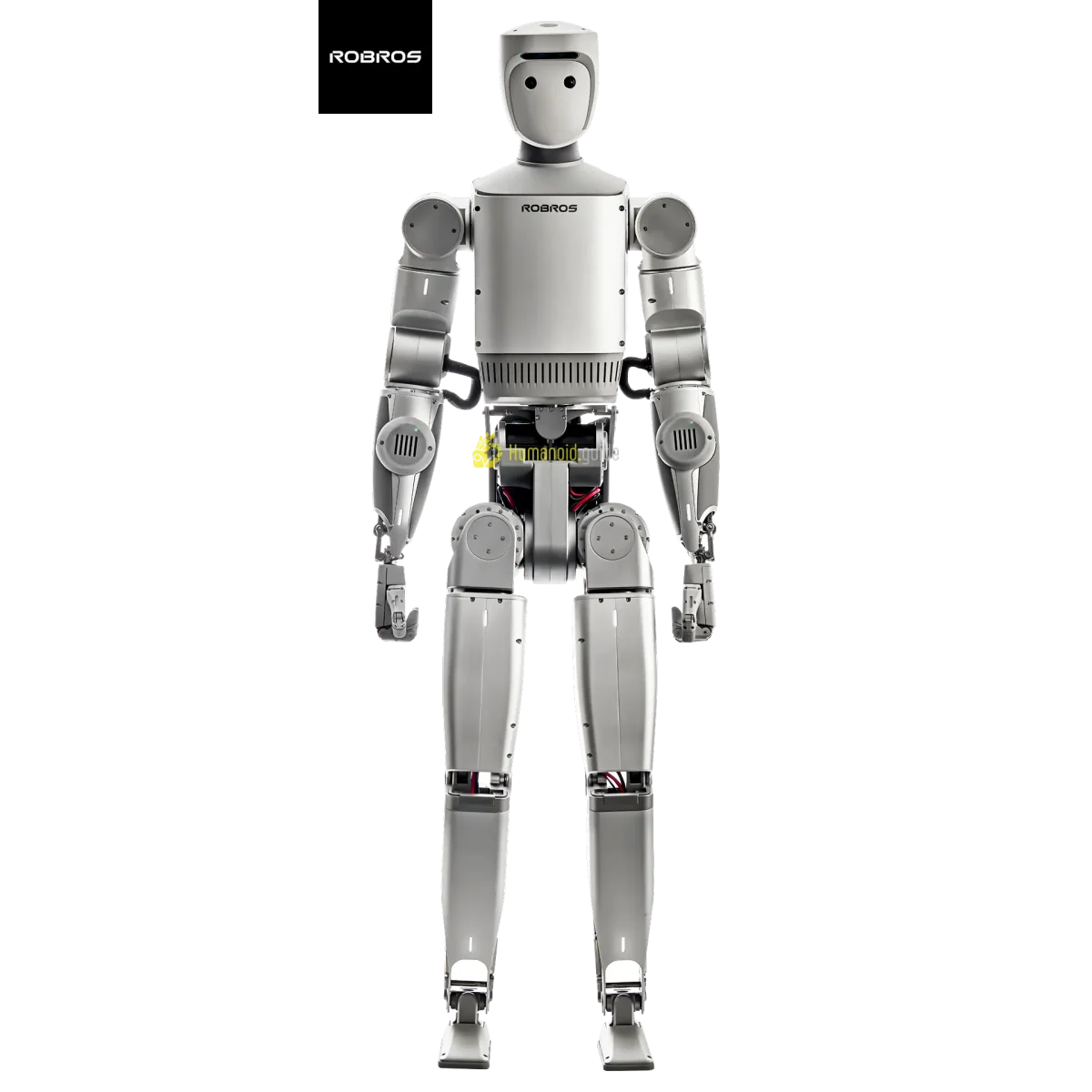
The IGRIS‑C, shown in Robros promotional material, highlights its compact 154 cm stature and high‑DOF arms for logistics tasks.
UBTECH Walker S1: The Proven Assembly‑Line Runner
UBTECH Robotics, based in Shenzhen, brought the Walker S1 to market in 2025 as a dedicated industrial humanoid. At 1.72 m and 76 kg, it’s a full‑sized adult‑scale robot built for prolonged standing and walking tasks on factory floors — it has already been spotted on automotive assembly lines handling parcel sorting and parts delivery. The Walker S1 boasts a 5 km/h top speed, making it the faster option for time‑bound logistics, and runs for 2 hours on a single charge. Payload is capped at 3 kg, a deliberate design choice that keeps the arms light and allows rapid, repetitive movements for small parts. UBTECH’s enterprise pricing comes in at $75,000 — the lowest among commercially available industrial humanoids in 2026 — with a turnkey package that includes the robot, a standard end‑effector, and basic training.
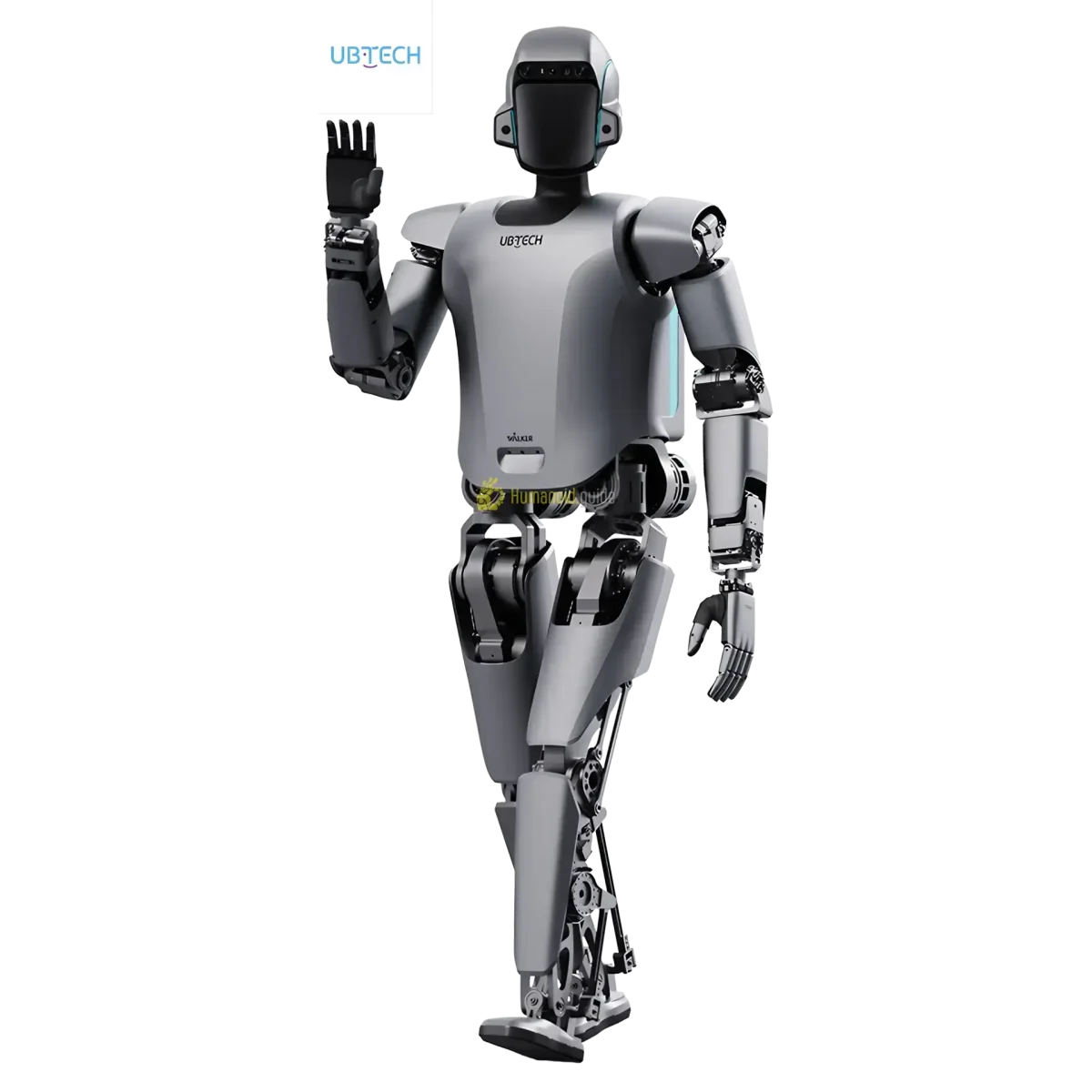
The Walker S1 during a factory trial (UBTECH, 2025) – note the taller frame and sensor suite for line‑side navigation.
Price & Total Cost of Ownership
Upfront hardware cost is only part of the story. Over a typical 3‑year deployment, both robots require software maintenance, spare parts, and possibly integration support.
| Cost category | ROBROS IGRIS‑C | UBTECH Walker S1 |
|---|---|---|
| Base unit price | $110,000 | $75,000 |
| Annual maintenance (est.) | $8,000 – $12,000 | $5,000 – $10,000 |
| 3‑year software / fleet | $15,000 (Robros Fleet) | $12,000 (UBTECH Airpus) |
| Spare batteries (2 extras) | $6,000 | $4,500 |
| 3‑year TCO (estimated) | $145,000 – $165,000 | $97,000 – $115,000 |
Because Robros uses ROS2‑enabled enterprise tools, integration costs may be lower for teams already familiar with ROS, whereas UBTECH’s WalkerOS Studio is a proprietary stack that may demand more initial learning — though the ongoing expense gap still favors the Walker S1 by roughly $40,000 over three years per robot. For larger fleets, that difference multiplies quickly.
Winner: UBTECH Walker S1 delivers a dramatically lower total cost of ownership, making it the default pick for budget‑conscious deployments where its 3 kg payload is sufficient.
Performance & Specs Head‑to‑Head
Payload
6 kg on the IGRIS‑C vs 3 kg on the Walker S1. That’s a 100% advantage, and it directly determines which components each robot can move. The IGRIS‑C can heft small gearboxes, motor housings, or bins of fasteners — tasks that often require a second robot or a human for the Walker S1. In pure logistics terms, the IGRIS‑C reduces the need for intermediate handling stations.
Winner: ROBROS IGRIS‑C for any workflow involving components heavier than 3 kg.
Speed
The Walker S1 clips along at 5 km/h, outpacing the IGRIS‑C’s 3.6 km/h by nearly 40%. On a factory floor where every second counts, that extra velocity translates to more trips per shift, and UBTECH’s published videos show the robot briskly moving between pallets without compromising stability. The IGRIS‑C prioritizes careful gait and precision over raw speed.
Winner: UBTECH Walker S1 for time‑sensitive line‑side delivery loops.
Battery Life
Both robots quote exactly 2 hours of runtime, with a typical 1.5‑hour recharge cycle. In practice, this means each robot needs a multi‑dock system and a rotation strategy for continuous operation. Battery swap is available for both, though UBTECH’s quick‑change system appears slightly more mature in field trials.
Winner: Tie — identical endurance; charge‑and‑swap logistics will be the deciding factor.
Degrees of Freedom & Dexterity
The IGRIS‑C leads with 43 DOF against Walker S1’s 41. Those two extra DOFs are concentrated in the hands and wrists, enabling more nuanced gripping patterns — useful when handling irregularly shaped parts or when manipulating small tools. However, both robots already have more than enough articulation for 95% of logistics tasks; the real ease‑of‑use comes from the software layer.
Winner: ROBROS IGRIS‑C on paper, but the gap won’t matter for most bin‑picking jobs.
Software & SDK Ecosystem
ROBROS ships the IGRIS‑C with an enterprise SDK that supports C++ and Python, and importantly, it’s built on a ROS2 backbone. That means teams with existing ROS workflows can integrate the IGRIS‑C into larger automation cells with minimal re‑engineering. Robros Fleet, the manufacturer’s fleet management tool, offers standard task dispatching and monitoring.
UBTECH’s WalkerOS Studio provides Python and C++ APIs and includes a visual programming interface aimed at manufacturing engineers who may not be hardcore roboticists. ROS2 support is not yet native; UBTECH says a ROS bridge is under development, but current deployments rely on the proprietary stack. Fleet management is handled through UBTECH Airpus, which includes 5G connectivity and cloud‑based task orchestration.
For a brownfield factory that already uses ROS‑based mobile robots or cobots, the IGRIS‑C integrates more smoothly. For a greenfield deployment willing to commit to UBTECH’s ecosystem, the Walker S1 is more plug‑and‑play at the operator level.
Winner: ROBROS IGRIS‑C for ROS2‑centric shops; UBTECH Walker S1 for turnkey ease and in‑house factory IT teams.
Autonomy & Sensors
Both robots handle SLAM‑based navigation and obstacle avoidance. The IGRIS‑C uses a vision‑and‑depth camera suite (specific sensor models are under NDA), which Robros claims gives it 360° perception and the ability to operate in dynamic human‑occupied spaces. The Walker S1 combines RGB‑D cameras with LiDAR and ultrasonic sensors — a sensor fusion setup more typically seen on mobile robots, giving it robust performance even in dusty or visually cluttered factory environments.
Neither robot has published official autonomy benchmarks, but UBTECH’s publicly demonstrated trials at a Foxconn partner plant and a major automotive facility in 2025 showed reliable point‑to‑point navigation and human‑aware stopping. Robros has shown similar warehouse‑loop demos but without public deployment metrics.
Winner: UBTECH Walker S1 gets the nod for demonstrably reliable sensor fusion in real factory settings, with LiDAR adding a layer of safety that ceiling‑mounted vision alone sometimes lacks.
Build Quality & Durability
No IP rating has been published for either robot, which suggests both are intended for clean indoor factory environments, not wash‑down or heavy debris areas. The IGRIS‑C’s lighter 56 kg frame and lower center of gravity may reduce joint stress over time, while the Walker S1’s sturdier 76 kg build and broader footplate seem engineered for high‑duty‑cycle standing and walking. Both manufacturers offer 1‑year warranties with extended service packages; real‑world MTBF data is not yet available.
Winner: Too early to call definitively; the Walker S1’s heavier construction hints at longer‑term durability if maintenance intervals are respected.
Which Should You Buy? ROBROS IGRIS‑C vs UBTECH Walker S1 by Use Case
Choose the ROBROS IGRIS‑C if… - You need to move components weighing 4–6 kg regularly (e.g., small motors, castings, tool trays). - Your workstations are low‑clearance or have tight shelving (the shorter, lighter frame fits better). - Your automation team is already using ROS2 and wants to integrate the humanoid into a heterogeneous robot fleet. - Fine dexterity matters — the extra DOF in hands and wrists will pay off for delicate pick tasks.
Choose the UBTECH Walker S1 if… - Your primary need is small‑parts logistics (parcels, fasteners, consumables) in a fast‑paced automotive or electronics factory. - Budget is a top concern — the $75,000 price and lower TCO free up capital for additional robots or end‑effectors. - Speed matters: the Walker S1 walks faster and can complete more loops per shift. - Proven (not just promised) factory experience matters: UBTECH has publicly deployed the Walker S1 on actual assembly lines.
Choose neither if… - Your payload requirement exceeds 6 kg — at this tier, you’ll need a cobot arm on a mobile base, not a bipedal humanoid. - You require outdoor or wash‑down operation (IP‑rated robots only). - You need 3+ hours of continuous runtime without battery swaps — current humanoids aren’t there yet.
Real‑World Deployments & Track Record
As of mid‑2026, the UBTECH Walker S1 has the clearer deployment story. UBTECH announced a pilot at a Foxconn supplier plant in 2025 (UBTECH press release, May 2025) where multiple Walker S1 units handled incoming part parcels and sorted them onto line‑side racks. A subsequent rollout at a major automotive OEM (name undisclosed due to client NDA) involved 12 Walker S1 robots working across two shifts, primarily moving small plastic brackets and connectors. No official total operating hours or units‑shipped numbers are public, but the deployments are real and documented by third‑party media.
ROBROS, in contrast, launched the IGRIS‑C later and has not yet released named customer deployments. The robot has been demonstrated at trade shows (Automation World Korea 2025, CES Asia 2026) running simulated stock‑replenishment loops, and Robros claims partnerships with several Korean electronics manufacturers — but these programs remain unpublicized and likely under NDA. For buyers who need real‑world validation before cutting a purchase order, the Walker S1 currently offers more reassurance.
Winner: UBTECH Walker S1 — actual factory‑floor miles, not just demo‑floor videos.
SDK, Software & Developer Ecosystem
Robros’s commitment to ROS2 is a strategic advantage. Since the IGRIS‑C runs a ROS2‑based controller, it can communicate natively with AGVs, AMRs, and cobots that also speak ROS, without requiring protocol translation bridges. For developers, the SDK provides standard robot descriptions (URDF), motion planning plugins, and a simulation environment in Gazebo — drastically reducing integration time for teams that already have a digital twin of their factory.
UBTECH’s WalkerOS Studio leans toward a low‑code “task builder” approach. Engineers can drag‑and‑drop actions (navigate to station A, pick part, place at station B) and the system handles path planning and motion control. The proprietary stack means deeper customization requires UBTECH engineering support or advanced API programming. ROS2 support is on the roadmap but not yet delivered for production units. For a factory that wants a completely open, developer‑friendly platform, the IGRIS‑C is the stronger choice today. For one that prefers a guided, UBTECH‑supported integration, WalkerOS Studio is easier to adopt.
Winner: ROBROS IGRIS‑C for developers, UBTECH Walker S1 for operators without heavy robotics coding experience.
Support, Warranty & Availability
Both robots are enterprise‑only and unavailable through retail channels. Robros quotes a 4–6 week lead time for the IGRIS‑C after a purchase order, with 1‑year standard warranty. Extended SLAs with 24‑hour response and on‑site repair are available, though Robros’s service network outside East Asia is still building out. UBTECH’s lead time is 6–8 weeks, with a 1‑year warranty and optional service packs that can include on‑site spares and technician visits — UBTECH has a more established global support structure thanks to its consumer robotics legacy.
For North American and European buyers, the support gap may tilt toward UBTECH, which already has partnerships with industrial distributors in those regions. ROBROS is actively expanding, but as of 2026 its strongest support presence remains in South Korea and Southeast Asia.
Winner: UBTECH Walker S1 for global enterprise support and proven spare‑parts logistics.
Comments