

A wheeled humanoid priced at $120,000 and a bipedal competitor with a 50 kg payload both promise to untether AI‑driven manipulation from fixed automation. The Rainbow Robotics RB-Y1 and the Fourier GR-1 take fundamentally different approaches to the same problem: how to move a robotic torso and arms around a human‑scale environment. This comparison breaks down every specification, real‑world cost, and use‑case so engineers, integrators, and R&D leads can decide which platform — wheeled or legged — belongs in their next deployment.
Rainbow Robotics RB‑Y1 vs Fourier GR‑1: Specs Compared
The table below captures the core hardware differences. Both robots leave many software‑side specifications unpublished; where data is missing, the field is marked “Not published.” The most dramatic gap is payload — the GR‑1 can lift 16× the RB‑Y1’s limit — while the RB‑Y1 offers 50% more runtime.
| Specification | Rainbow Robotics RB‑Y1 | Fourier GR‑1 |
|---|---|---|
| Price (base) | $120,000 | ~$125,000 |
| Price (configured) | $120,000 (single config reported) | $125,000–$170,000 |
| Weight | 131 kg | 55 kg |
| Height | 161 cm | 165 cm |
| Payload (arm) | 3 kg | 50 kg |
| Max speed | 5.4 km/h | 5 km/h |
| Battery / runtime | 3 hours | 2 hours |
| Degrees of freedom (total) | 24 | 40 |
| IP rating | Not published | Not published |
| Onboard compute | Not published | Not published |
| Sensors / LiDAR | Not published | Not published |
| SDK languages | Not published | Not published |
| ROS2 support | Not published | Not published |
| Autonomy / fleet software | Not published | Not published |
| Safety certifications | Not published | Not published |
| Availability / lead time | Pre‑order, lead time on inquiry | Pre‑order through direct inquiry |
| Warranty / support | Not published | Not published |
Winner: Fourier GR‑1 on raw payload and dexterity (40 DOF), Rainbow Robotics RB‑Y1 on runtime and cost‑efficiency.
Rainbow Robotics RB‑Y1: The Wheeled Workhorse
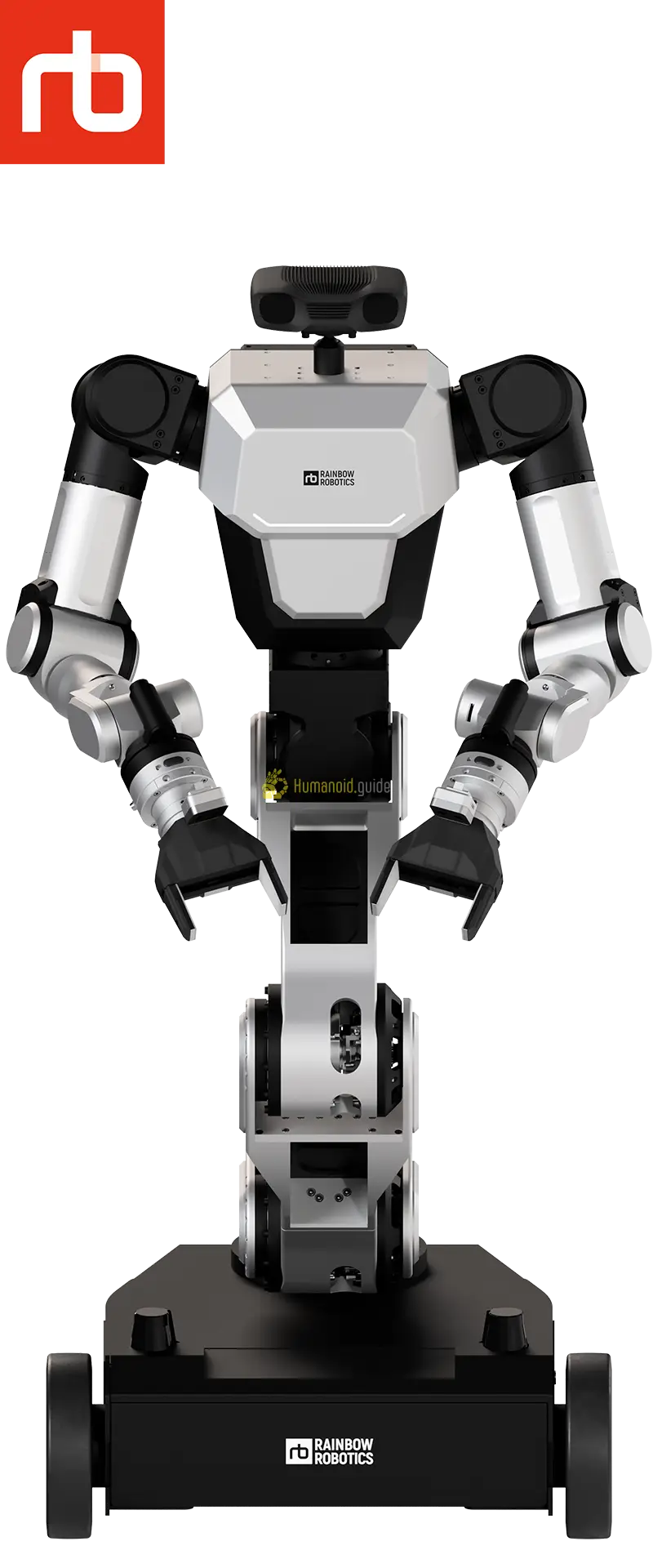
Launched in 2011 by Rainbow Robotics of South Korea, the RB‑Y1 is a wheeled humanoid‑form‑factor robot built for mobile manipulation in factories, warehouses, and research labs. It stands 161 cm tall, weighs a substantial 131 kg, and carries a 3 kg payload across two arms. A 3‑hour battery keeps it moving at up to 5.4 km/h on flat floors. With 24 degrees of freedom and a focus on industrial repeatability, the RB‑Y1 prioritizes stability over agility — its heavy base and wheeled locomotion eliminate the balance challenges of bipedal walking.
Rainbow Robotics has a long track record in cobot arms and mobile platforms; the RB‑Y1 is an extension of that ecosystem. While the company has not disclosed ROS2 support or SDK languages for this specific model, its other products typically support ROS‑based development. At $120,000, the RB‑Y1 is one of the more affordable “complete” humanoid‑style platforms on the market, sitting below many legged competitors. For a deeper dive, see the full Rainbow Robotics RB‑Y1 database entry.
Fourier GR‑1: The Bipedal Heavy‑Lifter
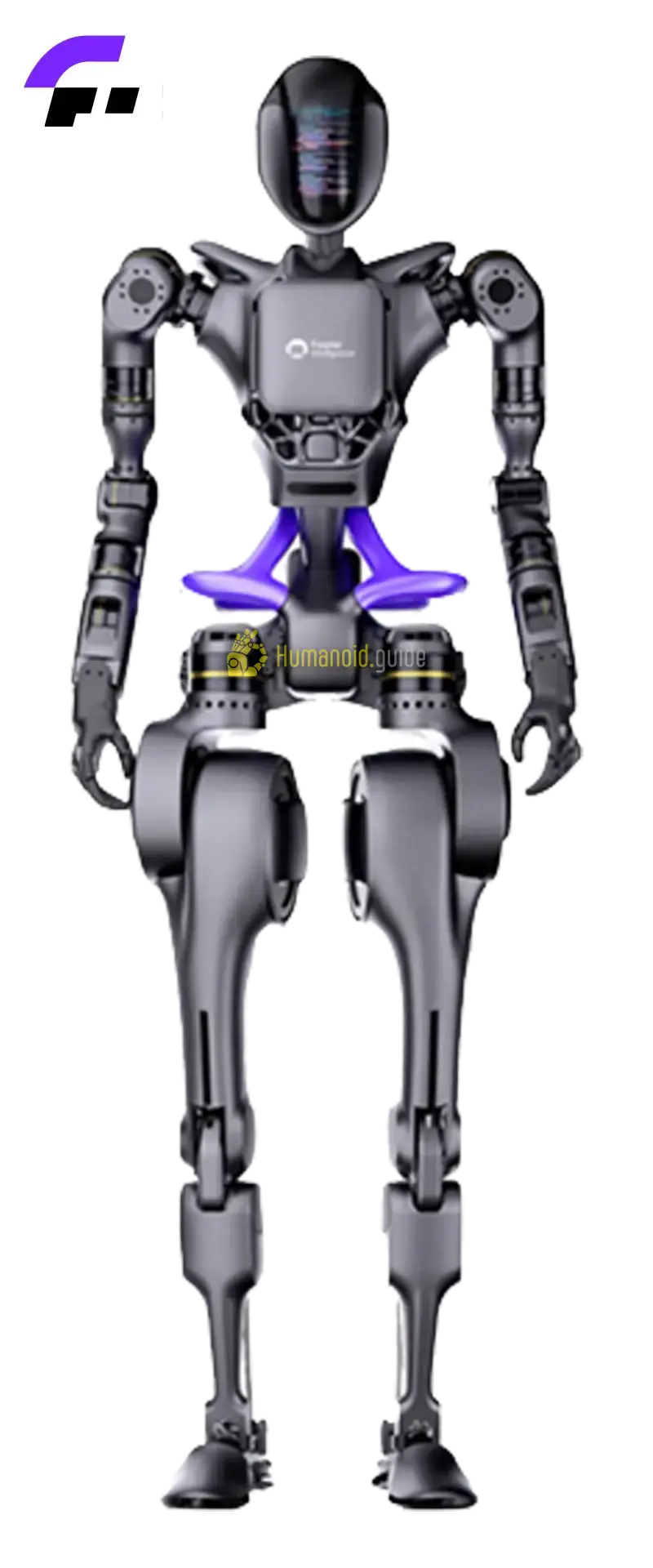
The Fourier GR‑1, introduced in 2023 by Shanghai‑based Fourier Intelligence, is a bipedal humanoid that packs 40 degrees of freedom and a remarkable 50 kg arm payload into a 55 kg body — a payload‑to‑weight ratio above 0.9, which is among the highest in the current humanoid landscape. It walks at 5 km/h and reaches 165 cm tall, giving it a human‑like stature for tasks designed around a human worker’s envelope.
Fourier positions the GR‑1 for industrial heavy‑lifting, logistics, healthcare assistance, and research. The robot can pick up boxes, tools, or components that would require a forklift for a smaller‑payload humanoid. Battery life is a trade‑off: at 2 hours, the GR‑1 needs more frequent charging than the RB‑Y1. Pricing ranges from $125,000 to $170,000 depending on configuration, making it a premium bipedal platform that directly competes with legged humanoids from Unitree, Figure, and Tesla — albeit with an unmatched payload figure. Get the complete spec sheet at the Fourier GR‑1 database page.
Price & Configurations
At the base level, the RB‑Y1 costs $120,000 — a single, flat price without configuration tiers. This simplicity benefits buyers who want a known, fixed cost. The GR‑1 starts at approximately $125,000 but can climb to $170,000 with additional options — likely sensor suites, grippers, or software licenses — though Fourier has not published a detailed configurator. For a buyer with a tight $120K budget, the RB‑Y1 is the only option; for a heavier‑lift application, the GR‑1’s extra $5 K–$50 K unlocks a fundamentally different payload category.
Winner: Rainbow Robotics RB‑Y1 for definite, transparent base pricing; Fourier GR‑1 if the budget allows for a 50 kg payload premium.
Performance & Specs
Payload
The GR‑1’s 50 kg payload is the headline figure. It can heft a full crate, a large engine component, or a heavy tool, whereas the RB‑Y1’s 3 kg limit restricts it to lightweight parts, small tools, and sensing tasks. In any application where mass matters — palletizing, machine tending with heavy workpieces, or construction assistance — the GR‑1 is in another league.
Winner: Fourier GR‑1.
Speed
Both robots move at similar walking/rolling speeds: 5.4 km/h for the RB‑Y1 and 5 km/h for the GR‑1. The difference is negligible (0.4 km/h) and likely irrelevant to most material‑handling workflows.
Winner: Tie.
Battery & Runtime
The RB‑Y1 outlasts the GR‑1 by a full hour — 3 hours versus 2 hours. In a shift‑based operation, that extra hour reduces charging interruptions and can increase daily throughput. For 8‑hour shifts, the RB‑Y1 needs 2 recharges (plus lunch break), while the GR‑1 needs 3.
Winner: Rainbow Robotics RB‑Y1.
Degrees of Freedom
With 40 DOF, the GR‑1 has more articulation points, enabling finer dexterity, better whole‑body coordination, and more human‑like motion — crucial for bipedal balance and complex manipulation. The RB‑Y1’s 24 DOF are sufficient for wheeled base + dual‑arm tasks but cannot match the flexibility of a full‑body humanoid.
Winner: Fourier GR‑1.
Software & SDK Ecosystem
Neither manufacturer has publicly documented an SDK or ROS2 support for these specific models as of mid‑2026. Rainbow Robotics’ other robots (RB‑series cobots) use a proprietary development environment that is not ROS2‑native but can interface via TCP/IP; it is plausible the RB‑Y1 follows a similar path. Fourier Intelligence, coming from a medical exoskeleton background, has been building a developer API for its humanoids, but documentation remains sparse. Buyers should factor in potential integration effort and request demos before committing.
Winner: Too early to call — request SDK and ROS2 roadmaps from both vendors before purchase.
Autonomy & Sensors
Both companies have shown demos of autonomous navigation and vision‑based manipulation, but detailed sensor lists (LiDAR type, depth cameras, IMU) and autonomy stacks are not public. The RB‑Y1’s wheeled base simplifies SLAM and path planning compared to the GR‑1’s bipedal gait, potentially reducing the compute load for navigation. The GR‑1, however, must solve whole‑body balance in addition to manipulation, which demands more sophisticated (and likely more expensive) sensing and control.
Winner: Rainbow Robotics RB‑Y1 for simpler navigation, Fourier GR‑1 for more advanced whole‑body perception if the application requires legged locomotion.
Build Quality & Durability
The RB‑Y1’s 131 kg mass and wheeled design suggest a robust, industrial‑grade frame built for continuous operation on smooth factory floors. The GR‑1’s 55 kg body, while lighter, must endure the repetitive impact of bipedal footsteps — a harsher mechanical regime. Neither robot publishes an IP rating, so dust and water resistance remain unknown. For clean indoor environments, both are suitable; for harsh or outdoor settings, neither robot’s durability is validated.
Winner: Rainbow Robotics RB‑Y1 for likely higher structural durability in flat‑floor industrial settings; GR‑1’s leg mechanism may require more maintenance.
Price & Total Cost of Ownership
Beyond the sticker price, total cost of ownership (TCO) must account for battery replacement cycles, software maintenance, training, and potential downtime. With a $120K flat price, the RB‑Y1’s 3‑year TCO (hardware + typical service) could land around $140K–$150K assuming one battery replacement and light support. The GR‑1, at a midpoint of $145K configured, plus shorter battery life (more cycles, earlier replacement), could reach $170K–$190K over three years. Both manufacturers likely offer service contracts on inquiry. The wheeled design of the RB‑Y1 may also reduce repair costs versus bipedal leg joints.
Winner: Rainbow Robotics RB‑Y1 on likely lower 3‑year TCO.
Which Should You Buy? Rainbow Robotics RB‑Y1 vs Fourier GR‑1 by Use Case
- Choose the Rainbow Robotics RB‑Y1 if…
- Your facility has flat, hard floors (warehouse aisle, factory floor, research lab).
- Your manipulation tasks stay under 3 kg — assembly, inspection, small‑part kitting.
- You need longer uninterrupted runtime (3 hours) and a stable, anti‑tip base.
- You want a transparent, $120K flat price with a decade‑old manufacturer behind it.
- Choose the Fourier GR‑1 if…
- You need to lift heavy objects — pallets, tooling, crates — up to 50 kg regularly.
- Your environment includes stairs, uneven floors, or spaces that require bipedal mobility.
- You can manage shorter battery life (2 hours) and a higher budget ($125K–$170K).
- Whole‑body dexterity (40 DOF) and future legged‑locomotion research are priorities.
- Choose neither if…
- You require an IP‑rated, outdoor‑hardened platform — neither robot has published ingress protection.
- You need a robot that is truly “buy today, deploy tomorrow” — both are still on pre‑order with unclear lead times and software stacks.
Real‑World Deployments & Track Record
As of mid‑2026, no named, verifiable industrial deployments have been publicly disclosed for either the RB‑Y1 or the GR‑1. Rainbow Robotics has a long history in collaborative robots and mobile platforms; the RB‑Y1 has appeared in Korean research labs and trade shows, but production‑scale rollout data is absent. Fourier Intelligence launched the GR‑1 in 2023 and has since focused on factory pilot programs, but unit shipment figures and operating‑hour statistics are not available. Both robots should be treated as early‑commercial or pre‑order platforms. Organizations evaluating these robots for production should insist on site‑visit references and real‑world uptime data from the manufacturers.
SDK, Software & Developer Ecosystem
The lack of published SDKs, ROS2 drivers, and simulation models is the biggest adoption risk for both robots. For comparison, competitive platforms like the Unitree G1 and Boston Dynamics Spot now offer ROS2 packages, Isaac Sim support, and active GitHub communities. RB‑Y1 and GR‑1 buyers must rely on the respective manufacturers’ training and integration services, which can incur additional cost and dependency. Before purchasing, request that engineering teams receive a sandbox evaluation with whatever API or middleware is currently available. If open‑source compatibility is critical, the RB‑Y1’s wheeled base may be easier to integrate with existing ROS‑based mobile‑manipulation stacks (e.g., MoveIt, Nav2) than the GR‑1’s custom bipedal controller.
Winner: Neither today — this dimension is a shared risk; ask both vendors for a concrete software roadmap.
Support, Warranty & Availability
Both the RB‑Y1 and GR‑1 are available only through pre‑order and direct manufacturer inquiry. Lead times, warranty terms, and service‑level agreements (SLAs) are not published. Rainbow Robotics, as a longer‑established robot arm and mobile‑robot vendor, may have a more mature support infrastructure in South Korea and select export markets. Fourier Intelligence, while growing rapidly, is still scaling its international service network. Enterprises in North America or Europe should confirm local service partner availability before signing a purchase order. Expect typical capital‑equipment warranties (1‑year) and fee‑based extended service plans, but negotiate this explicitly.
Winner: Rainbow Robotics RB‑Y1 likely offers more mature global support, but verify region‑by‑region.
Comments