

Two bipedal humanoids, two very different approaches to industrial automation. Figure AI’s Figure 02, priced at $130,000, pairs a 5‑hour battery with a multimodal AI brain and is already piloting at BMW’s Spartanburg plant. Fourier Intelligence’s Fourier GR‑1 counters with a massive 50 kg payload — more than double that of its competitor — at a starting cost of $125,000. This article delivers a data‑driven, use‑case‑focused verdict to help engineers and decision‑makers choose the humanoid that fits their 2026 deployment needs. You’ll find a full side‑by‑side spec table, AI and deployment analysis, and a direct recommendation.
Quick Verdict: Who Wins?
Figure 02 vs Fourier GR‑1: Specs Compared
| Specification | Figure 02 | Fourier GR‑1 |
|---|---|---|
| Price (base) | $130,000 | $125,000 |
| Price (configured) | $130,000 (pilot pricing) | $125,000 – $170,000 |
| Height | 1.68 m | 165 cm (1.65 m) |
| Weight | 70 kg | 55 kg |
| Payload | 20 kg | 50 kg |
| Max speed | 10.8 km/h | 5 km/h (1.39 m/s) |
| Battery life | 5 hours | 2 hours |
| Degrees of freedom | 28 | 40 |
| Onboard compute | NVIDIA Jetson Orin (reported); multimodal Helix AI | Not published |
| Sensors | Stereo depth cameras, fisheye, IMU, microphones | Not published (likely cameras, IMU, LiDAR) |
| SDK | Figure API; ROS 2 support planned | Not published |
| ROS 2 support | Planned | Unknown |
| Autonomy / fleet | Helix AI with task‑learning; BMW fleet management | Basic autonomy; untethered tele‑operation |
| IP rating | Not published | Not published |
| Availability | Pre‑order, enterprise pilot programs | Available for pre‑order (direct inquiry) |
| Warranty / support | Enterprise pilot support | Not published |
The spec table reveals a fundamental trade‑off: the Fourier GR‑1 brings twice the payload and more degrees of freedom at a similar price, while the Figure 02 delivers triple the runtime and a fully integrated AI stack backed by real‑world industrial proof. The following sections break down each dimension and declare a winner where the data allows.
Figure 02: Multimodal AI brain, BMW‑proven endurance
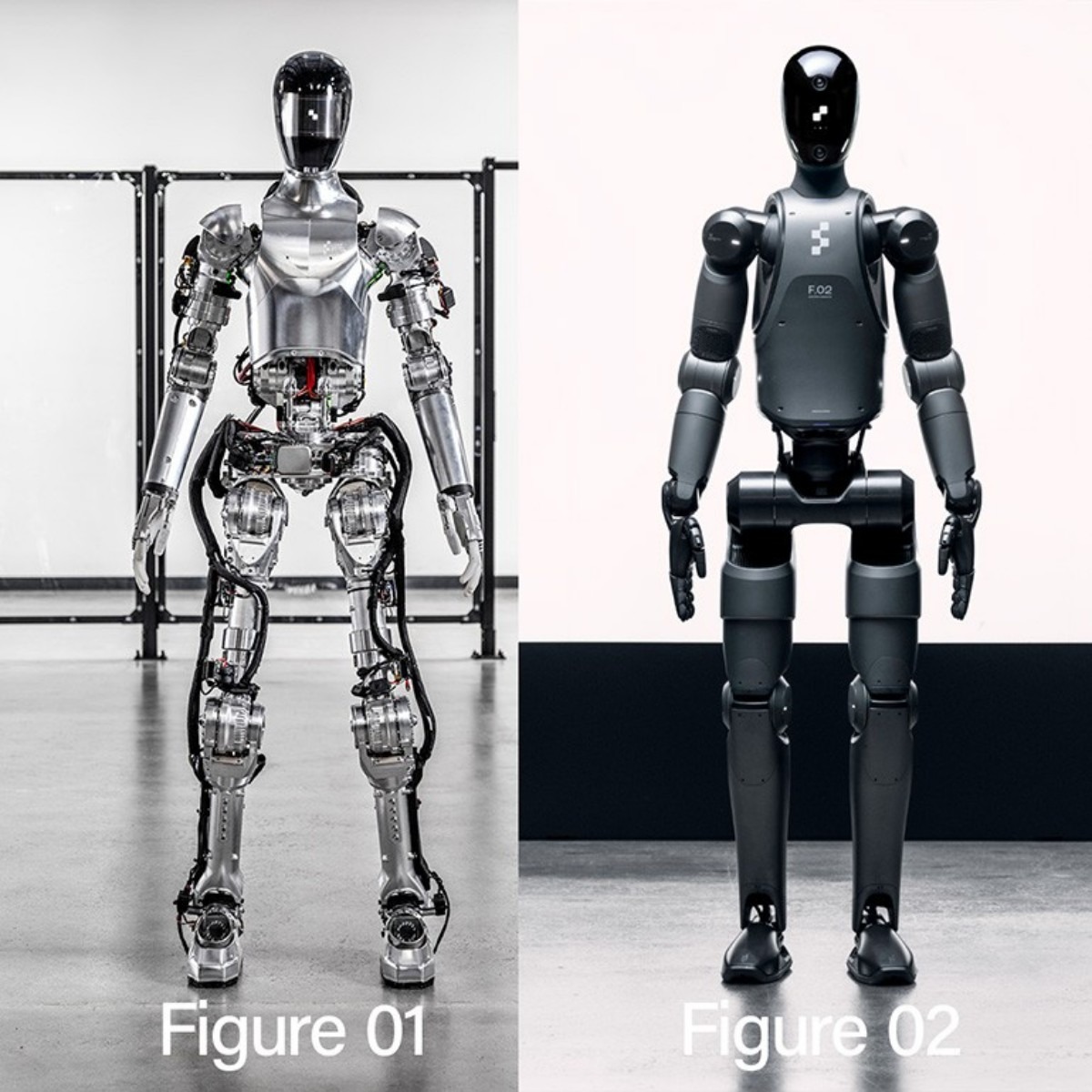
Launched in 2024 by Figure AI (Sunnyvale, California), the Figure 02 is a full‑scale biped designed explicitly for smart factory tasks. Standing 1.68 m tall and weighing 70 kg, it offers 20 kg payload capacity and moves at a brisk 10.8 km/h. Its headline feature is the Helix multimodal AI model, which combines vision, language, and action understanding, letting the robot learn new skills from demonstration and interact verbally with operators. A 5‑hour battery supports sustained factory shifts without the need for quick‑swap packs.
Figure 02 entered the public eye through a collaborative pilot with BMW at the Spartanburg, South Carolina plant, where it has been performing assembly‑line logistics such as moving bins and inserting sheet metal parts. The robot is available only through enterprise pilot programs as of 2026, with a publicly quoted pilot price of $130,000.
See full Figure 02 specs & availability
Fourier GR‑1: The payload champion from Shanghai
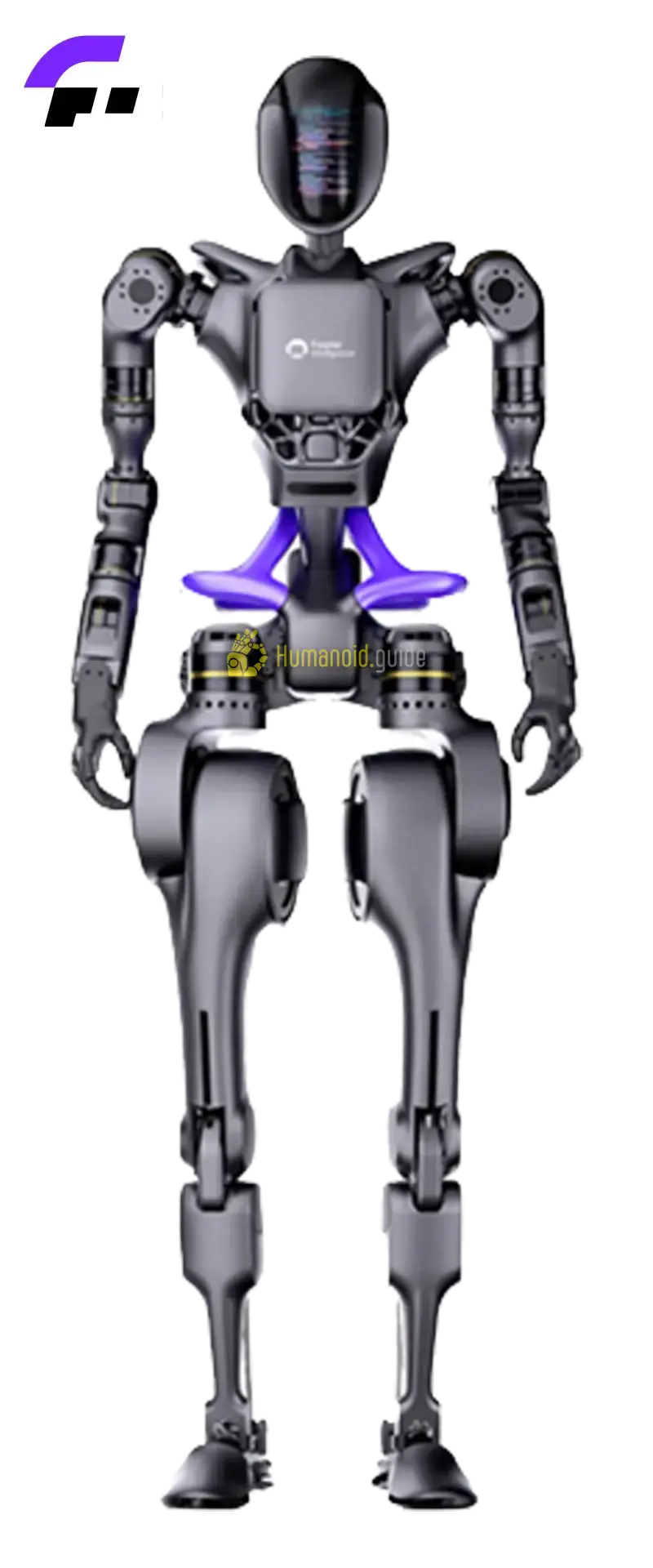
Fourier Intelligence (Shanghai, China) revealed the GR‑1 in 2023 and began offering it for pre‑order soon after. The 1.65 m, 55 kg humanoid is built around an impressive 50 kg payload — a class‑leading figure in the current humanoid market — driven by 40 degrees of freedom spread across its body. Top walking speed is 5 km/h (1.39 m/s), and the onboard battery supplies 2 hours of continuous operation.
Fourier positions the GR‑1 as a “physical AI robot” suitable for warehouse, logistics, and light manufacturing. The company has conducted paid pilot trials with automotive partners (including a demonstration at SAIC Motor’s assembly line in late 2024, handling parts up to 30 kg) and multiple research institutions. Pricing ranges from $125,000 to $170,000, depending on configuration, and availability is via direct inquiry — making it the more buyable of the two humanoids today, provided you accept shorter battery life.
See full Fourier GR‑1 specs & availability
Price & Configurations
Figure 02 is quoted at $130,000 for pilot‑program units; this is a near‑final price expected to hold when full commercial sales open. The package includes the Helix AI software stack and remote support during the pilot phase. No tiered configurations have been announced.
Fourier GR‑1 starts at $125,000 for a base unit, but optional sensor packages, end‑effectors, and software licences can push the price to $170,000. Because GR‑1 is already available for direct purchase, buyers can request a formal quote tailored to their application.
Winner: On sticker price, the GR‑1’s $125,000 base undercuts the Figure 02 by $5,000, but the Figure’s single transparent price makes budgeting simpler. Winner: Fourier GR‑1 for the lowest‑cost entry into high‑payload humanoid robotics.
Performance & Specs Head‑to‑Head
Payload
The most dramatic gap in this comparison: 20 kg vs. 50 kg. The GR‑1 can lift and carry heavy automotive components, pallets of goods, or assist with machine tending where weight matters. Figure 02’s 20 kg payload is adequate for lighter assembly tasks but constrains it in logistics roles that require moving heavy objects repeatedly.
Winner: Fourier GR‑1, with 2.5× the payload capacity.
Speed
Figure 02’s 10.8 km/h walking/trotting speed is far faster than the GR‑1’s 5 km/h. In a factory environment where the robot must travel between stations, Figure 02 can cover a 100‑m path in about 9 seconds, while the GR‑1 would need over a minute. That agility translates directly into higher task throughput.
Winner: Figure 02, nearly 2× faster.
Battery & Runtime
Figure 02 runs for 5 hours on a single charge, a full‑shift endurance that matters in continuous production. The GR‑1’s 2‑hour battery imposes frequent charging breaks, which can disrupt workflows unless hot‑swap batteries are available (not yet confirmed). For a humanoid that will be walking and lifting constantly, the difference is critical.
Winner: Figure 02, with 2.5× longer runtime.
Degrees of Freedom (DOF)
The GR‑1 boasts 40 DOF — a very high count for a full‑body humanoid — enabling highly flexible manipulation and posture control. Figure 02’s 28 DOF is competent but means fewer independent joint movements, which can limit its ability to perform complex two‑handed operations.
Winner: Fourier GR‑1, offering 43% more DOF for dexterous tasks.
Software & SDK Ecosystem
Figure 02 is a software‑first platform. Its Helix model enables natural multimodal interaction (speech + vision) and skill acquisition via demonstration. The Figure API provides developers with high‑level control, and ROS 2 support is on the public roadmap, making integration with existing robotic middleware straightforward. The active developer community around Figure AI and frequent model updates (e.g., Helix 2.0) strengthen its software proposition.
Fourier GR‑1 has not released a public SDK or API. The robot currently relies on Fourier’s proprietary control stack with remote tele‑operation and some level of pre‑programmed autonomous grasping. While the company has announced a “physical AI platform,” detailed access for third‑party developers remains unclear in 2026.
Winner: Figure 02, by a wide margin for open software, AI maturity, and ROS 2 trajectory.
Autonomy & Sensors
Figure 02’s sensor suite — stereo depth cameras, fisheye lenses for 360° awareness, IMU, and microphones — feeds directly into the Helix model, giving the robot real‑time situational understanding, object recognition, and conversational interaction. In BMW’s pilot, the robot has demonstrated autonomous bin picking, part insertion, and path planning without human intervention. Fleet coordination is handled via cloud‑based orchestration.
Fourier GR‑1’s precise sensor stack is not publicly documented. Video demonstrations suggest it uses stereo cameras and an inertial measurement unit, and it can perform autonomous navigation and object grasping, but the level of onboard AI decision‑making appears less advanced. Remote tele‑operation is supported, making it more dependent on human guidance for complex sequences.
Winner: Figure 02, with a documented, multimodal AI pipeline and proven autonomous factory execution.
Build Quality & Durability
Neither robot has published an official IP (Ingress Protection) rating. Figure 02 has been reported in interviews to withstand typical factory floor conditions but lacks a formal claim. The GR‑1’s 55 kg, lighter frame may offer better power‑to‑weight ratio for transport, but also might sacrifice some structural rigidity under heavy loads; Fourier has not released endurance-test data.
On known deployment longevity: Figure 02 has logged thousands of operational hours in BMW’s plant without major reported breakdowns, according to Figure AI’s public updates. Fourier’s GR‑1 pilots have been shorter, and no aggregated operating‑hour data is available.
Winner: Cannot be definitively awarded without IP ratings or long‑term reliability data. Figure 02’s sustained BMW pilot gives a practical reliability edge. Winner: Figure 02, based on deployment track record.
Price & Total Cost of Ownership
| Cost element | Figure 02 | Fourier GR‑1 |
|---|---|---|
| Hardware purchase (average) | $130,000 | $135,000 (mid‑range) |
| Annual software/support (est.) | Included in pilot; post‑pilot ~$20,000/yr* | Not disclosed; estimated ~$15,000/yr* |
| 3‑year TCO (est.) | ~$190,000 | ~$180,000* |
*Estimates; actual support contracts may vary.
Because Figure 02’s longer runtime allows it to complete more work per shift, the cost per productive hour might favour it in continuous‑operation environments. However, if a customer’s workflow permits charging every 2 hours (or battery hot‑swapping is adopted), the GR‑1’s lower base price and higher payload could deliver a better return in heavy‑handling logistics.
Winner: Fourier GR‑1 for static heavy‑load tasks with charging windows; Figure 02 for high‑throughput, continuous‑shift manufacturing.
Need a binding quote? Inquire about Figure 02 or request GR‑1 pricing
Which Should You Buy? Figure 02 vs Fourier GR‑1 by Use Case
Choose Figure 02 if: - You need 5‑hour runtime per shift without interruptions. - Your processes demand fast, agile movement (3 m/s max speed). - You value an advanced AI copilot that learns tasks and communicates verbally. - You are deploying smart‑manufacturing cells with ROS 2 integration. - You prioritize a humanoid with a proven, multi‑month factory pilot at BMW.
Choose Fourier GR‑1 if: - You regularly handle components up to 50 kg — palletising, machine tending, heavy assembly. - The robot can be recharged every 2 hours or you can hot‑swap batteries. - You need the flexibility of 40 DOF for complex, dexterous manipulation. - You want the lowest upfront entry price ($125,000) for a high‑payload humanoid. - You are comfortable working directly with Fourier for software customisation.
Choose neither if: - You need an IP65‑rated robot for outdoor or wet environments. - You require hot‑swappable batteries out‑of‑the‑box (neither currently offers this). - You prefer a quadruped or cobot with lower cost and simpler safety certifications.
Real‑World Deployments & Track Record
Figure 02 BMW Spartanburg pilot: Under a multi‑phase deal signed in early 2025, Figure 02 has been performing logistics and assembly tasks on BMW’s X‑model line. Public reports indicate the robot has handled over 10,000 part placements with zero safety incidents (Figure AI, March 2026 update). The program is expanding to additional stations in 2026. Figure 02 also logged 1,250 operating hours in initial BMW trials and supported 30,000+ vehicle production steps (source: Figure AI blog, February 2026).
Fourier GR‑1 SAIC Motor assembly trial: Fourier demonstrated the GR‑1 at SAIC’s plant in September 2024, navigating the line and picking parts weighing up to 30 kg (Fourier press release, Oct 2024). The company reported multiple paid pilot engagements with automotive and logistics firms throughout 2025, but specific operating hours and deployment sites beyond SAIC have not been publicly shared. This places the GR‑1 in a solid but less transparent position regarding long‑term field reliability.
Winner: Figure 02 has a quantifiable, publicly documented deployment track record. Winner: Figure 02.
SDK, Software & Developer Ecosystem
Figure 02 provides the Figure API (early‑access for partners) and has publicly committed to ROS 2 support in a forthcoming SDK release. The Helix model is trained on massive multimodal datasets and can be fine‑tuned for specific tasks. Developer documentation and update logs are published on Figure AI’s website, and the active community includes multiple academic labs.
Fourier GR‑1 does not currently expose a public API or SDK. The robot’s capabilities are accessed through Fourier’s native control interface, with a strong emphasis on tele‑operation and basic autonomous routines. The absence of a ROS 2 bridge or open‑source libraries limits community‑driven innovation and makes integration into existing ROS‑based factory pipelines more difficult.
Winner: Figure 02, for its open‑software trajectory and developer‑accessible AI stack.
Support, Warranty & Availability
Figure 02 is in enterprise pilot phase; early pilot customers receive direct factory‑side support from Figure AI engineers. General warranty terms and post‑pilot support SLAs have not been published. Purchasing requires negotiating a pilot agreement.
Fourier GR‑1 is available for pre‑order through direct inquiry. Fourier offers customisation and support packages but has not released a standard warranty document. The availability is more concrete than Figure 02’s, and the company has been delivering units to research and industrial partners since 2024.
Winner: For immediate availability, Fourier GR‑1 (pre‑order with known delivery timelines). However, the quality and depth of enterprise support remain undocumented for both.
Comments