

Welcome to the definitive head‑to‑head between the Engineered Arts RoboThespian and the Promobot V4. One is a stationary actor built to replicate human expression; the other is a wheeled interactive terminal designed for customer service. This article compares price, specifications, real‑world deployments, software, and use‑case suitability so you can decide which humanoid‑style robot fits your venue.
RoboThespian vs Promobot V4: Specs Compared
| Specification | Engineered Arts RoboThespian | Promobot V4 |
|---|---|---|
| Price (new) | $79,000 | $70,000 |
| Price (used) | ~$40,000 – $60,000 | $45,000 – $60,000 |
| Height | 1.75 m | 1.57 m |
| Weight | 33 kg | 70 kg |
| Payload | Not rated (stationary) | — (not specified; likely none) |
| Max speed | N/A (stationary) | 3.6 km/h |
| Battery / Runtime | Mains powered (continuous) | 8 hours |
| Degrees of freedom | 32 (22 facial, 10 body/arms) | 6 |
| IP rating | Not published (indoor only) | Not published (indoor use) |
| Onboard compute | Proprietary controller | Embedded industrial PC + sensors |
| Sensors | Microphone arrays, CMOS cameras (facial tracking) | 2D/3D LiDAR, cameras, ultrasonic, bumpers |
| SDK / Scripting | Virtual Robot API, drag‑and‑drop content manager | Promobot Script, API for dialogue trees and integrations |
| ROS2 support | Not disclosed | Not disclosed |
| Autonomy / Fleet | Pre‑programmed sequences, tele‑operation | SLAM autonomy, can patrol pre‑defined routes |
| Safety certs | Not published | Not published |
| Availability / Lead time | Available from manufacturer; custom lead time | Available for purchase or lease; standard lead time |
| Warranty / Support | Manufacturer direct; extended support plans offered | Manufacturer warranty; regional support via partners |
The biggest delta jumps out immediately: RoboThespian is completely stationary — a stage actor — while Promobot V4 is a mobile wheeled platform. Their use cases are so different that the choice hinges squarely on whether mobility or expressive range matters more.
Engineered Arts RoboThespian: The Animatronic Stage Actor
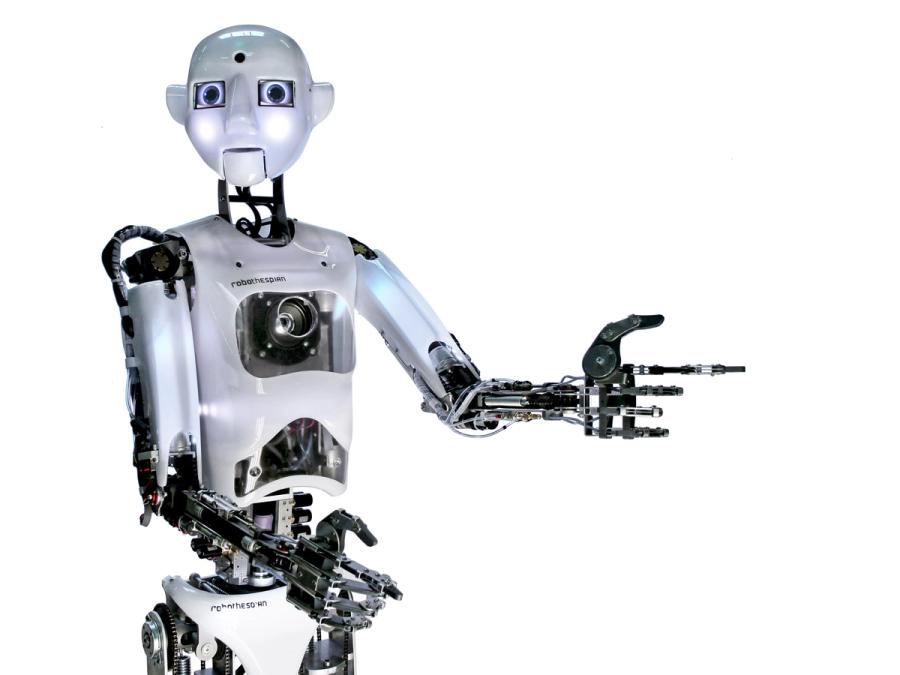
Launched in 2018 by Engineered Arts (Falmouth, UK), the RoboThespian is the successor to earlier RoboThespian models and shares DNA with the ultra‑realistic Ameca. It is a life‑size (1.75 m, 33 kg) humanoid built for one purpose: to perform. Mains‑powered and bolted to a base, it delivers 32 degrees of freedom — 22 in the face alone — enabling eyebrow raises, smiles, frowns, lip sync, and head tilts that rival a human actor. Its arms, shoulders, and torso add expressive physical movements. A full‑color LED mouth matrix supplements the mechanical facial expressions for speech‑sync effects.
Programming is done via Engineered Arts’ Virtual Robot controller, which provides a drag‑and‑drop timeline and a scripting API. Users can create scripted shows, trigger interactions from sensors (camera‑based face tracking, microphone prompts), or tele‑operate live via a puppeteering interface. At $79,000 new (and used units dipping below $40,000), RoboThespian is a premium storytelling platform, not a general‑purpose service robot.
Promobot V4: The Autonomous Service Kiosk on Wheels
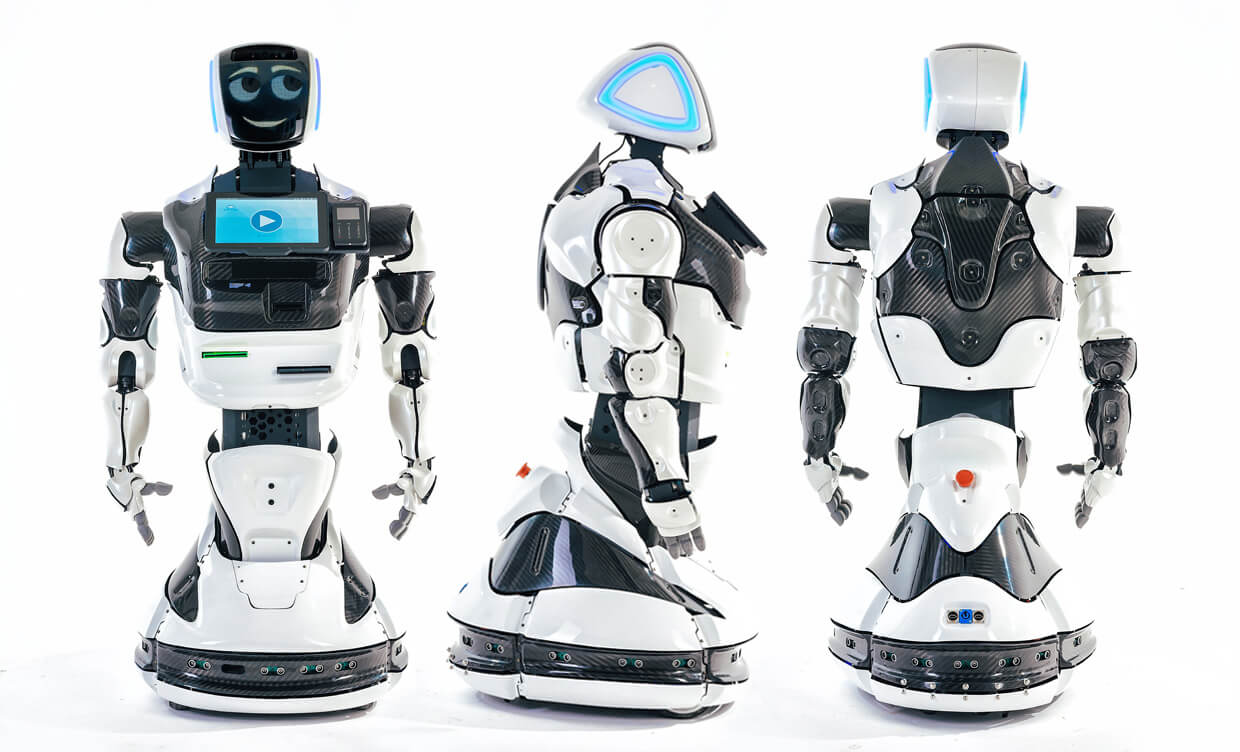
Built by Promobot in Perm, Russia, the V4 is a wheeled service humanoid standing 157 cm tall and weighing 70 kg. It packs a 21.5‑inch touchscreen, speech recognition, and SLAM‑based autonomous navigation, enabling it to roam malls, airports, and office lobbies for up to 8 hours on a charge. With only 6 degrees of freedom (neck and arm movements), its physical expression is limited to simple gestures and screen‑driven content, but it excels at information delivery: wayfinding, product catalogues, FAQ answers, and lead capture.
The V4 runs Promobot’s proprietary software suite. Operators can build dialogue trees, integrate third‑party databases (e.g., CRM or inventory systems), and trigger voice lines when a face is detected. A 2D/3D LiDAR and ultrasonic sensor suite allows it to avoid obstacles and return to its charging station autonomously. At $70,000 new, it’s priced comparably to RoboThespian but offers an entirely different value proposition: continuous mobile presence rather than scripted theatrical performance.
Price & Total Cost of Ownership
At the sticker level, the two robots are close: $79,000 for a new RoboThespian vs $70,000 for a Promobot V4. However, operational costs diverge sharply.
- RoboThespian: Mains‑powered, so no battery replacement costs. Ongoing expenses include software maintenance contracts (typically $2,000–$5,000/year) and possibly a trained operator to curate new shows. Used units at $40K–$60K can lower the acquisition cost, but the same support contracts apply.
- Promobot V4: Battery‑powered; after 2–3 years, a replacement battery (~$2,000) may be needed. The robot itself requires a dedicated charging station and periodic mapping updates. Leasing options exist, often around $1,200–$1,800/month, which bundles support and software. On a 3‑year TCO basis, a leased V4 could total $43,000–$65,000, while a purchased RoboThespian with support and content creation may land at $85,000–$95,000.
Neither robot has a payload capability, so no efficiencies from hauling materials factor in.
Winner: Promobot V4 edges RoboThespian in pure cost‑effectiveness if mobility and screen‑based service are the primary goals, thanks to lower new price and leasing options.
Performance & Specs: Stage Presence vs. Mobile Utility
Payload
Neither robot is designed to carry loads. RoboThespian’s arms can lift small props (a book, a microphone) but its payload is not rated; it is built for gesturing, not lifting. Promobot V4’s payload is unstated, and the form factor suggests none. Neither is a realistic candidate for object manipulation.
Winner: Draw — payload is not a decision factor.
Speed
RoboThespian is stationary. Promobot V4 rolls at a pedestrian 3.6 km/h, fast enough to move through a lobby but slower than a walking human. For fixed‑location performances, speed is irrelevant; for mobile customer engagement, 3.6 km/h is adequate.
Winner: Promobot V4 by default, as RoboThespian doesn’t move. But the real question is whether you need mobility at all.
Battery & Runtime
RoboThespian runs on mains power, so it can perform 24/7 with no downtime for charging — crucial for museum exhibits or permanent installations. Promobot V4’s 8‑hour battery suits a standard shift, but requires a 2–3 hour charging pause. If continuous operation is a must, RoboThespian shines.
Winner: RoboThespian for constant availability.
Degrees of Freedom (Expressiveness)
RoboThespian’s 32 DOF with 22 facial motors deliver a remarkable expressive range: it can emote, lip‑sync, and engage audiences with near‑human nuance. Promobot V4’s 6 DOF allow basic neck and arm movements; the main interactive channel is its screen and voice. For emotional impact, RoboThespian is leagues ahead.
Winner: RoboThespian, absolutely.
Software & SDK Ecosystem
RoboThespian’s Virtual Robot platform is tailored for content creators, not software engineers. A timeline‑based drag‑and‑drop interface lets non‑programmers choreograph speech, motion, and lighting cues. For advanced users, an API and Remote Control interface support integration with external triggers (e.g., stage lighting, sound systems). It is not a ROS2 ecosystem, and there is no open‑source community.
Promobot V4 uses a proprietary scripting language (Promobot Script) enabling dialogue trees, database queries, and conditional logic. Integration with enterprise systems (CRM, ERP) is possible through a published API, and Promobot offers an SDK for custom modules. Like RoboThespian, ROS2 is not publicly adopted, and the developer community is small.
For creative staff (scriptwriters, museum curators) the RoboThespian toolset is more intuitive. For IT teams wanting to hook a robot into a corporate data pipeline, Promobot is more flexible.
Winner: RoboThespian for ease of creative content creation; Promobot V4 for enterprise integration.
Autonomy & Sensors
Promobot V4 boasts a full SLAM autonomy stack backed by 2D/3D LiDAR, depth cameras, and ultrasonic sensors. It can self‑navigate through a mapped environment, avoid moving obstacles, and return to its charging dock without human intervention. Face detection triggers greetings, and it can patrol pre‑defined routes. This makes it a true “drop‑in‑and‑go” mobile robot after an initial mapping session.
RoboThespian has no autonomy — it is statically placed. However, it uses onboard cameras and microphones for audience interaction: face tracking and simple audio prompts trigger pre‑programmed behaviours. The operator can also tele‑operate the robot via a remote console, enabling live puppeteering. While not autonomous, this tele‑presence model allows highly dynamic, improvisational performances.
Winner: Promobot V4 for autonomous mobility; RoboThespian for interactive sensing with human‑in‑the‑loop control.
Build Quality & Durability
Both robots are designed for indoor use and lack published IP ratings. RoboThespian is a lightweight 33 kg with limbs built for fluid, low‑force motion. Its exposed mechanisms and projector‑based mouth matrix require a controlled environment (theatre, museum, science centre). Promobot V4 weighs 70 kg and feels more industrial — its wheeled base, thick shell, and sensor‑rich chassis can withstand gentle bumps in high‑traffic areas. However, neither is rated for dust or moisture, so they must stay indoors.
In terms of longevity, Engineered Arts has a track record of supporting RoboThespian installations that have run for 5+ years with routine maintenance. Promobot’s warranty terms are not publicly detailed, but field reports indicate the V4 is durable enough for daily use in retail settings.
Winner: Promobot V4 for physical robustness in public spaces; RoboThespian for long‑term performance quality when properly maintained.
Which Should You Buy? RoboThespian vs Promobot V4 by Use Case
- Choose RoboThespian if…
- You need a robot that can act, emote, and deliver scripted theatre or educational presentations.
- Your venue (museum, science centre, stage) wants a permanent, always‑on attraction that doesn’t need to move around.
- You have a creative team comfortable with a timeline‑based show‑authoring tool.
- Continuous availability (no battery swaps) matters.
- Choose Promobot V4 if…
- Your primary goal is mobile customer service: greeting, wayfinding, brochure display, lead capture.
- The robot must patrol a large area (airport, mall, lobby) autonomously.
- You need a touchscreen interface for intricate interactions (catalogues, forms).
- Lease/subscription models fit your budget better than a capital purchase.
- Choose neither if…
- You need a robot that manipulates objects or carries payloads.
- You require an IP‑rated outdoor solution.
- Your audience expects a natural language conversationalist — both robots’ dialogue is largely scripted, not deep‑AI generative.
Real‑World Deployments & Track Record
RoboThespian has performed at venues such as the Science Museum London, the Copernicus Science Centre in Warsaw, and Edinburgh’s Robotarium (Engineered Arts portfolio, 2023). It regularly appears at trade shows and has been used by research labs studying human‑robot interaction. While exact operating hours aren’t published, the model’s reliability in fixed installations is well‑proven.
Promobot V4 units have been deployed at Sheremetyevo Airport in Moscow to guide passengers, in Russian banks for customer queuing, and at shopping centres in the Middle East (Promobot case studies, 2021). Reports indicate V4 robots have logged tens of thousands of interaction hours globally. Their ambient performance is consistent, though users occasionally note that the speech recognition can struggle in very noisy environments.
Winner: No clear winner — both have credible, though different, deployment legacies. RoboThespian dominates entertainment and education; Promobot V4 dominates customer‑service mobility.
Support, Warranty & Availability
Both robots are currently available to purchase directly from the manufacturer. Lead times vary by configuration and region; Engineered Arts typically quotes 8–12 weeks for a new RoboThespian, while Promobot’s standard lead time is in a similar range. Promobot also offers lease‑to‑own or pure‑lease contracts in select markets.
Warranty specifics are not publicly published for either robot. Buyers should expect a standard 1‑year manufacturer warranty, extendable through paid support plans. Engineered Arts provides remote troubleshooting, on‑site training, and a content‑creation service for an additional fee. Promobot maintains a network of regional partners for maintenance and spare parts, though availability in Western Europe and North America is thinner than in Russia and the CIS.
Winner: RoboThespian for global support consistency; Promobot V4 for flexible acquisition options (lease/buy).
Comments