

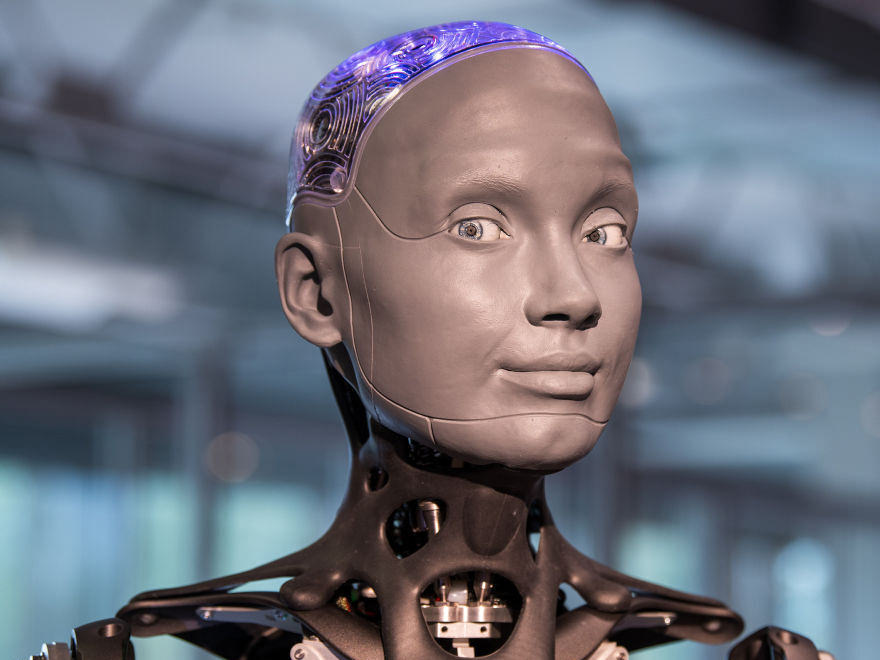
 and G1 (right) — two fundamentally different approaches to humanoid research") Ameca (left) and Unitree G1 (right) — comparable weight but opposite mobility and use-case profiles.
Engineered Arts Ameca and Unitree G1 represent two opposing philosophies for affordable humanoid research. Ameca is a desk‑bound, emotionally rich face and torso, power‑savvy for human‑AI dialogue and presence studies. The Ameca starts at $100,000 and can climb past $500,000 in custom guises. The Unitree G1, on the other hand, is a full 23–43 DOF biped that walks, runs at 7.2 km/h, can carry 3 kg, and runs on batteries — starting at just $13,500. This comparison dissects price, specs, software, durability, real‑world track records, and use cases, so robotics researchers, integrators, and lab directors can pick the platform that matches their research goals.
Engineered Arts Ameca vs Unitree G1: Specs Compared
The table below highlights the fundamental separation between a static, interaction‑focused robot and a mobile, task‑focused one. Empty fields indicate capabilities that do not apply to the platform.
| Feature | Engineered Arts Ameca | Unitree G1 |
|---|---|---|
| Price (base config) | ~$100,000 | $13,500 |
| Price (fully config’d) | Up to $500,000 | Up to $73,900 (Ultimate) |
| Height | 1,600 mm (above desk) | 1,270–1,320 mm (adjustable) |
| Weight | 35 kg | ~35 kg |
| Payload (per arm) | 2 kg | 3 kg per arm (standard) |
| Max speed | Not applicable (stationary) | 7.2 km/h |
| Battery life | Not applicable (AC‑powered) | ~2 hours (removable battery) |
| Degrees of freedom (total) | 31 (mostly face & upper body) | 23–43 (depending on variant) |
| IP rating | Not published (indoor use) | IP54 ready (resistant to dust & splashes) |
| Onboard compute | Intel NUC / Jetson‑class (disclosed for custom builds) | Jetson Orin NX (Ultimate) / Intel RealSense‑ready |
| Sensors | RGB cameras, microphones, speaker array | LiDAR (optional), depth cameras, IMU, force/torque |
| ROS2 support | Via ROS‑bridge (custom integration) | Native ROS2 (official SDK) |
| SDK languages | C++, Python (Tritium API) | Python, C++, ROS2 |
| Safety certs | CE (custom build assessed) | CE, FCC (safety‑rated controllers) |
| Availability | Made to order (purchase or rental) | In production, shipping globally |
Ameca’s specification sheet is dominated by interaction hardware; G1’s by mobility and dexterity. Ameca cannot move from its plinth; G1 cannot produce realistic smiles or frowns. This table alone already points the buyer toward their research domain.
Engineered Arts Ameca: Expressive Humanoid for Human‑Robot Interaction
 Ameca’s 31 DOF face can replicate micro‑expressions that other research robots cannot.
Developed by Engineered Arts in Penryn, UK, Ameca is a modular humanoid platform built entirely around believable nonverbal communication. The robot consists of a human‑like head, articulated neck, shoulders, arms, and a torso that houses the compute stack and the company’s proprietary Tritium operating system. It does not have legs or a mobile base — it is intended to sit behind a desk, on a pedestal, or at a museum counter.
Ameca’s 31 degrees of freedom are dedicated almost entirely to the face (eyebrows, eyelids, cheeks, jaw, lips) and upper body, enabling micro‑expressions that researchers can map to emotional states. Combined with an array of cameras and microphones, Ameca can track faces, maintain eye contact, and respond to natural speech with the help of large language models. Engineered Arts regularly demonstrates Ameca in conversation with GPT‑4 and other models, making the robot a popular testbed for AI‑driven social interaction.
Availability and price — Base units start near $100,000, but most research groups order custom configurations with upgraded compute, additional sensors, and tailored aesthetic shells, pushing the price to $300,000–$500,000. Ameca is built to order, with lead times ranging from 3 to 6 months. Engineered Arts also offers a rental program for short‑term exhibitions and film productions.
Unitree G1: Mobile Humanoid for Whole‑Body Research
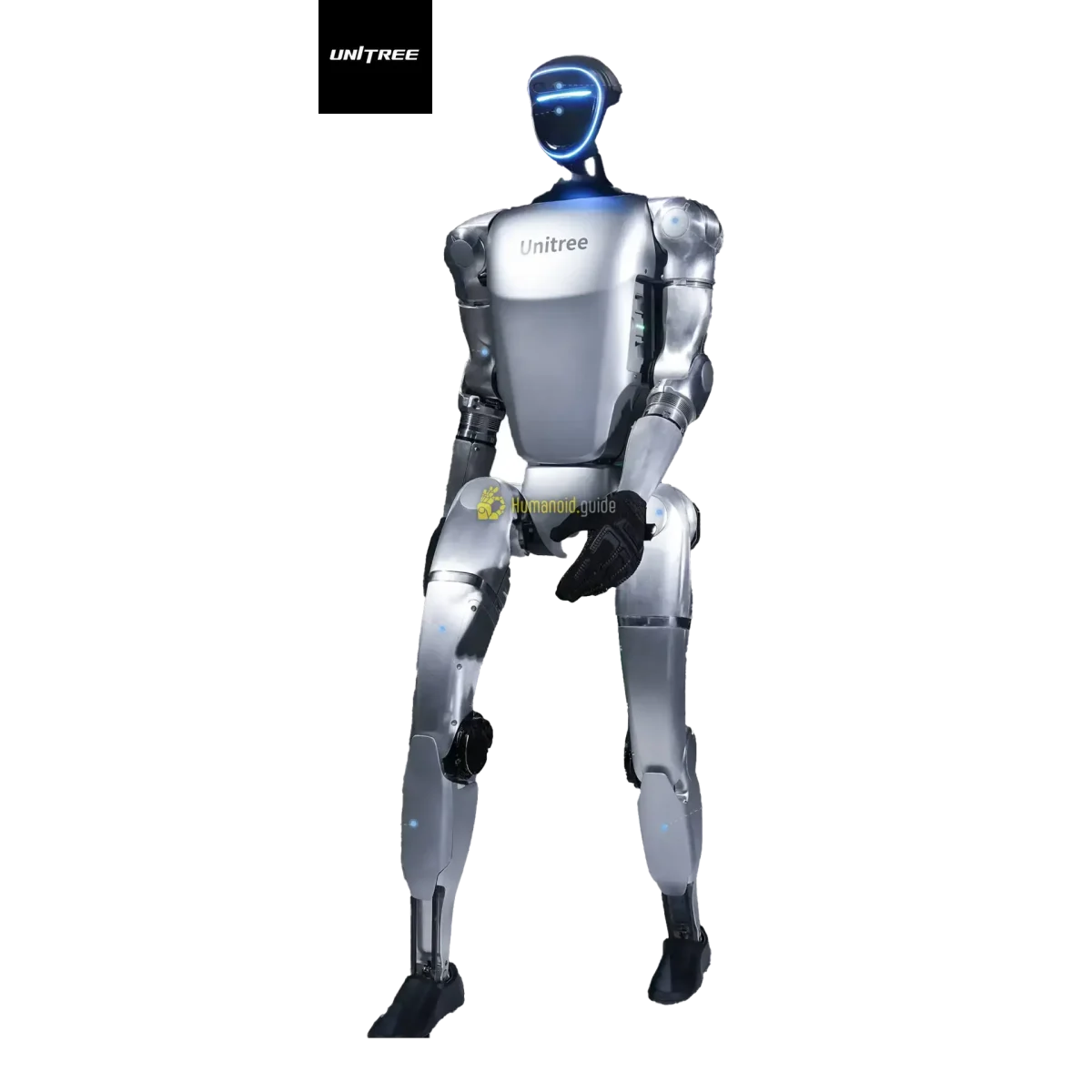 Unitree G1 walks, runs, climbs stairs, and manipulates objects — all battery‑powered.
Unitree Robotics, headquartered in Hangzhou, China, entered the full‑size humanoid market in 2024 with the G1. The robot stands roughly 1.3 meters tall, weighs about 35 kg, and comes in three tiers: Base (23 DOF, $13,500), EDU (up to 40 DOF, educational package), and Ultimate (43 DOF, $73,900 with force‑torque sensors and higher‑performance joints). All variants are bipedal and self‑contained, with a 2‑hour removable battery and WiFi/LTE connectivity.
The G1’s design prioritizes dynamic locomotion and whole‑body manipulation. With a top speed of 7.2 km/h (roughly a jog), 3 kg payload capacity per arm, and robust SLAM‑based navigation, it is suited for research in humanoid walking, reinforcement learning of pick‑and‑place, and even light industrial inspection. The EDU and Ultimate configurations add dexterous hands with force feedback and additional torso joints, bringing the DOF count to 43 — comparable to much more expensive research platforms.
Availability — The G1 has been shipping since late 2024. Unitree reports that several hundred units have been delivered to universities and R&D labs globally; purchasing is straightforward via Unitree’s online store with typical lead times of 4–8 weeks.
Head‑to‑Head by Dimension
Price & Configurations
The price gap between Ameca and G1 is the most striking differentiator. Ameca’s starting price nears $100,000 and quickly escalates with custom engineering; G1 starts at $13,500 — less than many industrial sensors. A fully loaded G1 Ultimate ($73,900) still comes in under the cheapest Ameca build. For a university lab on a tight budget, the G1 is a practical humanoid “starter” for mobile robotics, whereas Ameca is a premium interaction appliance.
Winner: Unitree G1 offers far more hardware mobility per dollar; Ameca’s cost is justified only if real‑time, high‑fidelity facial expression is the core research requirement.
Performance & Specs
Payload
Ameca’s arms can lift 2 kg — enough for light props, but the robot is not designed for repeated heavy lifts. G1’s arms carry 3 kg with standard hands, and the EDU/Ultimate models can manage more complex grasps. Neither robot is intended for industrial payloads, but G1’s whole‑body stability allows more natural carrying of objects while walking.
Winner: Unitree G1 has a slight edge in raw payload and far better integration with mobile tasks.
Speed
Ameca is stationary — speed is zero. G1 walks at 7.2 km/h, faster than most other small humanoids in its class. This gives G1 the clear advantage for any study involving navigation, SLAM, or human‑following.
Winner: Unitree G1. Ameca cannot move.
Battery
Ameca is permanently tethered to wall power and so has indefinite runtime. G1’s 2‑hour battery limits continuous operation, though it is hot‑swappable. For a robot at a trade show booth, tethered power is an advantage; for autonomous patrols, a battery is essential even if limited.
Winner: Tie — depends on use case. For stationary dialogue, Ameca’s infinite runtime is superior; for mobile experiments, G1’s battery is necessary.
Degrees of Freedom
Ameca concentrates its 31 DOF in the face and upper body for fluid expressions; it has no lower body at all. G1’s 23–43 DOF map across legs, torso, arms, and hands, enabling walking, stair climbing, and dexterous manipulation. If the goal is to study whole‑body dynamics or reinforcement learning of locomotion, G1’s high‑DOF body wins. If the goal is to study micro‑expressions or nuanced head‑gaze behavior, Ameca’s facial DOF cannot be matched.
Winner: For whole‑body research, G1. For facial expression research, Ameca.
Software & SDK Ecosystem
Ameca runs Engineered Arts’ Tritium operating system. Tritium provides a Python and C++ API to control actuators, stream camera feeds, and integrate external AI models. The platform can accept ROS2 input via a bridge, but native ROS2 support is not out of the box — labs must do custom integration. Engineered Arts supplies detailed documentation and maintains an active forum, though the developer community remains small compared to open‑source ecosystems.
G1 ships with Unitree’s own SDK, which offers Python and C++ bindings for joint control, IMU reading, and state estimation. Crucially, the SDK includes native ROS2 support, making the G1 instantly compatible with ROS‑based navigation stacks, MoveIt, and Gazebo/Isaac Sim simulations. Unitree also provides a teleoperation interface and VR integration. The open‑source community around Unitree quadruped SDKs carries over to the G1, giving researchers more shared tooling and example projects.
Winner: Unitree G1’s native ROS2 support and larger developer community make it easier to plug into existing robotics pipelines. Ameca’s Tritium is capable but requires more custom engineering for ROS‑heavy labs.
Autonomy & Sensors
Ameca uses high‑resolution RGB cameras and microphone arrays to achieve person detection, face tracking, and speech recognition. It is not designed for autonomous navigation — it stays put. Engineered Arts demonstrates Ameca’s autonomous conversational abilities using cloud‑connected LLMs, but the robot’s autonomy is strictly verbal and expressive.
G1 is equipped with depth cameras, optional LiDAR, and an IMU‑centric state estimator. It can build 3D maps, localize itself, and autonomously navigate indoor environments. With Unitree’s “Autowalk” style path recording (ported from its quadruped line), the G1 can repeat learned routes. The G1’s autonomy stack is geared toward physical tasks — walk to a table, grasp an object, return — rather than conversation.
Winner: For spatial autonomy, G1. For conversational autonomy, Ameca.
Build Quality & Durability
Ameca is beautifully finished with custom silicone‑style facial skin and precision actuators. It is designed for indoor, climate‑controlled environments. Engineered Arts has not published an IP rating; the robot would likely be damaged by dust or moisture.
G1 is built with a tougher, industrial‑looking plastic‑metal shell and carries an IP54 rating on some configurations, meaning it resists dust and splashing water. This practical durability is a significant advantage for development labs where spills, bumped tables, and occasional rough handling occur.
Winner: Unitree G1 — its durability and modest IP rating suit real‑world lab environments better than Ameca’s delicate appearance.
Price & Total Cost of Ownership
Ameca: At $100,000–$500,000, Ameca is a capital‑intensive investment. Three‑year TCO should factor in the cost of dedicated compute (often a separate PC), any custom‑engineered modifications, and annual software support contracts. Engineered Arts does not publicly share support pricing, but enterprise‑grade support is typically included for the first year. Because the robot is tethered, there are no battery replacement costs.
G1: Starting at $13,500 and topping out at $73,900, the G1’s initial cost is dramatically lower. Over three years, a lab might need to replace a few batteries (~$500 each) and possibly upgrade the onboard compute (Jetson modules are replaceable). The native ROS2 support reduces integration time, which indirectly lowers labor costs. The G1 can be purchased online with standard PO‑based invoicing, making procurement straightforward even for institutions with limited robotics budgets.
For the price of one fully optioned Ameca, a research group could purchase nearly four G1 Ultimate robots — enabling multi‑robot locomotion studies or distributed sensor fusion experiments.
Which Should You Buy? Ameca or Unitree G1 by Use Case
Choose Engineered Arts Ameca if… - Your research centers on realistic human‑robot interaction, affective computing, or non‑verbal communication. - You need a robot that can hold a face‑to‑face conversation with credible eye contact, nods, and micro‑expressions. - You require a showpiece for public engagement, museums, or corporate lobbies. - Budget allows a $100,000+ investment and you do not need the robot to walk.
Choose Unitree G1 if… - Your lab works on bipedal locomotion, whole‑body control, or mobile manipulation. - You need a robot that can walk, traverse doorways, climb stairs, and carry objects. - You want to experiment with reinforcement learning in the real world without risking a six‑figure platform. - You already use ROS2 and want a plug‑and‑play research humanoid.
Choose neither if… - You need a robot for industrial heavy lifting (look at cobots like Universal Robots UR10e). - You require a fully certified, explosion‑proof inspection robot (consider Spot or ANYmal). - Your budget is under $10,000 (consider the Unitree Go2 quadruped).
Real‑World Deployments & Track Record
Ameca has been featured at CES 2022, 2023, and 2024, as well as AI summits and technology exhibitions worldwide. Engineered Arts states that Ameca platforms are installed at several top‑tier university AI labs and research centers; however, specific institution names are not publicly disclosed. Publicly documented deployments include installations at the SETI Institute (for public engagement) and temporary placements in museums such as the Museum of the Future in Dubai. As of 2026, Ameca remains a low‑volume, bespoke product with an estimated few dozen units in the field (Engineered Arts, 2025).
G1 shipped its first batch in late 2024 and has since been adopted by multiple research universities in North America, Europe, and Asia. Unitree Robotics reports a cumulative shipment figure of over 500 units (Unitree, Q1 2026), with documented research outputs from labs like the University of Edinburgh (locomotion) and Shanghai Jiao Tong University (manipulation). The G1’s presence in the preprint community (arXiv papers detailing reinforcement learning on G1 platforms) is growing rapidly, giving new users a base of reproducible results.
SDK, Software & Developer Ecosystem
Ameca’s Tritium software offers a clean Python API for expression scripting, and Engineered Arts has demonstrated integrations with ChatGPT, Microsoft Azure Cognitive Services, and other cloud AI tools. Tritium also includes a visual programming interface, which non‑technical operators can use to sequence facial expressions and speech. ROS2 bridging is possible but not native — it requires the user to set up translation nodes.
The G1’s Unitree SDK is deeply aligned with open‑source robotics. The ROS2 packages are fully supported and pre‑installed on the onboard computer (in Ultimate models). Developers can leverage Unitree’s simulation environment, which integrates with NVIDIA Isaac Sim, and use off‑the‑shelf MoveIt configurations for manipulation tasks. The GitHub repository for Unitree’s general SDK is active, and while G1‑specific examples are still growing, the community around Unitree quadrupeds often shares tools that are cross‑compatible.
Winner: Unitree G1, by virtue of native ROS2, wider community support, and compatibility with mainstream simulation tools.
Support, Warranty & Availability
Ameca is built to order. Engineered Arts offers a standard 12‑month warranty and optional extended support contracts. Lead times vary from 12 to 24 weeks depending on customization. Because each unit is hand‑assembled, repair and spare parts require shipping components back to the UK, which can cause extended downtime.
G1 is mass‑produced, with an online ordering process and typical delivery in 4–8 weeks. Unitree provides a standard 12‑month warranty; an extended warranty is available for EDU and Ultimate models. Replacement parts (batteries, actuators) can be ordered from Unitree’s e‑commerce portal, and the company maintains service centers in China, the EU, and the US.
Winner: Unitree G1 for shorter lead times, easier spare‑part procurement, and broader service network.
Comments