
Two humanoid robots that could hardly be more different—one a pioneering research platform that helped define whole‑body torque control, the other the most widely discussed all‑electric industrial humanoid of 2026. The DLR Justin (German Aerospace Center) has been a reference for academic manipulation since the late 2000s, while the new all‑electric Boston Dynamics Atlas finally turned the page from hydraulic prototypes to a production‑ready, untethered design. This comparison breaks down specs, price, performance, and real‑world role so you can understand which humanoid fits a research lab—and which is built for factory floors.
- Best overall value: Not applicable — Justin is not for sale; Atlas is the only commercially available option at $420,000.
- Best for research: DLR Justin (open research platform, torque‑controlled arms, 41 DOF for dexterity).
- Best for industrial deployment: Boston Dynamics Atlas (battery‑powered, 50 kg payload, 56 DOF, full mobility, enterprise support).
- Best budget pick: Neither — Justin has no purchase price and Atlas costs $420k; budget‑conscious researchers often use custom manipulators or smaller platforms.
DLR Justin vs Boston Dynamics Atlas: Specs Compared
The driving numbers behind these two humanoids.
| Specification | DLR Justin | Boston Dynamics Atlas |
|---|---|---|
| Price (base) | Not for sale | $420,000 |
| Price (configured) | Not applicable | $420,000 (enterprise package) |
| Weight | 150 kg | 89 kg |
| Height | 190 cm | 150 cm |
| Payload | ~15 kg (arm) | 50 kg |
| Max speed | 3.6 km/h | 8 km/h |
| Battery / Runtime | Not applicable (tethered) | 4 hours |
| Degrees of freedom (DOF) | 41 | 56 |
| IP rating | Not published | Not published |
| Onboard compute | Custom DLR real‑time control | Not published (expected NVIDIA Jetson‑class) |
| Sensors | Joint torque sensors in all joints, stereo cameras | RGB‑D cameras, LiDAR, IMU |
| SDK languages | Internal research software (C++), not public | BD SDK (Python / C++), ROS2 bridge expected |
| ROS2 support | No (proprietary DLR framework) | Yes (via Boston Dynamics API) |
| Autonomy / Fleet software | None (research‑only) | Scout fleet management (planned) |
| Safety certs | None (lab‑only) | Not certified for collaborative operation |
| Availability / Lead time | Research‑only; not for sale | Limited production; enterprise inquiry required |
| Warranty / Support | Not applicable | 1‑year enterprise warranty, plus support contract |
Atlas delivers more than three times the payload, twice the speed, and untethered battery endurance. Justin counters with a legacy of torque‑controlled manipulation research and a taller, heavier build that prioritises research flexibility over mobility. Neither robot is a product that walks onto a store shelf—but Atlas is the only one that a buyer can actually order.
DLR Justin: The torque‑controlled research pioneer
[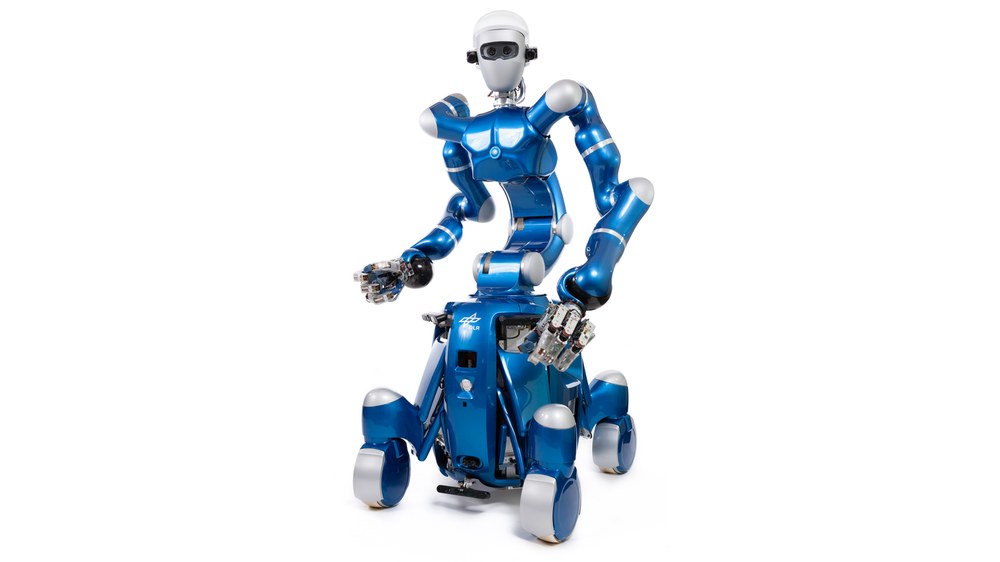 ] The DLR Justin was developed by the German Aerospace Center’s Robotics and Mechatronics Centre in Oberpfaffenhofen. First introduced in the late 2000s, it was one of the world’s first full‑body torque‑controlled humanoids, using series‑elastic actuators in every joint to achieve sensitive force regulation. The robot stands 190 cm tall and weighs 150 kg, with 41 degrees of freedom—most of them concentrated in the arms and hands.
Justin is explicitly not a product; it was built as a research platform to explore autonomous manipulation, teleoperation, and whole‑body control. It has no onboard battery, requiring a tether for power and cooling, and remains confined to laboratory settings. Its biggest contributions are academic: the DLR team published extensively on impedance control, multi‑contact planning, and dexterous grasping, and the robot served as part of ESA’s METERON teleoperation experiments. Today, Justin continues to be used for sensorimotor research, but there is no commercial supply chain, pricing, or support contract—if you want one, you collaborate with DLR directly.
Boston Dynamics Atlas: The all‑electric enterprise humanoid
[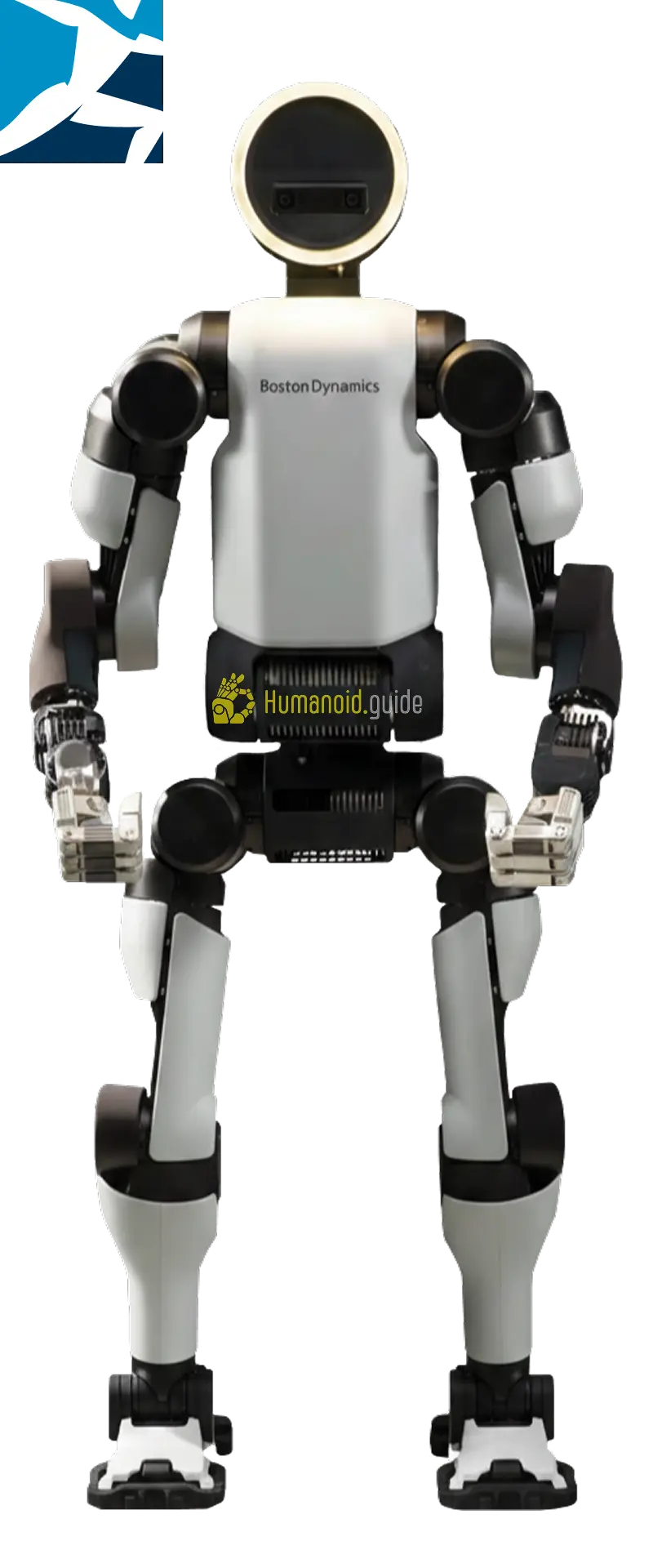 ] The Boston Dynamics Atlas represents a ground‑up redesign from the original hydraulic version that retired in 2024. The all‑electric Atlas was first shown that year, and by CES 2026 Boston Dynamics had confirmed a $420,000 enterprise price tag and limited production availability. Standing 150 cm tall and weighing just 89 kg, it is significantly more compact and lighter than Justin while packing a 50 kg payload, 56 degrees of freedom, and a top speed of 8 km/h.
Atlas runs on a 4‑hour rechargeable battery, uses a suite of RGB‑D cameras and LiDAR for perception, and executes dynamic movements—backflips, running, object detection—that have made it a social media icon. Under the hood, Boston Dynamics provides its SDK with Python and C++ interfaces and a path to ROS2 integration via its API. The robot is targeted at industrial logistics and manufacturing; Hyundai Motor Group (the parent company) is piloting Atlas for parts handling and assembly tasks. While still early in deployment, Atlas is currently the only advanced full‑body humanoid that enterprises can order and receive with a warranty and support plan.
Price & Total Cost of Ownership
DLR Justin has no purchase price—it is not a commercial product. Research institutions that work with DLR typically provide their own funding and resources, and there is no “total cost of ownership” in a traditional sense. Hardware maintenance and upgrades are handled by the lab, and software is freely shared within the research consortium.
Boston Dynamics Atlas costs $420,000 for the base enterprise configuration, which includes the robot, battery, charger, and a basic software license. Additional costs are not yet public, but typical enterprise robotics deployments often include a multi‑year support contract, spare parts, and optional software modules (e.g., fleet management via Scout). A rough 3‑year TCO, assuming a support contract of ~20% of hardware per year, could approach $620,000–$700,000. However, unlike Justin, this is a commercially supported, production‑ready robot with a warranty and a defined roadmap.
Winner: Atlas, by default, because you can buy it. For a lab that wants a high‑dexterity humanoid, Justin’s cost is hidden in research collaboration—but it’s not an asset you can purchase.
Performance & Specs
Payload
Justin’s arm payload is approximately 15 kg, sufficient for typical manipulation tasks with moderate tools or objects. Atlas offers 50 kg, making it capable of lifting heavy automotive parts, boxes, or even another humanoid. Winner: Atlas.
Speed
Justin maxes out at 3.6 km/h, a slow walking pace constrained by its tethered lab environment. Atlas runs at 8 km/h—over twice as fast—and can sprint and jump, giving it real industrial mobility. Winner: Atlas.
Battery & Runtime
Justin is tethered, so runtime is unlimited but immobility is absolute. Atlas’s 4‑hour battery enables multi‑shift operations with battery swaps. For any untethered application, Atlas is the only option. Winner: Atlas.
Degrees of Freedom
Justin’s 41 DOF are mostly in the upper body, with highly articulated hands and torque‑controlled arms that deliver exceptional manipulation finesse. Atlas has 56 DOF spread across the full body, including powerful legs and a dynamic torso, providing superior overall agility. For fine manipulation, Justin’s DOF density and torque sensing are superior; for whole‑body motion, Atlas wins. Winner: Split — Justin for arm/hand dexterity, Atlas for whole‑body capability.
Software & SDK Ecosystem
DLR Justin runs on a custom real‑time control framework developed at DLR, written in C++ and tightly integrated with the robot’s hardware. There is no public SDK, no ROS2 support, and no off‑the‑shelf simulation model. Researchers who collaborate with DLR gain access to the software stack, but it is not a self‑serve experience.
Boston Dynamics provides the BD SDK for Atlas, with Python and C++ libraries, a simulation environment (likely integration with NVIDIA Isaac Sim), and a proven API that already supports ROS2 on the company’s Spot quadruped. The Atlas software ecosystem is clearly designed for enterprise integrators, and the roadmap includes fleet management through Scout. Winner: Atlas — accessible, supported, and integrable.
Autonomy & Sensors
Justin’s sensor suite includes torque sensors in every joint—a hallmark of its compliant, safe interaction—and stereo cameras for vision. Its autonomy capabilities have been demonstrated in structured grasp planning and teleoperation scenarios, but it has never been deployed for autonomous navigation in unstructured environments.
Atlas relies on RGB‑D cameras, a LiDAR sensor, and an IMU to build a 3D understanding of its surroundings, enabling whole‑body manipulation, path planning, and dynamic balancing. Its autonomy demonstrations include object sorting, cart pushing, and autonomous tool use, all while adapting to real‑time changes. Winner: Atlas, which brings production‑grade perception and autonomy to the table.
Build Quality & Durability
Justin is a one‑off research machine built for lab experiments, not for harsh environments. Its actuators and structure are designed for precision, not for repeated drops or outdoor use. IP rating has never been published, and maintenance is performed by DLR engineers.
Atlas has been engineered for reliability: the electric design sheds the hydraulic complexity of the old model, while the battery and onboard compute are sealed against dust and light moisture (exact IP rating still not published). Boston Dynamics has a track record of rugged robots (Spot, Stretch) and Atlas is built to eventually operate on factory floors, though it is still early in its production lifecycle. Winner: Atlas, by virtue of being a productized design.
Which Should You Buy? DLR Justin vs Boston Dynamics Atlas by Use Case
- Choose DLR Justin if… you’re a university or research institute specialising in whole‑body torque control, impedance control, dexterous manipulation, or teleoperation, and you have the ability to collaborate with DLR. Justin gives you a one‑of‑a‑kind platform with 41 DOF and joint‑level torque sensing that no commercial humanoid currently matches.
- Choose Boston Dynamics Atlas if… you’re an industrial enterprise evaluating humanoid robots for logistics, assembly, or mobile manipulation. Atlas is the only robot in this comparison that you can actually order, deploy, and scale. It offers industry‑leading mobility, a 50 kg payload, and a supported SDK.
- Choose neither if… you need a low‑cost humanoid for education or a lab that requires immediate ROS2‑native access, high‑volume availability, or a robot that can be repaired independently. Atlas’s price tag and limited production make it inaccessible to most, and Justin requires a formal collaboration that can take years.
Real‑World Deployments & Track Record
DLR Justin has been a fixture in academic robotics for nearly two decades. Its real‑world impact is measured in research papers and technology transfer: the torque‑control techniques developed on Justin influenced the design of the KUKA‑DLR lightweight arm and the DLR Hand Arm System. It participated in ESA’s METERON project (2010s), teleoperating from space‑to‑ground, and dozens of peer‑reviewed studies have validated its manipulation capabilities. No industrial deployments exist.
Boston Dynamics Atlas (electric) is still early in deployment, but the company demonstrated autonomous automotive part handling at CES 2026, and Hyundai Motor Group is reported to be piloting Atlas for tasks at its manufacturing plants. Boston Dynamics has not publicly disclosed units shipped or operating hours, but the robot is now being built in limited series for enterprise customers. The previous hydraulic Atlas achieved viral fame with parkour demos, but those models were never sold. Winner: Atlas, because it is now entering real industrial use—but expect deployment data to remain thin for another year.
SDK, Software & Developer Ecosystem
A critical difference for technical buyers: Justin’s software is a closed research stack, not a developer‑friendly platform. You’ll need deep robotic control knowledge and a direct partnership with DLR to do anything meaningful. There is no public GitHub, no ROS bindings, and no forum.
Atlas ships with Boston Dynamics’ Spot‑derived SDK, which has thousands of developers, active forums, and integration with NVIDIA Isaac Sim for simulation. ROS2 compatibility, while not yet native, is expected through the API bridge that already works for Spot. This lowers the barrier for integrators and enables faster prototyping. Winner: Atlas — a supported SDK with a growing community.
Support, Warranty & Availability
- DLR Justin: no warranty, no support contract, no lead time. Collaboration is governed by bilateral research agreements. Spare parts are fabricated by DLR as needed.
- Boston Dynamics Atlas: 1‑year enterprise warranty, with optional extended support contracts. Spare parts and repair are handled through Boston Dynamics’ service network. Lead times are not public, but the robot is in limited production; expect a vetting process and possible waitlist.
Comments