

The core tension is stark: a $74,500 quadruped workhorse from Boston Dynamics, battle-tested on offshore rigs and factory floors, versus a still-unreleased Chinese humanoid from Deep Robotic that stands 175 cm tall, walks on two legs, and promises a different kind of operational envelope. This Boston Dynamics Spot vs Deep Robotic DR01 comparison dissects every relevant dimension — from price and payload to software ecosystem and real-world deployment data — so you can match the right robot to your mission, whether you’re buying for oil & gas inspection or academic research in 2026.
Spot vs DR01: Specs Compared
The raw numbers reveal a form-factor battle: a compact, payload-focused quadruped against a tall, bipedal humanoid. The table below is the key data artifact for this comparison.
| Feature | Boston Dynamics Spot | Deep Robotic DR01 |
|---|---|---|
| Form factor | Quadruped | Humanoid (bipedal) |
| Height | 840 mm | 1750 mm |
| Weight | 32.5 kg | 55 kg |
| Payload | 14 kg | 15 kg (standing) |
| Max speed | 5.76 km/h (1.6 m/s) | 5.8 km/h |
| Battery life | 1.5 hours | 2 hours |
| Degrees of freedom | 12 (legs only); 18 with Spot Arm | 12 |
| IP rating | IP54 | Undisclosed |
| Onboard compute | NVIDIA Jetson Xavier NX (custom carrier) | Undisclosed |
| Sensors | 5 stereo depth cameras, 2D/3D LiDAR (optional), IMU | Undisclosed |
| ROS2 support | Yes (native and API) | Undisclosed |
| Price (base) | $74,500 | Undisclosed |
| Availability | In stock, ships globally | Pre-order / prototype |
Biggest delta: Spot’s sensor suite and IP54 rating are documented and field-tested; the DR01’s environmental resilience and compute stack remain completely unpublished. That gap alone defines who can buy today with confidence.
Boston Dynamics Spot: Enterprise Quadruped with a Track Record
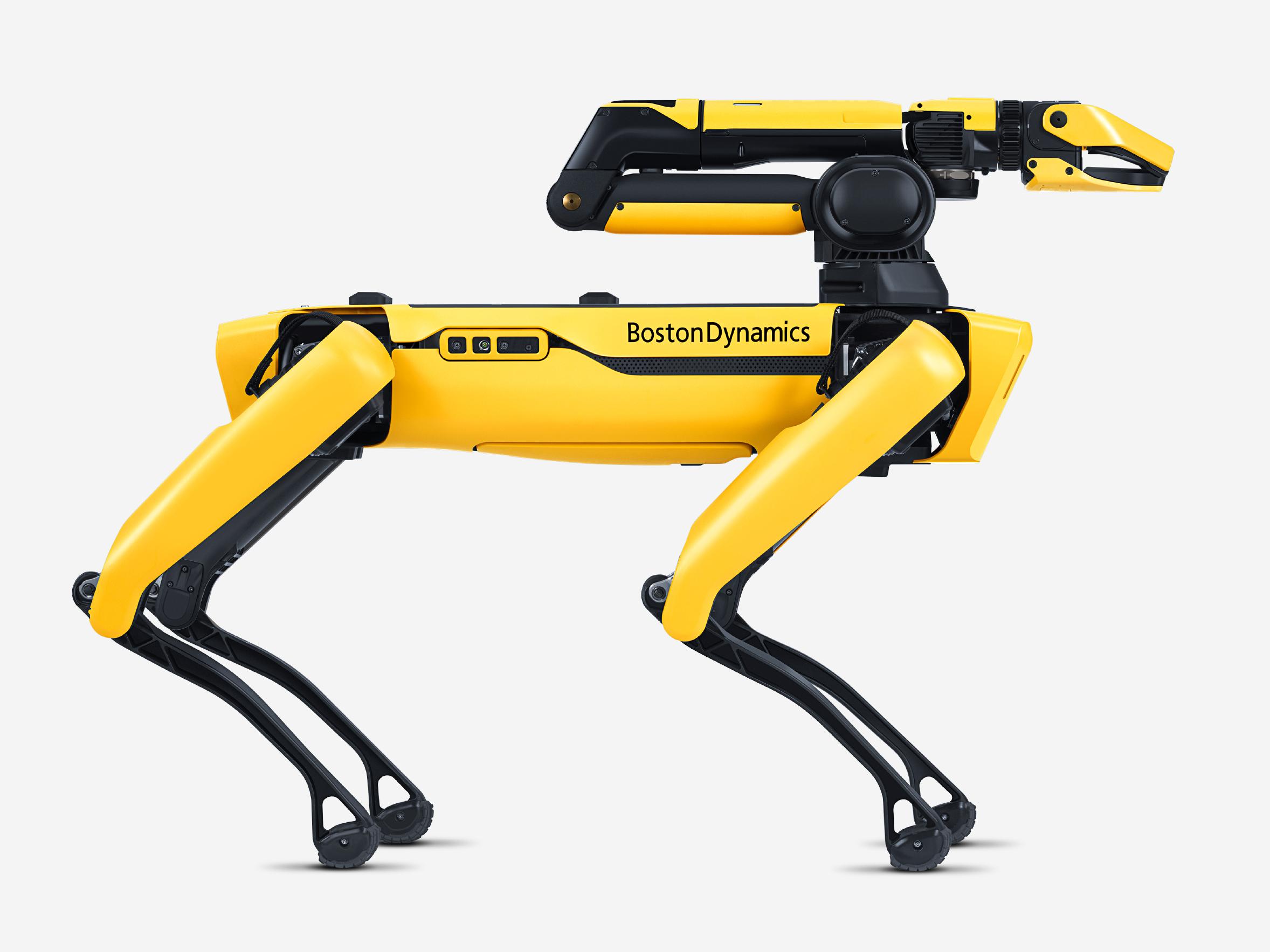
The Boston Dynamics Spot is a quadruped robot purpose-built for dynamic sensing, inspection, and data collection in industrial environments. Launched commercially in 2020 after years of DARPA-funded development, Spot measures 840 mm tall, weighs 32.5 kg, and can carry up to 14 kg of payload via its back-mounted rails or 10 kg with the optional Spot Arm. Pricing starts at $74,500 for the Explorer Kit, with fully loaded Enterprise configurations reaching $150,000 when adding the arm, LiDAR, and advanced autonomy software.
More than 1,500 units have been deployed by organizations including BP, Merck, Kvaerner, and the French Army. Spot’s AI-powered dynamic mobility lets it climb stairs, traverse gravel, and recover from slips autonomously — all while streaming 360° perception through five stereo depth cameras. It runs on an NVIDIA Jetson Xavier NX and supports ROS2, the Spot SDK (Python/C++), and Boston Dynamics’ Scout fleet management platform. Spot is IP54 rated, meaning it can handle dust and light water spray, though not submersion.
Deep Robotic DR01: The Newcomer Humanoid for Research
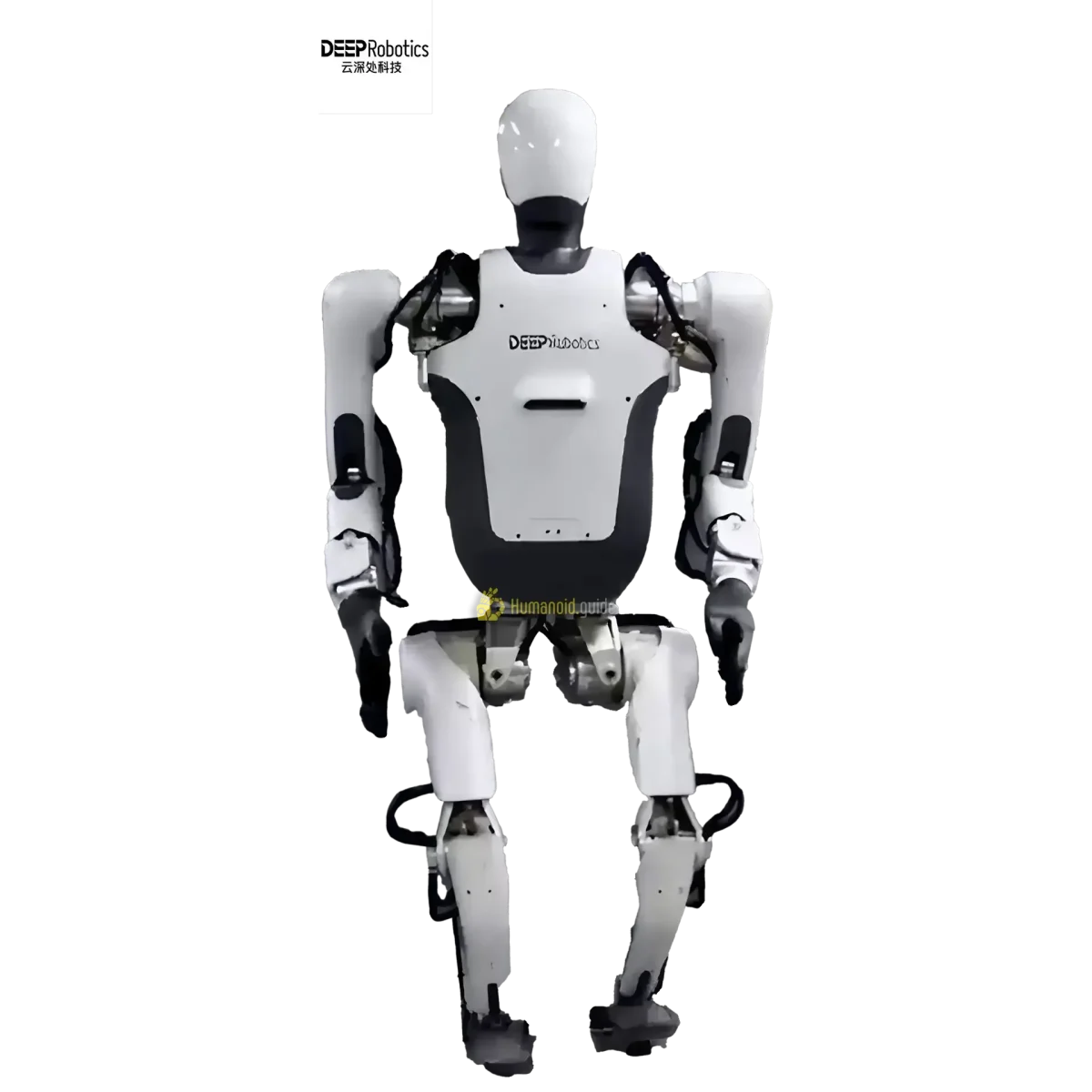
The Deep Robotic DR01 is a full-size bipedal humanoid robot developed by Deep Robotics (Hangzhou, China). Standing 175 cm tall and weighing 55 kg, it is designed for research into bipedal locomotion, manipulation, and human-robot interaction. Its 12 degrees of freedom and 15 kg standing payload hint at applications where a human-height robot can work alongside people — but details on its joint torque, walking speed stability, and sensor suite remain unpublished.
Deep Robotic announced the DR01 in 2024, presenting it as a prototype with a 2-hour battery life and a top speed of 5.8 km/h. As of mid-2026, the robot is listed as available for pre-order; pricing is undisclosed, and no production units have been verified in the field. The DR01 lacks public SDK documentation, ROS2 integration announcements, or any third‑party deployment testimonials. That makes it a speculative platform for ambitious research labs, not a purchase-ready industrial tool.
Price & Total Cost of Ownership
Spot’s pricing is transparent and modular. The Explorer Kit starts at $74,500 (core robot without the arm), while the Enterprise model with arm, LiDAR, and self‑charging dock pushes costs to $150,000. Annual Scout fleet‑management and support subscriptions add roughly $5,000–$10,000, and a typical 3‑year total cost of ownership (including spares and training) comes to approximately $120,000–$200,000. Used Spot units are available on secondary markets at $45,000–$90,000, lowering the barrier for research labs and smaller integrators.
For the DR01, price is a black box. No MSRP, no TCO estimates, and no published warranty or support plan. Researchers evaluating this humanoid must budget for uncertainty — any eventual price below $60,000 would make it competitive with used Spot units, but until that number materializes, financial planning is guesswork.
Winner: Spot for budget certainty and available TCO models.
Performance & Specs Head‑to‑Head
Payload & Manipulation
Spot’s payload capacity is 14 kg on its back rails plus an optional 5‑axis arm that lifts up to 10 kg. The DR01 claims a 15 kg standing payload, which surpasses Spot’s arm‑less payload slightly, but without an integrated manipulator, that weight capacity is less useful for real‑world object handling.
Winner: Spot, because payload is usable with a proven arm; DR01’s payload remains an unvalidated number.
Speed & Mobility
Both robots top out around 5.8 km/h, but form factor dictates terrain capability. Spot’s four legs give it unmatched stability on stairs, gravel, and uneven ground. The DR01’s bipedal gait is far more susceptible to falls — no published data shows it navigating industrial obstacles. Spot’s Autowalk feature enables repeatable autonomous routes; DR01’s mobility stack is unknown.
Winner: Spot for all‑terrain inspection and reliable repeatability.
Battery & Runtime
Spot runs for 1.5 hours per battery (hot‑swappable in the field). DR01 claims 2 hours, but no information on hot‑swap capability or charge time. A longer lab runtime is nice, but without field‑swap logistics, real‑world duty cycle remains speculative.
Winner: Spot for field‑proven hot‑swap and support infrastructure.
Degrees of Freedom & Form Factor
Spot’s 12 leg DOF (18 with arm) are optimized for locomotion and manipulation. DR01’s 12 full‑body DOF are shared across legs, likely arms, and torso, limiting dexterity per limb. The humanoid shape, however, lets it reach heights and interface with human‑scale workstations that a short quadruped cannot.
Winner: DR01 if height and human‑like reach matter; Spot for reliable, well‑allocated DOF.
Software & SDK Ecosystem
Spot is backed by one of the most mature robotics SDKs in existence. It runs ROS2 natively, offers Python and C++ APIs, and integrates with NVIDIA Isaac Sim for simulation. The Scout fleet management system allows remote operation, map‑sharing, and data centralization. An active developer community and Boston Dynamics’ own documentation library lower the coding barrier dramatically.
For DR01, no public SDK, APIs, or simulation support exist. ROS2 compatibility is not confirmed. A researcher would start from near‑zero integration effort, which is a massive hidden cost.
Winner: Spot overwhelmingly.
Autonomy & Sensors
Spot ships with five stereo depth cameras, an optional 2D/3D LiDAR, and an IMU, enabling 360° SLAM‑based autonomy. Its dynamic obstacle avoidance and Autowalk mapping work out‑of‑the‑box. The DR01’s sensor payload is a complete unknown — no LiDAR, camera, or compute module specs are published. Bipedal balance without documented proprioception or vision stack is particularly risky.
Winner: Spot, by the weight of documented, deployed sensor‑fusion autonomy.
Build Quality & Durability
Spot’s IP54 rating, ruggedized joints, and proven field deployments in rain, mud, and freezing temperatures set a high bar. The DR01 lacks any published IP rating, operating temperature range, or durability testing. At 55 kg, it’s heavy for a humanoid, and falls could be catastrophic without robust self‑protection.
Winner: Spot for certified environmental resilience.
Use-Case Matching: Spot vs DR01
- Choose Boston Dynamics Spot if: you need a ready‑to‑deploy inspection robot for oil & gas, construction, nuclear, or manufacturing; require IP54 rating and proven autonomy; value SDK maturity, fleet management, and global support; have a $75K–$150K budget and need delivery within weeks.
- Choose Deep Robotic DR01 if: you are a well‑funded academic lab exploring bipedal locomotion or HRI; need a tall humanoid to test warehouse‑like tasks at human height; can tolerate prototype‑stage risk, no SDK, and unknown pricing; are willing to invest years in custom software development.
- Choose neither if: you need a manufacturable price and timeline today (go with an industrial quadruped like the Unitree B2), or you need a proven humanoid (consider Unitree G1 at $16K with ROS2 support).
Real‑World Deployments & Track Record
Spot’s deployments are abundant and published: BP uses Spot for offshore platform inspection (2021, per BP press release); Merck deploys Spot for pharmaceutical facility monitoring (2021); Kvaerner shipyard uses Spot for confined‑space inspection (2020). More than 1,500 units have been shipped (Boston Dynamics, 2023). This track record reduces buyer risk to near‑zero.
For the DR01, no verified deployment exists. All that is known are demo videos from Deep Robotic’s YouTube channel, showing controlled walking. Until a named institutional pilot or published operating hours appear, the DR01 should be considered a lab prototype.
Winner: Spot, by the sheer weight of real‑world evidence.
SDK, Software & Developer Ecosystem (Expanded)
Beyond ROS2 and Python/C++, Spot’s SDK exposes low‑level joint control, payload integration APIs, and behavior trees. Boston Dynamics’ developer portal offers tutorials, sample code, and a forum with thousands of members. Academic labs often run Spot in Gazebo or Isaac Sim, enabling rapid algorithm prototyping before hardware tests. No comparable ecosystem exists for DR01 — its developer experience is a blank slate, and any community is non‑existent.
Winner: Spot.
Support, Warranty & Availability
Spot comes with a standard one‑year warranty, optional extended warranties, and enterprise SLA support. Boston Dynamics provides spare parts, repair services, and training programs. Lead time for a new Spot is typically 4–8 weeks.
The DR01 is only available for pre‑order; no warranty terms, lead times, or support infrastructure have been published. Relying on a Deep Robotic humanoid for time‑sensitive research would be a gamble.
Winner: Spot for availability and proven after‑sales.
Comments