

The biggest tension in advanced humanoid robotics today is no longer whether they can walk—it’s whether they are built as open research platforms or hardened industrial products. The Apptronik Valkyrie and the all-new Boston Dynamics Atlas represent the extreme ends of that spectrum: a one-of-a-kind NASA robot designed for disaster response and space missions, versus a shipping 2026 model designed to work on factory floors. This article dissects their specs, software ecosystems, pricing, and real-world deployment records to help you decide which platform—if either—fits your lab, enterprise, or innovation program. For deeper technical specifications, visit the Apptronik Valkyrie and Boston Dynamics Atlas database pages.
Apptronik Valkyrie vs Boston Dynamics Atlas: Specs Compared
Side-by-side, these two humanoids reveal almost no overlap. Valkyrie is tall, heavy, and built for unstructured environments; Atlas is compact, electrically driven, and designed for repeatable industrial tasks. The table below captures every published metric as of mid-2026.
| Specification | Apptronik Valkyrie | Boston Dynamics Atlas |
|---|---|---|
| Price (base) | Not commercially sold (~$250,000 est. for research units) | $420,000 (enterprise) |
| Height | 190 cm | 150 cm |
| Weight | 125 kg | 89 kg |
| Payload | Not published (arm payload ~15 kg per arm, research) | 50 kg |
| Max speed | 5.4 km/h | 8 km/h |
| Battery life | 1 hour | 4 hours |
| Degrees of freedom | 44 | 56 |
| IP rating | Not published | Not published |
| Onboard compute | Intel Core i7, NVIDIA GPU, custom electronics | Not disclosed |
| Sensors | Carnegie Robotics Multisense SL (stereo + LiDAR), additional cameras, IMU | RGB-D cameras, LiDAR, IMU |
| SDK / ROS | ROS 1 / ROS 2 (open-source) | Proprietary Boston Dynamics Pick SDK; limited ROS 2 via bridge |
| Autonomy & fleet | Research-grade SLAM; no commercial fleet management | Proprietary autonomy stack; fleet management via Boston Dynamics Orbit (for Spot; Atlas fleet tools not yet announced) |
| Safety certs | NASA safety standards for human-robot interaction (research) | Industrial safety certifications under evaluation (not yet published) |
| Availability | Not available for commercial purchase | Limited production; enterprise customers only, ~12-week lead time (2026) |
| Warranty | N/A | Standard 1-year enterprise warranty with optional service plans |
The biggest delta: payload (0 vs. 50 kg) and runtime (1 vs. 4 hours) define entirely different operational roles.
Apptronik Valkyrie: NASA’s Research-Purpose Humanoid
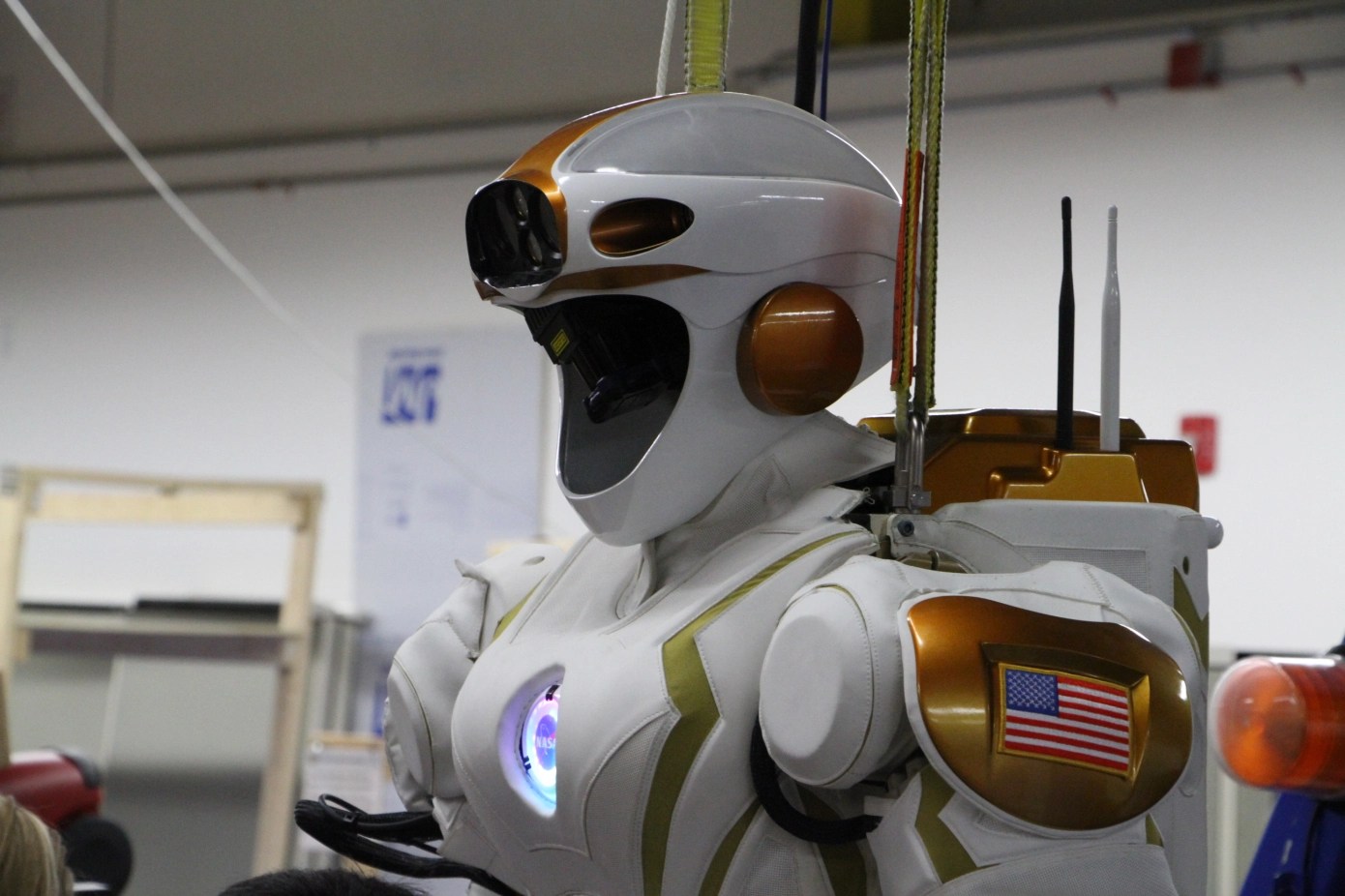
The Valkyrie (also known as R5) was originally developed by NASA’s Johnson Space Center for the DARPA Robotics Challenge (DRC) in 2013. Apptronik, the Austin-based spinoff, continued the platform as a research tool for space exploration and terrestrial disaster response. Standing 190 cm tall and weighing 125 kg, Valkyrie is one of the largest humanoids ever built—intentionally oversized to test human-scale task execution in habitats and on planetary surfaces. Its 44 degrees of freedom are concentrated in high-dexterity hands with four fingers and an opposable thumb, enabling complex manipulation. The robot is powered by a Intel Core i7 processor and an NVIDIA GPU, running ROS 1 and ROS 2 for maximum software flexibility. Valkyrie is not available for sale; NASA and a handful of partners operate the units for experimentation. The Boston Consulting Group placed an estimated unit cost at around $250,000 for early builds, but there is no public pricing or purchase pathway.
Boston Dynamics Atlas: All-Electric Industrial Humanoid
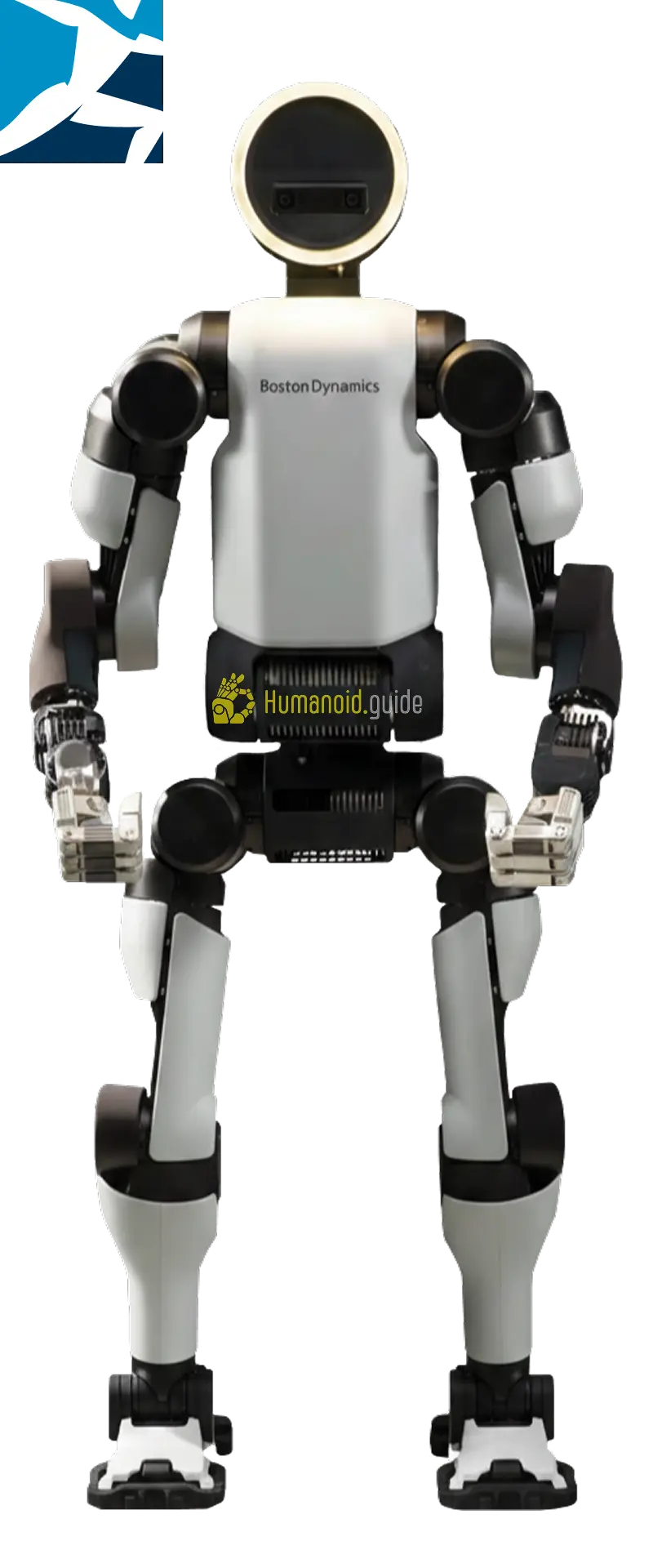
Boston Dynamics’ 2026 Atlas is a complete departure from the hydraulic research robots of the past. Unveiled at CES 2026, this third-generation Atlas runs entirely on electric motors, shedding hydraulic lines and noise while quadrupling battery life to 4 hours. It stands 150 cm tall and weighs just 89 kg—compact enough to navigate standard industrial doorways and work alongside humans. The robot’s 56 degrees of freedom include a powerful torso that enables 360-degree spinning and dynamic backflip recovery. Atlas handles a 50 kg payload at full reach, making it viable for parts transfer, pallet loading, and machine tending. Boston Dynamics ships the robot to enterprises only, with a base price of $420,000 and a 12-week lead time. The company has published that Atlas is in limited production and targets automotive, logistics, and construction customers.
Price & Configurations
Both robots sit at the high end of humanoid pricing, but only one comes with a purchase agreement.
- Valkyrie: No commercial configs. The few units produced are operated by NASA and research partners. The estimated hardware cost of ~$250,000 reflects the value of the research platform but does not include support, software licensing, or ongoing maintenance. There is no way to order a Valkyrie.
- Atlas: Priced at $420,000 in its base enterprise configuration. This includes the robot, a basic autonomy suite, and the Boston Dynamics Pick SDK. Optional service plans (on-site repair, software updates) add an estimated $50,000–$80,000 per year. Leasing or RaaS is not yet offered.
Winner: Atlas, purely because it is purchasable. If your organization can secure a Valkyrie collaboration, it may still be the right choice for specific research—but you cannot simply buy one.
Performance & Specs
Payload
Valkyrie’s payload capacity is not officially published. Bench-top tests during the DRC program showed arm payloads of about 15 kg per arm, limited by series-elastic actuators. Atlas, by contrast, lifts a rated 50 kg package at full arm extension, equivalent to a heavy automotive part or a loaded tote. That 50 kg payload is factory-verified and repeatable.
Winner: Atlas by a wide margin.
Speed
Atlas tops at 8 km/h, roughly the pace of a brisk walk. Valkyrie’s 5.4 km/h is 33% slower and more akin to a careful human pace in a cluttered environment. Speed matters less for stationary tasks, but Atlas’s quicker transit between workstations improves cycle time in an industrial setting.
Winner: Atlas.
Battery Life
This is the starkest contrast: Atlas runs for a full 4 hours on a charge, while Valkyrie depletes in just 1 hour. In a research lab, a 1-hour window may be sufficient for a single experiment; on a factory floor, 4 hours enables an entire shift segment without swapping batteries.
Winner: Atlas.
Degrees of Freedom
Atlas’s 56 DOF versus Valkyrie’s 44 reflects a different design philosophy. Atlas packs additional DOF into its torso and legs for dynamic athleticism, while Valkyrie prioritizes hand dexterity. For manipulation research, Valkyrie’s four-finger hands may offer finer control, but Atlas’s higher total DOF enables more whole-body versatility.
Winner: Atlas for whole-body agility; Valkyrie for hand-focused research.
Software & SDK Ecosystem
Valkyrie was built on ROS and remains one of the few humanoid platforms that runs ROS 2 natively. NASA and Apptronik provide open-source drivers, simulation models (Gazebo), and a wide community of academic developers. That openness makes Valkyrie uniquely valuable for universities and research labs exploring learning-based control.
Atlas ships with Boston Dynamics’ proprietary Pick SDK, a mature toolset for defining pick-and-place tasks via a graphical interface and API. The SDK enables quick integration with factory PLCs and warehouse management systems, but the underlying control stack is closed. A ROS 2 bridge exists but is not the primary interface, limiting deep customization.
Winner: Valkyrie for open-source research; Atlas for quick, production-ready integration.
Autonomy & Sensors
Both robots employ SLAM and sensor fusion, but their autonomy targets differ. Valkyrie uses a Carnegie Robotics Multisense SL head (stereo cameras + LiDAR) plus additional cameras, making it well-suited for 3D mapping of unknown environments—critical for disaster or space exploration. Atlas pairs RGB-D cameras with LiDAR and an IMU, emphasizing real-time collision avoidance and dynamic motion planning. Atlas’s autonomy stack is tightly integrated with its whole-body controller, enabling moves like full-speed running into a pallet and jumping to catch a box, as demonstrated in marketing videos. Neither platform offers commercial fleet management: Valkyrie is single-unit research, and Atlas’s fleet tools are not yet released.
Winner: Valkyrie for unstructured mapping autonomy; Atlas for dynamic industrial movement.
Build Quality & Durability
Valkyrie’s heritage as a DRC robot means it is built to survive falls, water spray, and rough terrain—though its exposed wiring and large joints can collect debris. It meets NASA’s human-robot interaction safety standards but lacks any IEC or ISO industrial certification. Atlas, as a newly launched commercial product, is designed for 24/7 operation in controlled factory environments but has not yet published IP ratings or safety certifications. Boston Dynamics claims a new electric actuator reliability target of 10,000 operating hours, but real-world MTBF is unverified.
Winner: Too early to declare; both have impressive engineering but different durability benchmarks.
Price & Total Cost of Ownership
A direct TCO comparison is impossible because Valkyrie has no purchase price. However, for an enterprise considering a humanoid, Atlas’s cost structure is quantifiable:
- Hardware: $420,000 upfront.
- Annual service & support (optional): ~$50,000–$80,000.
- Software updates: Included in the service plan; otherwise, major updates may carry separate licensing.
- Spare parts & repairs: Covered under warranty; after warranty, expect $15,000–$30,000 per year for heavy use.
- Integration & engineering: Plan $80,000–$150,000 for initial deployment (safety fencing, machine interfaces, training).
Over three years, a fully deployed Atlas can reach $700,000–$900,000. Valkyrie’s total cost for a university could be lower if obtained via a research grant—often just the cost of a postdoc and equipment maintenance—but acquiring the robot in the first place is the barrier.
Winner: N/A—they operate in different funding worlds.
Which Should You Buy? Apptronik Valkyrie vs Boston Dynamics Atlas by Use Case
Choose Apptronik Valkyrie if… - You are a NASA partner or space agency researching humanoid dexterity in microgravity. - Your lab needs full ROS 2 source access and an open hardware platform for advanced control algorithms. - You require a tall, end-effector-rich robot for disaster-site mapping and tool manipulation. - You have grant funding and can negotiate a collaboration with Apptronik.
Choose Boston Dynamics Atlas if… - You run a manufacturing, logistics, or automotive operation and need a human-form worker for machine tending, palletizing, or kitting. - You need a certified, insurable, purchasable robot with a clear service and support path. - You value long battery life (4 hours) and high payload (50 kg) for shift-based work. - You want to be part of the first wave of humanoid deployment with a trusted industrial robotics brand.
Choose neither if… - You need a budget-friendly humanoid under $100,000—look at Unitree G1 or Fourier GR-2. - Your tasks are static and repeatable enough for a traditional industrial cobot (e.g., UR10e).
Real-World Deployments & Track Record
- Valkyrie: NASA’s Valkyrie units have participated in multiple DARPA challenges and Space Robotics Challenges. The most notable deployment was at the 2015 DRC Finals, where it performed manipulation tasks under remote supervision. Since then, Apptronik has supplied four upgraded Valkyrie robots to university labs in the United States and Europe for collaborative research. No commercial deployments exist.
- Atlas: The 2026 Atlas is just entering production. Boston Dynamics announced initial shipments to an unnamed automotive customer in Q2 2026, with a target of 100 units by year-end. The company shared that Atlas has completed over 2,000 hours of pilot testing in logistics environments, performing bin picking and case palletizing. All numbers are self-reported by Boston Dynamics as of May 2026.
Winner (track record): Valkyrie has a decade of research heritage, but Atlas is rapidly accumulating commercial operating hours. For enterprise buyers, Atlas’s published pilot data provides more relevant assurance.
SDK, Software & Developer Ecosystem
Going beyond the earlier software comparison, the developer experience differs fundamentally:
- Valkyrie’s ecosystem is academic. Source code for controllers, URDFs, and simulation models is openly shared on GitHub under NASA/Apptronik licenses. The robot supports ROS 2 Humble and can integrate with NVIDIA Isaac Sim for reinforcement learning. There is no corporate support SLA; community forums and documentation are the primary resources.
- Atlas’s ecosystem is enterprise-oriented. The Pick SDK includes a visual programming interface, Python and C++ APIs, and direct connectors for Siemens, Rockwell, and Beckhoff PLCs. Boston Dynamics provides on-site training as part of the purchase, plus a developer portal with sandbox environments. While ROS 2 is supported via a bridge, it is not the native control architecture. Heavy customization requires a Boston Dynamics engineering partnership.
Winner: Valkyrie for community-driven, open-source development; Atlas for plug-and-play industrial programming.
Support, Warranty & Availability
- Valkyrie: No commercial support. Partner labs receive direct engineering assistance from Apptronik as part of research agreements. No warranty exists beyond the grant terms.
- Atlas: Comes with a standard 1-year warranty covering hardware defects. Extended service plans offer on-site repair within 48 hours in the contiguous US and EU. Lead time at time of writing is ~12 weeks, subject to allocation. Boston Dynamics sells direct; no third-party resellers yet.
If you need a humanoid that arrives with a support contract and predictable uptime, Atlas is the only game. Valkyrie is a “bring your own expertise” platform.
Comments