

The race to viable general‑purpose humanoids has split into two distinct lanes: one charging toward factories, warehouses, and logistics with brute‑strength and full‑body mobility, the other sprinting inside research labs as a nimble test platform for AI and manipulation. The AgiBot A2 and XPENG Robotics PX5 embody that divide perfectly. Both bipedal, both Chinese‑built, both priced around six figures — yet they serve radically different masters. This comparison dissects their specs, real‑world deployment posture, software ecosystems, and total cost of ownership to answer which one fits your work. Links to the AgiBot A2 and XPENG Robotics PX5 model pages anchor every data point.
- Best overall industrial value: AgiBot A2 — 80 kg payload, 5‑hour battery, 49 DOF, and $100,000 price make it the clear heavy‑duty choice.
- Best for research/development: XPENG PX5 — compact 1.5 m frame, 21 DOF, dexterous hands, and proven open‑platform heritage suit algorithm and interaction studies.
- Best for high‑speed locomotion: AgiBot A2 — 3.3 m/s top speed vs undisclosed PX5 speed.
- Best budget pick for an “available now” platform: XPENG PX5 — despite a $150,000 list price, its actual availability (pre‑commercial, but units in circulation) beats the A2’s pre‑order status.
AgiBot A2 vs XPENG Robotics PX5: Specs Compared
| Specification | AgiBot A2 | XPENG Robotics PX5 |
|---|---|---|
| Price (base) | $100,000 (pre‑order) | $150,000 (limited availability) |
| Price (configured) | ~$100,000–$130,000 with grippers/software options | $150,000–$200,000 with full‑lab package |
| Weight | 55 kg | 70 kg |
| Height | 1.69 m | 1.5 m |
| Payload (arms) | 80 kg | 20 kg |
| Max speed | 3.3 m/s | Not published |
| Battery life | 5 hours | Over 2 hours |
| Degrees of freedom | 49 | 21 |
| IP rating | Not published | Not published |
| Onboard compute | Not published | Not published |
| Sensors | LiDAR, depth cameras (undisclosed models) | Vision sensors, IMU (details not published) |
| SDK languages | Not published (proprietary AgiBot stack expected) | XPENG Robotics development kit (language support TBA) |
| ROS2 support | Unknown | Unknown |
| Autonomy / fleet software | AgiBot‑branded fleet management (in development) | Research‑focused autonomy stack |
| Safety certifications | Not published | None |
| Availability | Pre‑order, first deliveries 2025–2026 | Pre‑commercial development platform, units in circulation |
| Warranty / support | Standard manufacturer warranty (TBD) | Limited support via XPENG Robotics lab engagements |
The biggest delta: payload — the A2 lifts four times what the PX5 can, and does it with over double the DOF and more than double the runtime. The PX5, however, is a proven academic platform already in labs, while the A2 is still in the final pre‑order stage.
AgiBot A2: The Heavy‑Lift Industrial Workhorse
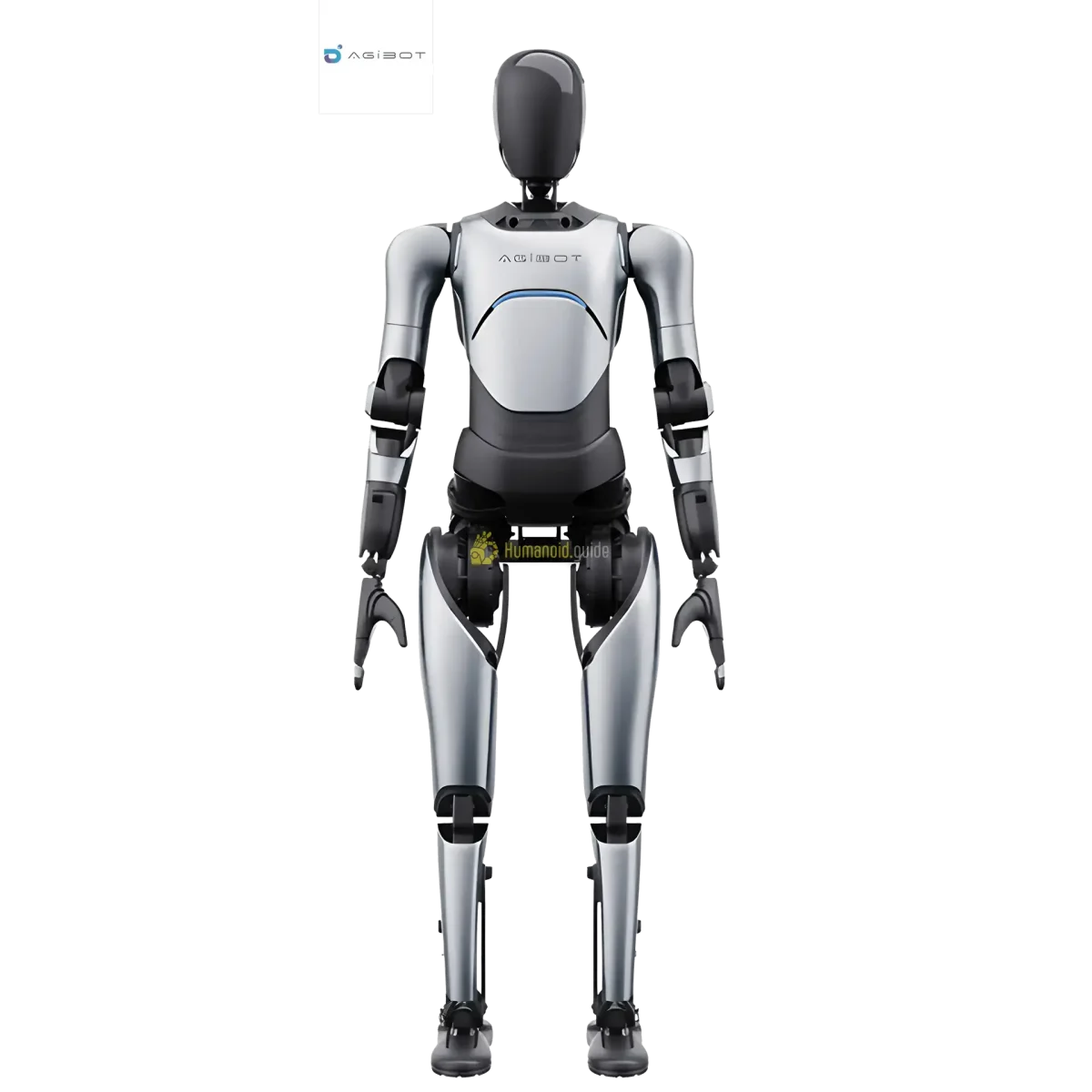
Launched in 2025 by Shanghai‑based AgiBot, the A2 is designed for real‑world logistics, manufacturing, and warehousing environments. Standing 1.69 m tall and weighing just 55 kg — lighter than the PX5 despite its heavier payload — the A2 achieves a remarkable 80 kg lift capacity, enough to move loaded pallets, manipulate industrial tools, and repeatedly handle heavy workpieces. Its 49 degrees of freedom (arms, legs, hands, torso) enable full‑body mobility and fine manipulation, and a top speed of 3.3 m/s lets it traverse factory floors quickly. Battery life reaches 5 hours of continuous operation, and the platform is sold for $100,000 on pre‑order, with first deployments expected in 2025–2026. AgiBot is already scaling mass‑production and has demonstrated the A2 alongside a fleet of its H1 and G1 models, positioning the A2 not as an experimental prototype but as a production‑ready industrial humanoid.
XPENG Robotics PX5: The Compact Research Platform
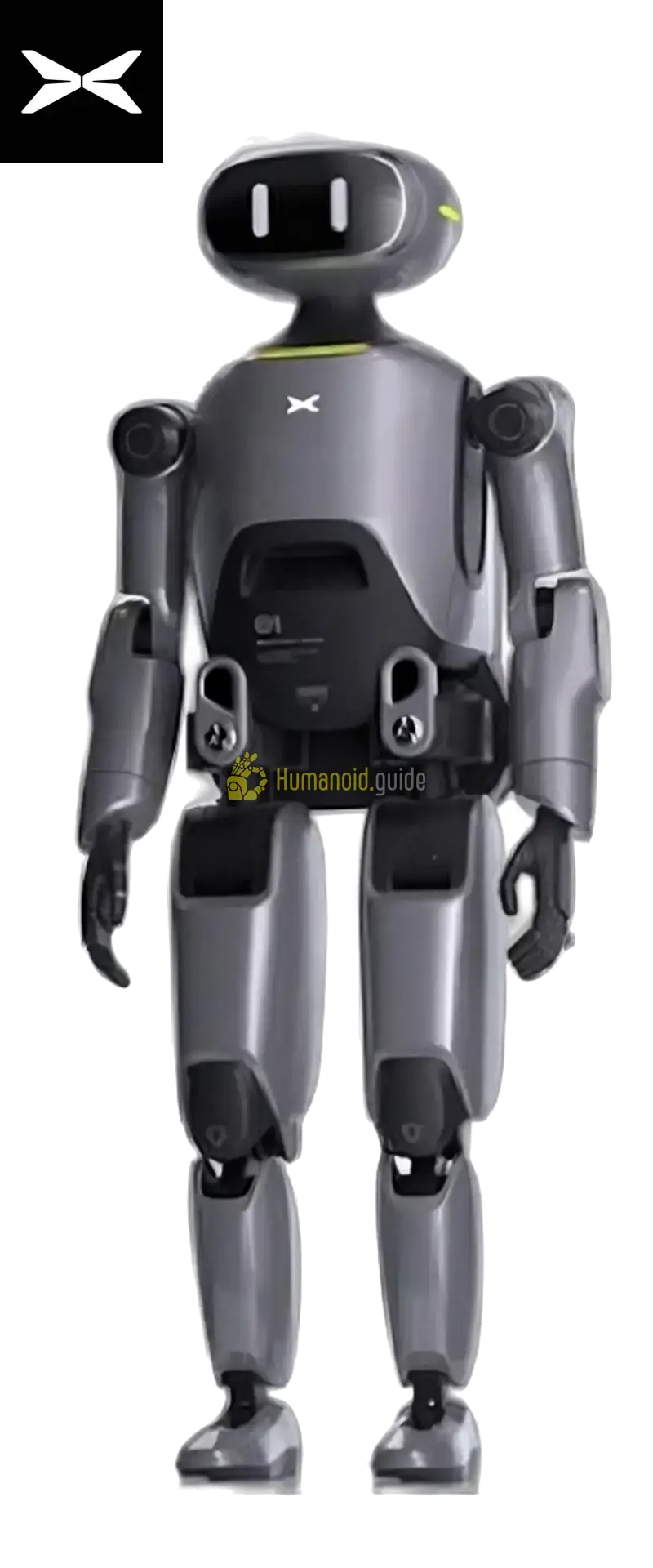
The XPENG Robotics PX5, unveiled in 2023 by XPENG’s robotics division in Guangzhou, is explicitly a research‑oriented bipedal humanoid. At 1.5 m tall and 70 kg, it packs only 21 DOF but features dexterous hands and an open development architecture. With a payload of just 20 kg and a battery life “over 2 hours,” it is not intended for heavy industrial work. Instead, labs value its compact size, simplified morphology, and the flexibility to test locomotion, manipulation, and AI algorithms. Priced at an estimated $150,000 — with fully‑configured lab packages reaching up to $200,000 — it is a premium academic tool, not a factory floor robot. XPENG already supplies units to university and corporate R&D programs, making the PX5 one of the few humanoids actually “available” today, albeit in limited numbers and without the extensive support infrastructure that production bots carry.
Head‑to‑Head by Dimension
Price & Configurations
The sticker prices alone obscure the real cost picture. The AgiBot A2 lists at $100,000 base, likely rising to $130,000 with industrial grippers, fleet‑management software, and optional tooling. The XPENG PX5 starts at $150,000 but can climb to $200,000 for a full research package including simulation licenses, technical support hours, and perhaps custom end‑effectors. For a factory buyer, the A2’s lower entry price and far higher payload per dollar make it the clear value leader. For a university lab, only the PX5 is actually shipable today — the A2 remains pre‑order with uncertain lead times. Winner: A2 for industrial value; PX5 for immediate availability.
Performance & Specs
Payload
80 kg versus 20 kg. The A2’s arms can lift and carry heavy boxes, motor assemblies, or tools, while the PX5 is limited to lighter, research‑scale objects. That 60 kg gap is the single most decisive difference between the two robots. Winner: AgiBot A2.
Speed
The A2 hits 3.3 m/s — about 12 km/h — a brisk walking pace that lets it cover typical factory aisles efficiently. XPENG has not published a maximum speed for the PX5, which is typical of a research platform where safety‑limited walking is more common. Winner: AgiBot A2 (verified).
Battery Life
5 hours vs “over 2 hours.” The A2 can work a full half‑shift between charges; the PX5 is good for a single experimental session. In any production‑oriented use case, this number alone tilts the decision. Winner: AgiBot A2.
Degrees of Freedom
49 DOF vs 21 DOF. The A2 has a fully articulated body — arms, legs, hands, torso, head — enabling complex whole‑body tasks like reaching into a shelf, balancing while carrying an irregular load, or using hand gestures. The PX5’s 21 DOF are concentrated in its legs and dexterous hands, fine for bipedal locomotion and manipulation research, but insufficient for the range of motions required in a dynamic factory. Winner: AgiBot A2.
Software & SDK Ecosystem
Neither manufacturer has published a complete SDK specification publicly. AgiBot operates its own proprietary software stack for fleet management, likely including a local API and simulation environment. XPENG Robotics, given its automotive and AI roots, provides development kits aimed at researchers, with support for high‑level programming interfaces. Both platforms are expected to support ROS2 eventually, but no commitment has been confirmed. For now, the PX5’s existing lab‑engagement model means its SDK is being used by third‑party AI developers — a pragmatic edge. Winner: XPENG PX5 (proven SDK access).
Autonomy & Sensors
The A2 is built around AgiBot’s autonomy stack, which integrates LiDAR, depth cameras, and IMU for SLAM‑based navigation and manipulation. XPENG’s PX5 uses vision‑based sensors and an in‑house autonomy layer that has been demonstrated in lab environments. Neither platform publishes detailed sensor models or autonomy performance metrics. Industrial buyers should expect the A2 to ship with a fleet‑management system capable of multi‑robot coordination; the PX5’s stack is research‑grade and may require significant customization. Winner: AgiBot A2 for industrial autonomy readiness; PX5 for open research.
Build Quality & Durability
Neither robot publishes an IP rating or operating‑temperature range. The A2, being targeted at logistics, is likely engineered for moderate dust and humidity in controlled indoor environments. The PX5, as a lab platform, is built for cleanrooms and academic settings. Durability track records are absent for both; actual deployment hours over a year will tell the real story. Until then, no clear winner.
Price & Total Cost of Ownership
For a 3‑year horizon, the A2’s lower base price ($100,000), longer runtime, and anticipated support structure from AgiBot’s expanding factory footprint give it a TCO advantage in industrial applications. Assuming a 5‑hour daily operation, the A2 could cover a full shift with a single battery swap, while the PX5 would need at least three charges to get the same coverage. Add software licensing, spare parts, and the PX5’s research‑grade fragility, and the total cost could balloon. However, for a 3‑year research project, the PX5 may be cheaper if the alternative is an A2 with a long pre‑order wait and uncertain integration support. A direct buy‑vs‑lease model is not yet available for either robot. Bottom line: The A2 is the better production investment; the PX5 is a safer, if pricier, research purchase today.
Which Should You Buy? AgiBot A2 vs XPENG PX5 by Use Case
Choose the AgiBot A2 if you… - Need a humanoid that lifts 80 kg in a warehouse or assembly line. - Can wait for pre‑order deliveries starting 2025–2026. - Value high DOF and fast locomotion for dynamic factory tasks. - Plan to scale a fleet with centralized fleet‑management software.
Choose the XPENG Robotics PX5 if you… - Run a university lab, AI research group, or corporate R&D center. - Need a bipedal platform now (PX5 units are in circulation). - Prioritize open SDK access and custom algorithm development. - Don’t need heavy payload — 20 kg is enough for experiments.
Choose neither if you… - Are a hobbyist or maker — both are six‑figure industrial/research platforms. - Require outdoor, all‑weather operation — neither publishes IP ratings.
Real‑World Deployments & Track Record
AgiBot has announced mass‑production plans for the A2 as part of its humanoid product line‑up, but actual deployment numbers and operating hours have not been publicly disclosed. The A2 has appeared in trade‑show demos and spec sheets, but no named pilot sites have been confirmed as of mid‑2026. The XPENG PX5, meanwhile, has been in the hands of select research partners since 2023; units have been spotted in Chinese university labs and corporate AI centres, though XPENG does not release official deployment tallies. Honest assessment: Both robots remain early‑stage in terms of public, verifiable deployment history. Industrial buyers should seek pilot‑trial commitments from manufacturers before committing.
SDK, Software & Developer Ecosystem
AgiBot’s software ecosystem is nascent but designed for fleet operations; the company is building a unified platform for its G1, H1, and A2 models. Early SDK documentation is expected to support Python and C++, with ROS2 compatibility likely given the market pressure. XPENG Robotics provides a development kit through its lab‑partnership programme, with open interfaces for perception and control. The PX5 has a built‑in advantage: it is already being used by external researchers who are contributing to a small but growing community. For a developer or engineer deciding between them, the PX5’s real‑world coding environment — even if not public — is a stronger signal than a promised future SDK.
Support, Warranty & Availability
The A2 is listed as “pre‑order” with no confirmed lead time. AgiBot has ramped production of its G1 and H1 lines, so the A2 is expected to follow a similar support path: manufacturer warranty, online documentation, and possibly on‑site service for fleet buyers. XPENG Robotics treats the PX5 as a “pre‑commercial development platform,” meaning support is limited to partner agreements and the company provides warranties only on a case‑by‑case basis. Availability is the key differentiator: if you need a humanoid today for a project, the PX5 is the only option of the two; if you can wait a year, the A2 presents far more capability per dollar.
Comments